. 2021 Apr 1;38(7):918-927.
doi: 10.1089/neu.2020.7177. Epub 2020 Dec 28.

High-Sensitivity C-Reactive Protein is a Prognostic Biomarker of Six-Month Disability after Traumatic Brain Injury: Results from the TRACK-TBI Study

Collaborators, Affiliations

High-Sensitivity C-Reactive Protein is a Prognostic Biomarker of Six-Month Disability after Traumatic Brain Injury: Results from the TRACK-TBI Study

Linda B Xu et al. J Neurotrauma. .

Abstract

Systemic inflammation impacts outcome after traumatic brain injury (TBI), but most TBI biomarker studies have focused on brain-specific proteins. C-reactive protein (CRP) is a widely used biomarker of inflammation with potential as a prognostic biomarker after TBI. The Transforming Research and Clinical Knowledge in Traumatic Brain Injury (TRACK-TBI) study prospectively enrolled TBI patients within 24 h of injury, as well as orthopedic injury and uninjured controls; biospecimens were collected at enrollment. A subset of hospitalized participants had blood collected on day 3, day 5, and 2 weeks. High-sensitivity CRP (hsCRP) and glial fibrillary acidic protein (GFAP) were measured. Receiver operating characteristic analysis was used to evaluate the prognostic ability of hsCRP for 6-month outcome, using the Glasgow Outcome Scale-Extended (GOSE). We included 1206 TBI subjects, 122 orthopedic trauma controls (OTCs), and 209 healthy controls (HCs). Longitudinal biomarker sampling was performed in 254 hospitalized TBI subjects and 19 OTCs. hsCRP rose between days 1 and 5 for TBI and OTC subjects, and fell by 2 weeks, but remained elevated compared with HCs (p < 0.001). Longitudinally, hsCRP was significantly higher in the first 2 weeks for subjects with death/severe disability (GOSE <5) compared with those with moderate disability/good recovery (GOSE ≥5); AUC was highest at 2 weeks (AUC = 0.892). Combining hsCRP and GFAP at 2 weeks produced AUC = 0.939 for prediction of disability. Serum hsCRP measured within 2 weeks of TBI is a prognostic biomarker for disability 6 months later. hsCRP may have utility as a biomarker of target engagement for anti-inflammatory therapies.

Keywords: biomarkers; head trauma; traumatic brain injury.


Conflict of interest statement

No competing financial interests exist.

Figures

FIG. 1.
FIG. 1.
TRACK-TBI phase 1 biomarker cohort CONSORT diagram. ADM = admission stratum: patients admitted to the hospital but not to the ICU. ICU = ICU stratum: patients admitted directly from ER or another hospital to the ICU. D1 = day 1. D3 = day 3. D5 = day 5. 2W = 2 weeks. Serial samples: available hsCRP samples on day 1 and 2 Weeks, and day 3 and/or day 5. GOSE = Glasgow Outcome Scale-Extended. CRP, C-reactive protein; CONSORT, Consolidated Standards of Reporting Trials; ER, emergency room; ICU, intensive care unit; TBI, traumatic brain injury; TRACK-TBI, Transforming Research and Clinical Knowledge in Traumatic Brain Injury.
FIG. 2.
FIG. 2.
hsCRP at days 1, 3, and 5 and 2 weeks, comparing TBI, OTC, and HC. Line plot indicates median and 25th–75th percentile. Among patients with serial hsCRP samples (day 1 and 2 weeks, and day 3 and/or day 5), Wilcoxon's rank-sum test found no significant difference in hsCRP level between TBI and OTC at any time point. Baseline hsCRP level in HC was measured at one time point and was significantly lower than TBI and OTC at all time points. HC, healthy controls; hsCRP, high-sensitivity C-reactive protein; OTC, orthopedic trauma controls; TBI, traumatic brain injury.
FIG. 3.
FIG. 3.
Relationship between hsCRP and ISS at (A) day 1 and (B) days 1, 3, and 5 and 2 weeks. Boxplots indicate median and 25th–75th percentile (interquartile range; IQR) of hsCRP values. Upper whisker indicates the smaller value of: the maximum value or 75th percentile +1.5*IQR, and lower whisker indicates the larger value of: the minimum value or 25th percentile −1.5*IQR. ISS total score was separated into four score categories: ≤9, 10–16, 17–25, and >25. (A) Among all TBI patients with available day 1 hsCRP samples, Ddy 1 hsCRP rises with increasing ISS total score. (B) Among patients with serial hsCRP samples (day 1 and 2 weeks, and day 3 and/or day 5), hsCRP rises with increasing ISS total score at all time points. hsCRP, high-sensitivity C-reactive protein; ISS, Injury Severity Score; TBI, traumatic brain injury.
FIG. 4.
FIG. 4.
hsCRP and outcome after TBI: (A) GOSE ≥5 versus <5 (B) GOSE = 8 versus <8. Line plots indicate median and 25th–75th percentile. (A) In patients with serial hsCRP samples (day 1 and 2 weeks, and day 3 and/or day 5), hsCRP level was compared between patients with unfavorable outcome (GOSE <5, indicating death/severe disability) and favorable outcome (GOSE ≥5). Patients with favorable outcome had significantly higher hsCRP level at all time points compared to patients with unfavorable outcome. (B) In patients with serial hsCRP samples, hsCRP level was compared between patients with complete recovery (GOSE = 8) and incomplete recovery (GOSE <8). Patients with incomplete recovery had significantly higher hsCRP level at the 2-week time point compared with patients with complete recovery, but were not significantly different at any other time point. GOSE, Glasgow Outcome Scale-Extended; hsCRP, high-sensitivity C-reactive protein; TBI, traumatic brain injury.
FIG. 5.
FIG. 5.
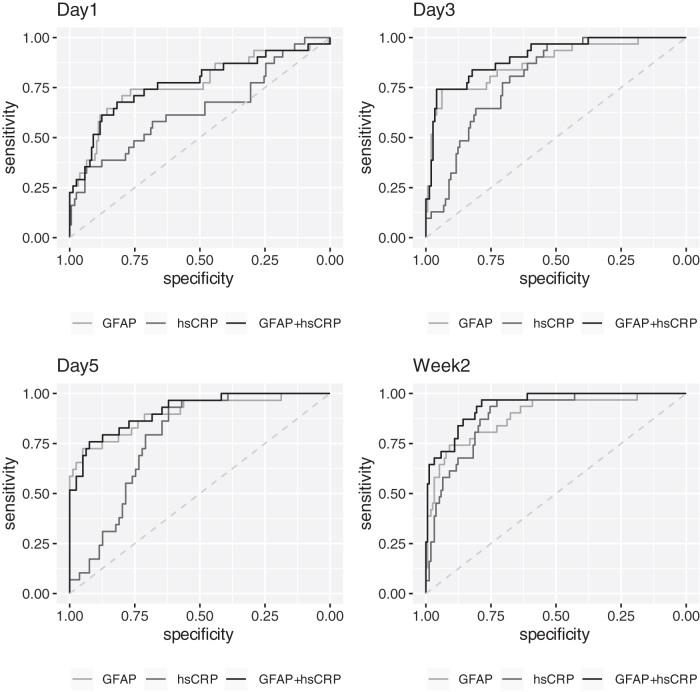
Receiver operating characteristic (ROC) curves for hsCRP and GFAP in predicting GOSE ≥5 versus <5 at 6 months after traumatic brain injury. ROC curves for GFAP alone, hsCRP alone, and GFAP + hsCRP at (A) day 1, (B) day 3, (C) day 5, and (D) 2 weeks post-injury. GOSE <5 indicates unfavorable outcome (severe disability/death). GFAP, glial fibrillary acidic protein; GOSE, Glasgow Outcome Scale-Extended; hsCRP, high-sensitivity C-reactive protein.

References

    1. Sandsmark, D.K. (2016). Clinical outcomes after traumatic brain injury. Curr. Neurol. Neurosci. Rep. 16, 52. - PubMed
    1. Foreman, B.P., Caesar, R.R., Parks, J., Madden, C., Gentilello, L.M., Shafi, S., Carlile, M.C., Harper, C.R., and Diaz-Arrastia, R.R. (2007). Usefulness of the abbreviated injury score and the injury severity score in comparison to the Glasgow Coma Scale in predicting outcome after traumatic brain injury. J. Trauma Acute Care Surg. 62, 946–950 - PubMed
    1. Diaz-Arrastia, R., Kochanek, P.M., Bergold, P., Kenney, K., Marx, C.E., Grimes, C.J.B., Loh, L.Y., Adam, L.G.E., Oskvig, D., and Curley, K.C. (2014). Pharmacotherapy of traumatic brain injury: state of the science and the road forward: report of the Department of Defense Neurotrauma Pharmacology Workgroup. J. Neurotrauma 31, 135–158 - PMC - PubMed
    1. Dadas, A., Washington, J., Diaz-Arrastia, R., and Janigro, D. (2018). Biomarkers in traumatic brain injury (TBI): a review. Neuropsychiatric disease and treatment 14, 2989–3000 - PMC - PubMed
    1. Gabay, C., and Kushner, I. (1999). Acute-phase proteins and other systemic responses to inflammation. N. Engl. J. Med. 340, 448–454 - PubMed

Publication types