. 2020 Nov 1;32(11):113101.
doi: 10.1063/5.0031875.

Coronavirus rotational diffusivity

Affiliations

Coronavirus rotational diffusivity

M A Kanso et al. Phys Fluids (1994). .

Abstract

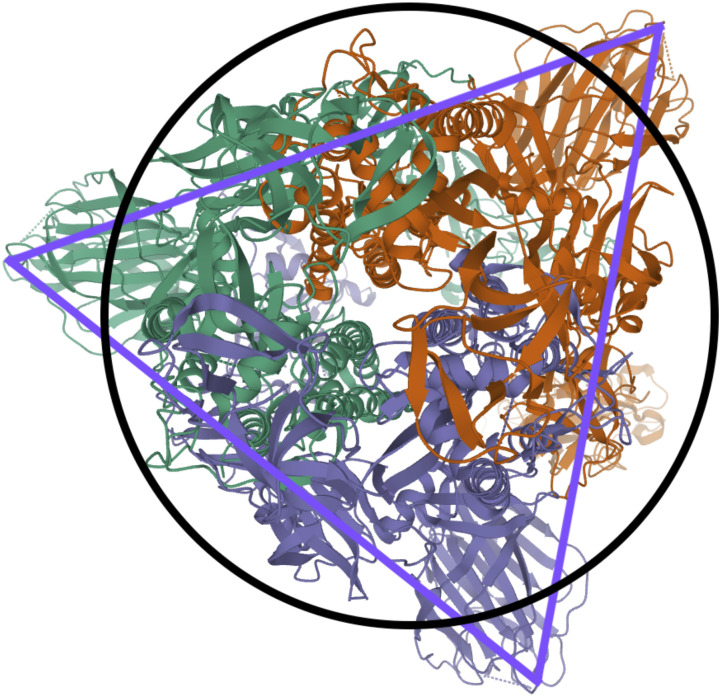
Just 11 weeks after the confirmation of first infection, one team had already discovered and published [D. Wrapp et al., "Cryo-EM structure of the 2019-nCoV spike in the prefusion conformation," Science 367(6483), 1260-1263 (2020)] in exquisite detail about the new coronavirus, along with how it differs from previous viruses. We call the virus particle causing the COVID-19 disease SARS-CoV-2, a spherical capsid covered with spikes termed peplomers. Since the virus is not motile, it relies on its own random thermal motion, specifically the rotational component of this thermal motion, to align its peplomers with targets. The governing transport property for the virus to attack successfully is thus the rotational diffusivity. Too little rotational diffusivity and too few alignments are produced to properly infect. Too much, and the alignment intervals will be too short to properly infect, and the peplomer is wasted. In this paper, we calculate the rotational diffusivity along with the complex viscosity of four classes of virus particles of ascending geometric complexity: tobacco mosaic, gemini, adeno, and corona. The gemini and adeno viruses share icosahedral bead arrangements, and for the corona virus, we use polyhedral solutions to the Thomson problem to arrange its peplomers. We employ general rigid bead-rod theory to calculate complex viscosities and rotational diffusivities, from first principles, of the virus suspensions. We find that our ab initio calculations agree with the observed complex viscosity of the tobacco mosaic virus suspension. From our analysis of the gemini virus suspension, we learn that the fine detail of the virus structure governs its rotational diffusivity. We find the characteristic time for the adenovirus from general rigid bead-rod theory. Finally, from our analysis of the coronavirus suspension, we learn that its rotational diffusivity descends monotonically with its number of peplomers.


Figures

FIG. 1.
FIG. 1.
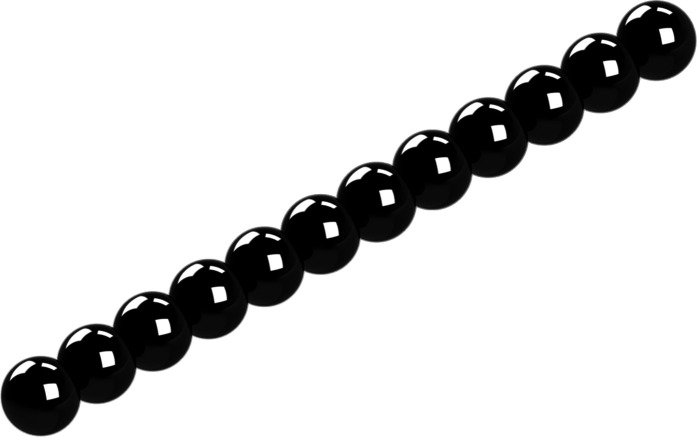
General rigid bead–rod model of tobacco mosaic virus, N = 12.
FIG. 2.
FIG. 2.
General rigid bead–rod model of gemini virus, N = 22. See Fig. 2 of Ref. .
FIG. 3.
FIG. 3.
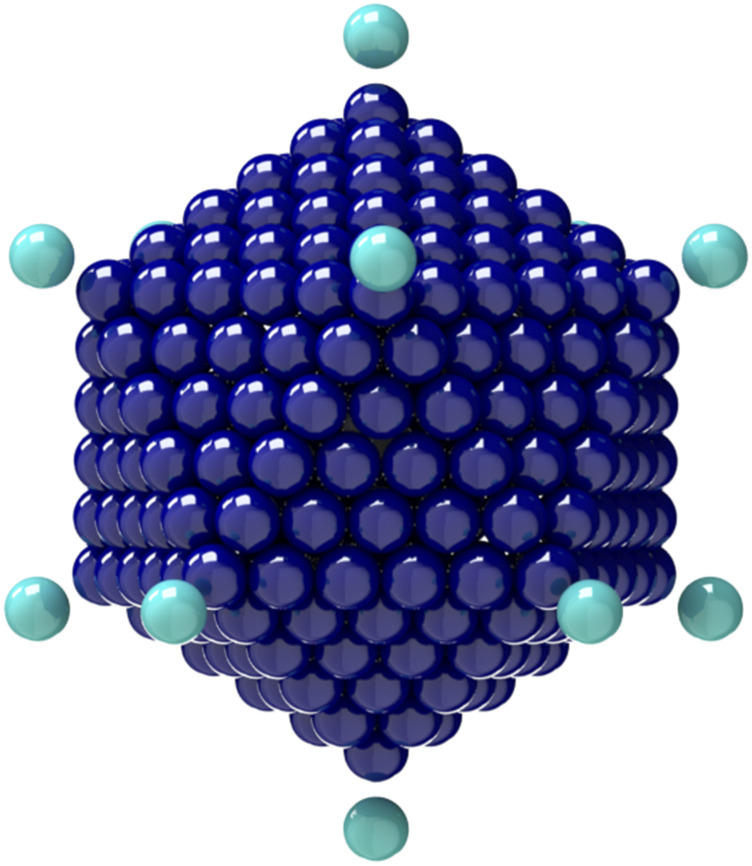
General rigid bead–rod model of adenovirus, Nc = 252, Np = 12, and rv/rc = 5/4.
FIG. 4.
FIG. 4.
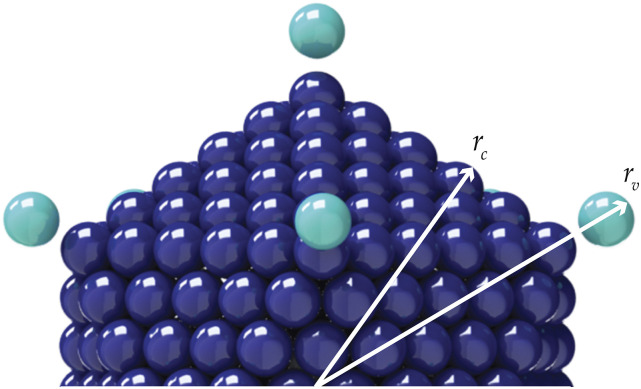
Connections between adenovirus particle dimensions and its general rigid bead–rod model.
FIG. 5.
FIG. 5.
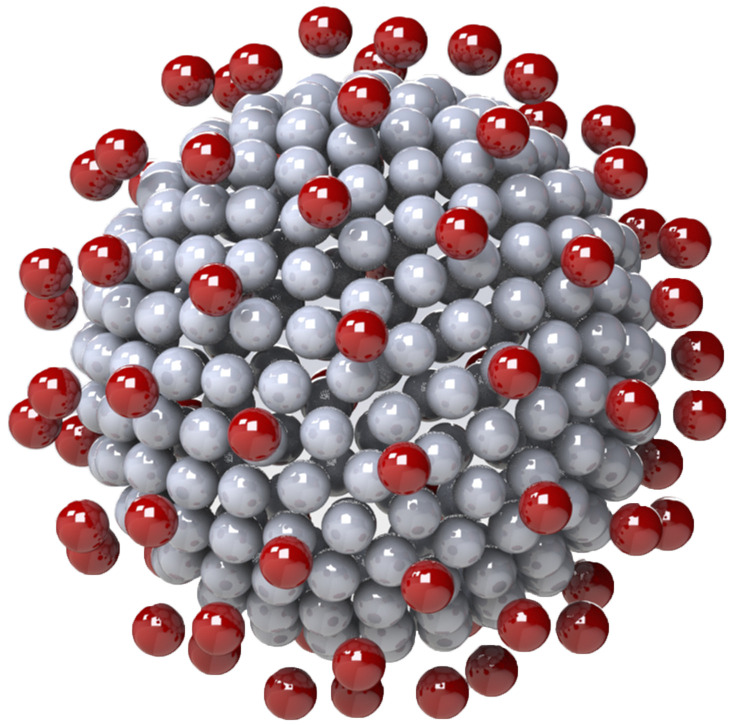
General rigid bead–rod model of coronavirus, Nc = 256, Np = 74, and rv/rc = 5/4.
FIG. 6.
FIG. 6.
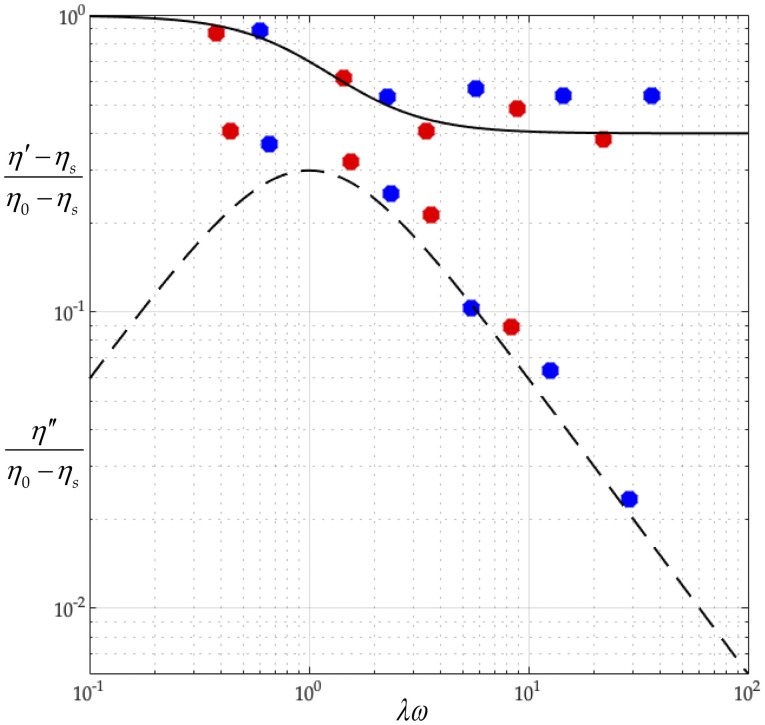
The dimensionless complex viscosity of tobacco mosaic virus suspension predicted by the general rigid bead–rod theory vs experimental data (Fig. 14.5-1 of Ref. 22). The data are for solutions of tobacco mosaic virus of M = 3.9 × 10⁷ g/mol. The red points represent data taken at 310 K, and the blue ones are taken at 298.2 K. The solvent viscosity at the two temperatures is ηs = 3.43 × 10⁻³ Pa s and ηs = 5.16 × 10⁻³ Pa s, respectively. The general rigid bead–rod theory predictions are computed using a value [η]0 = 18 cm3/g as the best fit with the data. The solid curve describes (η′ − ηs)/(η0ηs), and the dashed one describes η″/(η0ηs).
FIG. 7.
FIG. 7.
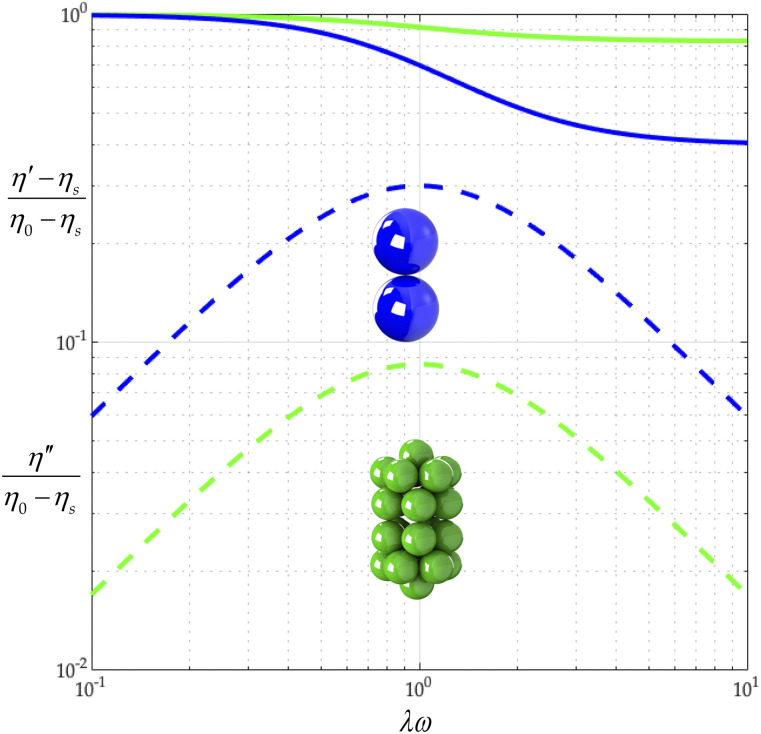
Gemini virus complex viscosity comparison: two osculating beads (green) and twin icosahedra (blue). The solid curve describes (η′ − ηs)/(η0ηs), and the dashed one describes η″/(η0ηs).
FIG. 8.
FIG. 8.
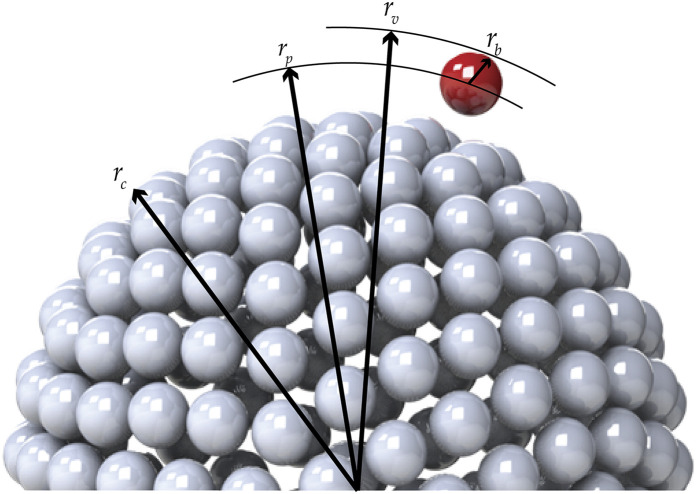
Connections between coronavirus particle dimensions and its general rigid bead–rod model. For the peplomer bulb, we have bead radius rb12d so that for the peplomer height, we have rvrc=rp+rb=rp+12d (see Table X). The peplomer head radial position is thus the center to center distance between the peplomer head and the capsid (rvrb).
FIG. 9.
FIG. 9.
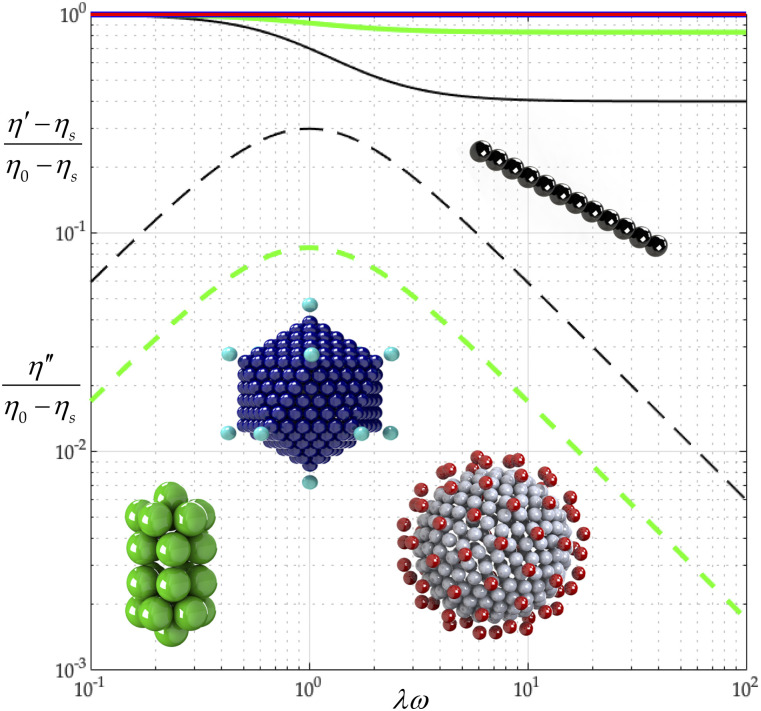
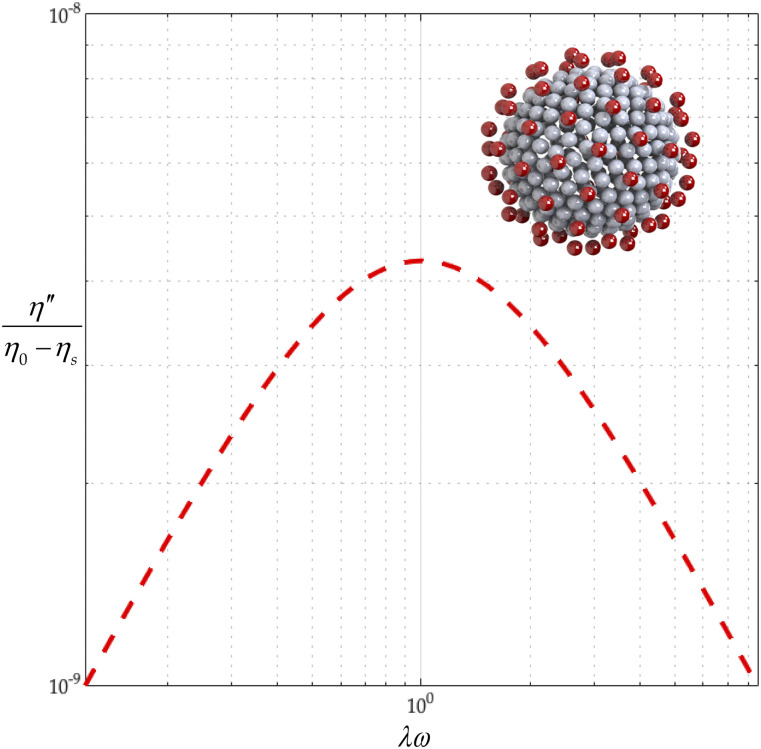
Tobacco mosaic (black), gemini (green), adeno (blue), and corona (red) complex viscosity comparison. The solid curve describes (η′ − ηs)/(η0ηs), and the dashed one describes η″/(η0ηs).
FIG. 10.
FIG. 10.
Corona (red) elastic complex viscosity, η″/(η0ηs), curve.
FIG. 11.
FIG. 11.
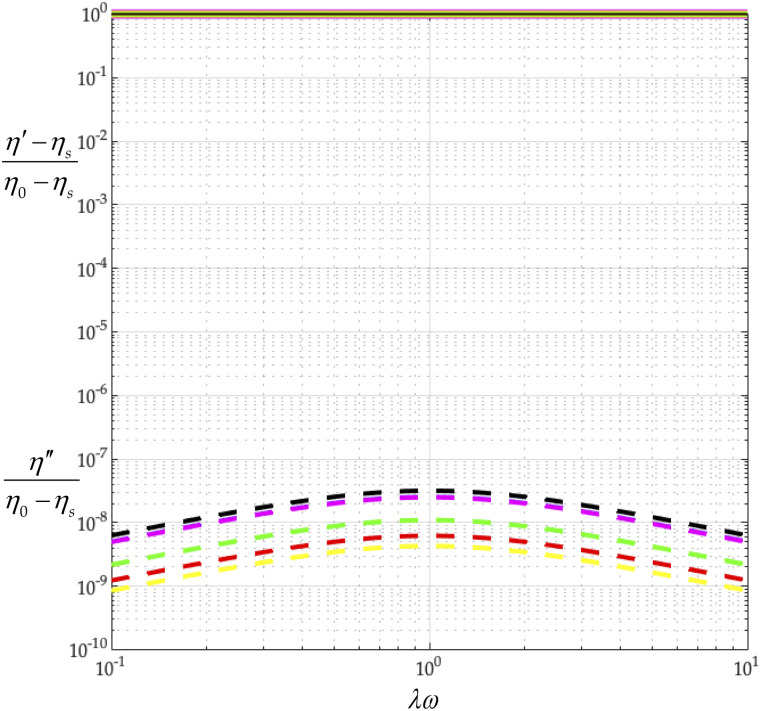
Effect of capsid osculated beadings on complex viscosity (Nc = 16, 32, 64, 128, 256, 510, Np = 74, rv/rc = 5/4, and L = d). Nc = 16 (black), Nc = 32 (blue), Nc = 64 (red), Nc = 128 (green), Nc = 256 (yellow), and Nc = 510 (magenta). The solid curve describes (η′ − ηs)/(η0ηs), and the dashed one describes η″/(η0ηs).
FIG. 12.
FIG. 12.
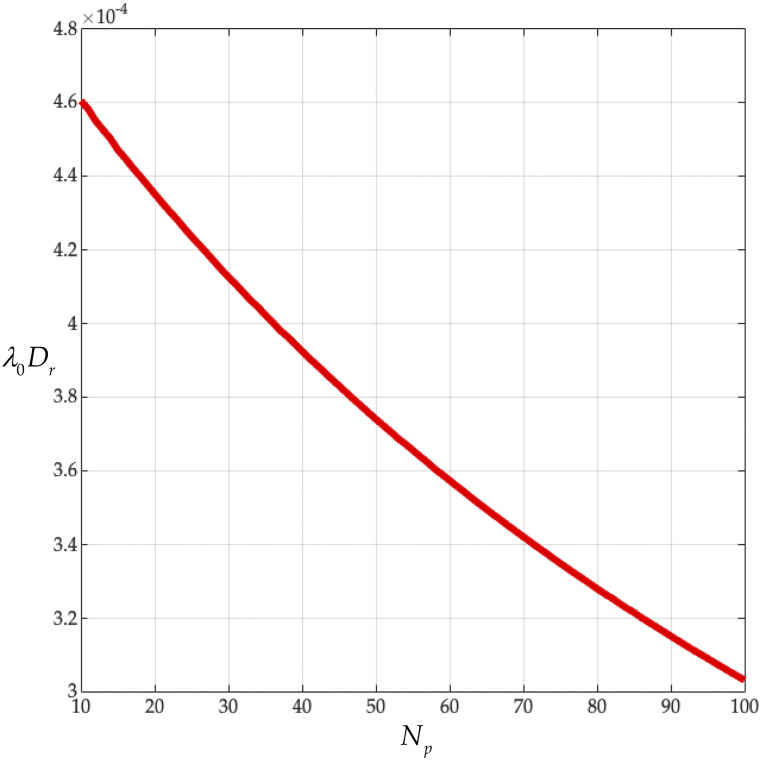
Dimensionless rotational diffusivity λ0Dr from Eq. (23) vs peplomer population Np (Nc = 256).
FIG. 13.
FIG. 13.
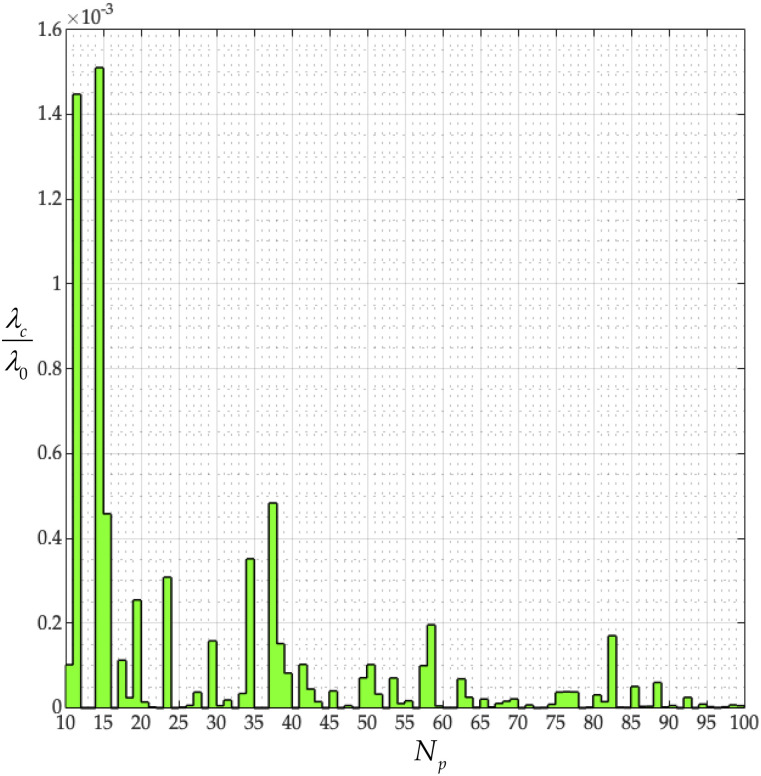
Dimensionless structure-dependent characteristic time, λc/λ0, vs peplomer population, Np (Nc = 256), from Eq. (40).
FIG. 14.
FIG. 14.
In this work, we replace the peplomer bulk with sphere (a) inscribed in the trimer, thus neglecting its triangularity. Future work shall improve upon this by inscribing the trimer (b) into three osculating beads.

References

    1. Wrapp D., Wang N., Corbett K. S., Goldsmith J. A., Hsieh C.-L., Abiona O., Graham B. S., and McLellan J. S., “Cryo-EM structure of the 2019-nCoV spike in the prefusion conformation,” Science 367(6483), 1260–1263 (2020). 10.1126/science.abb2507 - DOI - PMC - PubMed
    1. Yan R., Zhang Y., Li Y., Xia L., Guo Y., and Zhou Q., “Structural basis for the recognition of SARS-CoV-2 by full-length human ACE2,” Science 367(6485), 1444–1448 (2020). 10.1126/science.abb2762 - DOI - PMC - PubMed
    1. Dbouk T. and Drikakis D., “On coughing and airborne droplet transmission to humans,” Phys. Fluids 32(5), 053310 (2020). 10.1063/5.0011960 - DOI - PMC - PubMed
    1. Bhardwaj R. and Agrawal A., “Likelihood of survival of coronavirus in a respiratory droplet deposited on a solid surface,” Phys. Fluids 32(6), 061704 (2020). 10.1063/5.0012009 - DOI - PMC - PubMed
    1. Verma S., Dhanak M., and Frankenfield J., “Visualizing the effectiveness of face masks in obstructing respiratory jets,” Phys. Fluids 32(6), 061708 (2020). 10.1063/5.0016018 - DOI - PMC - PubMed

LinkOut - more resources