Review
. 2020 Nov;33(6):335-343.
doi: 10.1055/s-0040-1714236. Epub 2020 Sep 14.

Surgical Treatment for Crohn's Disease: A Role of Kono-S Anastomosis in the West

Affiliations
Review

Surgical Treatment for Crohn's Disease: A Role of Kono-S Anastomosis in the West

Toru Kono et al. Clin Colon Rectal Surg. 2020 Nov.

Abstract

More than 80% of patients with Crohn's disease (CD) will require surgical intervention during their lifetime, with high rates of anastomotic recurrence and stenosis necessitating repeat surgery. Current data show that pharmacotherapy has not significantly improved the natural history of postoperative clinical and surgical recurrence of CD. In 2003, antimesenteric hand-sewn functional end-to-end (Kono-S) anastomosis was first performed in Japan. This technique has yielded very desirable outcomes in terms of reducing the incidence of anastomotic surgical recurrence. The most recent follow-up of these patients showed that very few had developed surgical recurrence. This new approach is superior to stapled functional end-to-end anastomosis because the stumps are sutured together to create a stabilizing structure (a "supporting column"), serving as a supportive backbone of the anastomosis to help prevent distortion of the anastomotic lumen due to disease recurrence and subsequent clinical symptoms. This technique requires careful mesenteric excision for optimal preservation of the blood supply and innervation. It also results in a very wide anastomotic lumen on the antimesenteric side. The Kono-S technique has shown efficacy in preventing surgical recurrence and the potential to become the new standard of care for intestinal CD.

Keywords: Crohn’s disease; stapled functional end-to-end anastomosis; supporting column; surgical recurrence.


Conflict of interest statement

Conflict of Interest None.

Figures
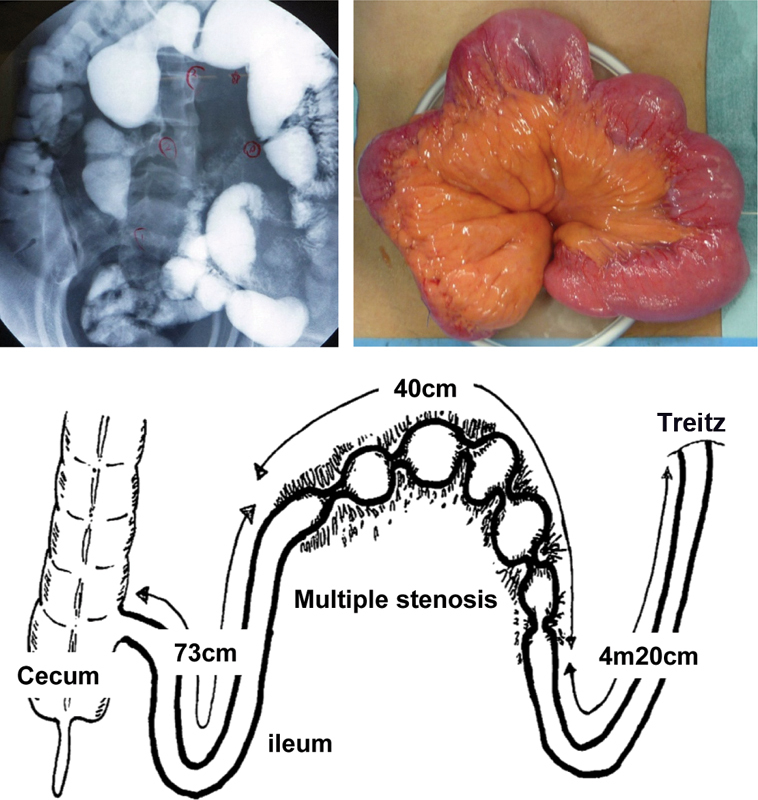
Fig. 1
Fig. 1
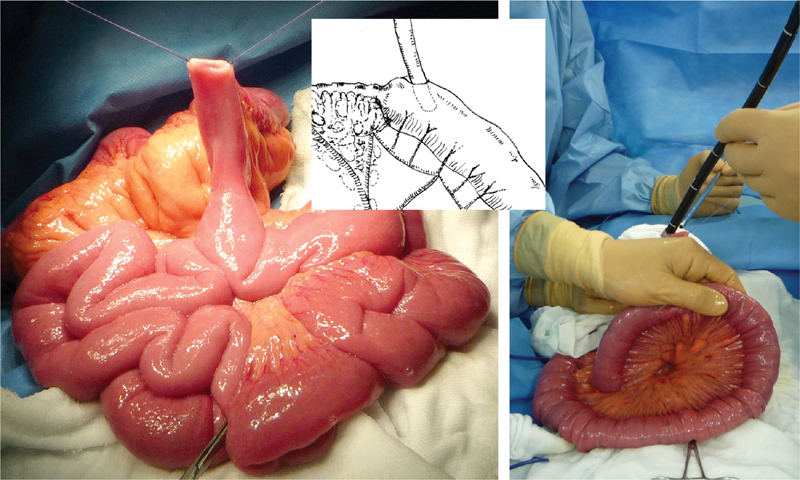
Multiple ileal stenoses in a patient with Crohn's disease. A 36-year-old man had Crohn's disease complicated by multiple stenoses in the small intestine. Six strictures spanning 40 cm were located within the distal 73 cm of the terminal ileum.
Fig. 2
Fig. 2
Intraoperative endoscopy. The whole bowel is carefully inspected for diseased segments using an endoscope via an enterotomy placed at the stenotic site. Intraoperative endoscopy is performed by a gastroenterologist when unexpected incidental surgical findings are noted upon exploration.
Fig. 3
Fig. 3
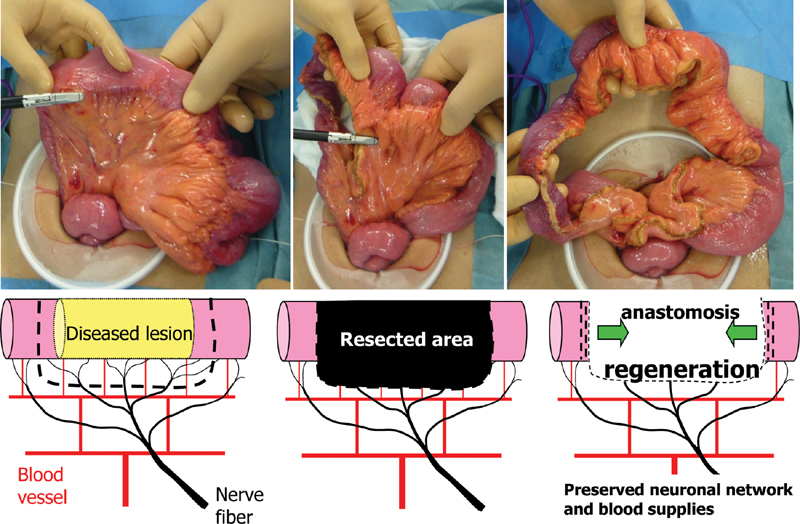
Mesenteric incision line. The mesentery is divided using a tissue-sealing device close to the intestinal wall to preserve the vascularization and innervation.
Fig. 4
Fig. 4
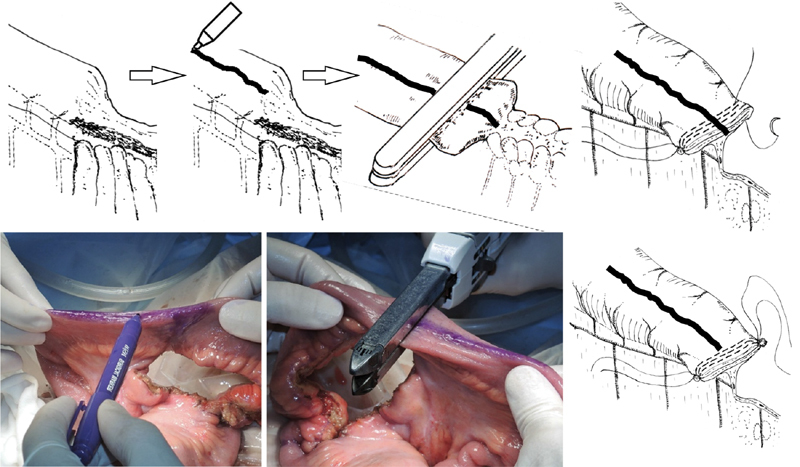
Transection of the intestinal tract and reinforcement of the corners of the staple line. Before dividing the bowel, a longitudinal line is drawn on the antimesenteric side. The bowel is divided transversely by placing the linear stapler perpendicular to the intestinal lumen, and the mesentery is located in the middle of the staple lines. The corners of the staple line are at risk of leakage and bleeding. Both corners of the staple lines are reinforced and imbricated. The sutures are tied together to construct the “supporting column.”
Fig. 5
Fig. 5
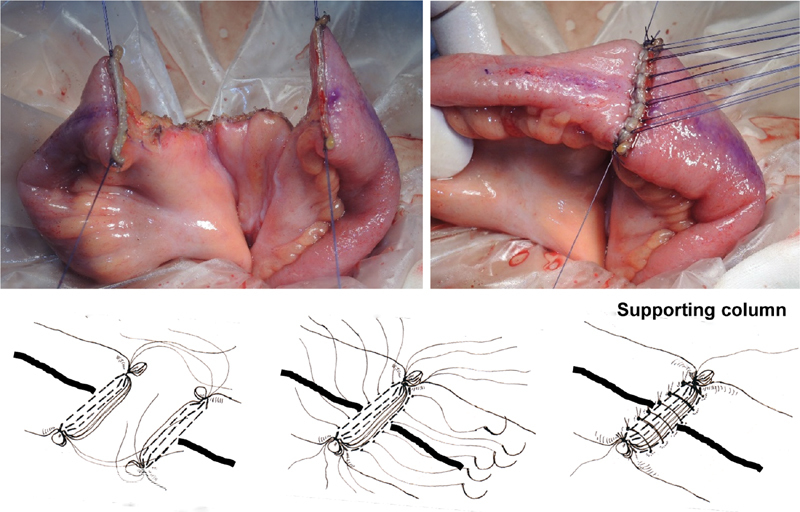
Creation of the supporting column. The suture threads used to reinforce the proximal and distal ends are tied together to create the supporting column. Adjustments are made to compensate for differences in stump sizes. The staple lines are securely sewn together using interrupted stitches. The supporting column helps to prevent distortion caused by relapse at the anastomotic site.
Fig. 6
Fig. 6
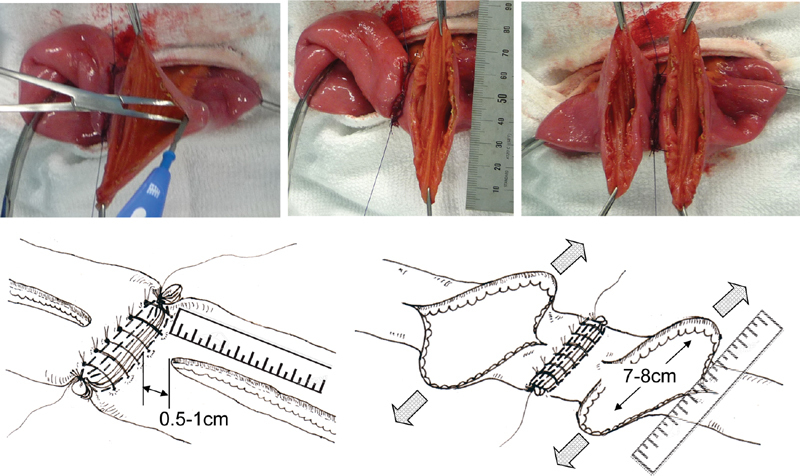
Creation of the anastomotic stoma. Antimesenteric longitudinal enterotomies are performed on each stump starting 5 to 10 mm away from the edge of the supporting column to maximize the effect of the supporting column on the anastomosis. The enterotomies are extended to allow a transverse lumen of 7 to 8 cm.
Fig. 7
Fig. 7
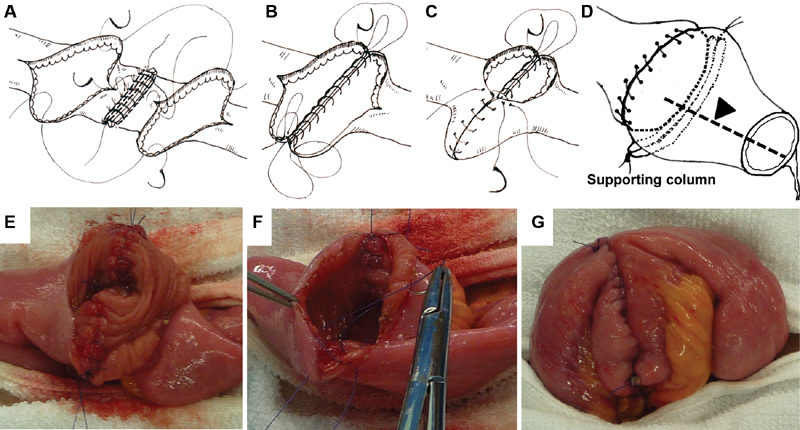
Closure of the anastomotic stoma and completion of the Kono-S anastomosis. ( A ) Posterior wall stitches. Two vertical mattress sutures are placed: one at the point most distal to the long axis of the intestine and one at the center of the posterior edge. Another nondetachable suture is placed to close the pre-existing suture at the point most distal to the long axis and will be used for subsequent closure of the posterior wall. ( E ) Posterior wall closure. ( B ) The posterior wall sutures are used to close the anterior wall. ( C ) The surgeon sutures the proximal half of the anterior wall and ties another short suture with a detachable needle, which is placed at the center of the anastomosis. ( F ) Next, the surgeon closes the distal half of the anterior wall and ties this suture to the pre-existing suture. ( G ) Completion of the Kono-S anastomosis. ( D ) The arrowhead indicates the mesenteric side of the wall that is located at the center of the supporting column.
Fig. 8
Fig. 8
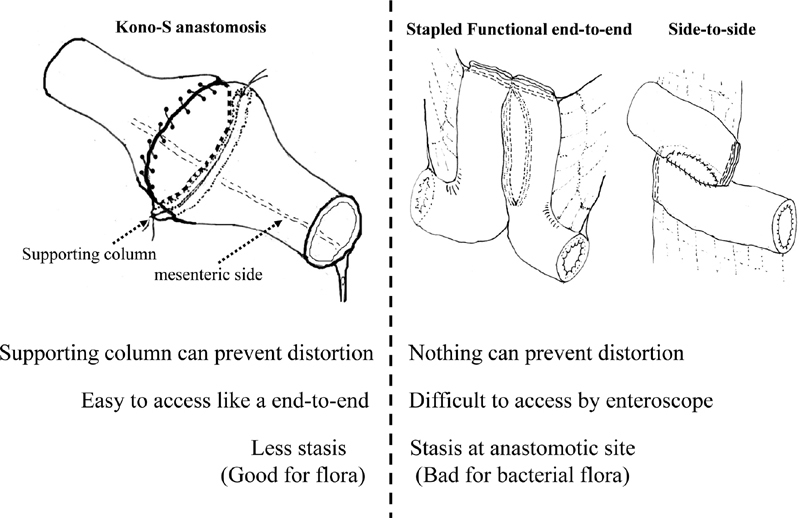
Comparison of the advantages and disadvantages of hand-sewn and stapled functional end-to-end anastomoses.

References

    1. Baumgart D C, Sandborn W J.Crohn's disease Lancet 2012380(9853):1590–1605. - PubMed
    1. Cosnes J, Nion-Larmurier I, Beaugerie L, Afchain P, Tiret E, Gendre J P. Impact of the increasing use of immunosuppressants in Crohn's disease on the need for intestinal surgery. Gut. 2005;54(02):237–241. - PMC - PubMed
    1. Fichera A, Schlottmann F, Krane M, Bernier G, Lange E. Role of surgery in the management of Crohn's disease. Curr Probl Surg. 2018;55(05):162–187. - PubMed
    1. Nos P, Domenech E. Postoperative Crohn's disease recurrence: a practical approach. World J Gastroenterol. 2008;14(36):5540–5548. - PMC - PubMed
    1. Terdiman J P. Prevention of postoperative recurrence in Crohn's disease. Clin Gastroenterol Hepatol. 2008;6(06):616–620. - PubMed