. 2020 Oct 14:11:568289.
doi: 10.3389/fmicb.2020.568289. eCollection 2020.

Halotolerant PGPR Stenotrophomonas maltophilia BJ01 Induces Salt Tolerance by Modulating Physiology and Biochemical Activities of Arachis hypogaea

Affiliations

Halotolerant PGPR Stenotrophomonas maltophilia BJ01 Induces Salt Tolerance by Modulating Physiology and Biochemical Activities of Arachis hypogaea

Ankita Alexander et al. Front Microbiol. .

Abstract

Arachis hypogaea (Peanut) is one of the most important cash crops grown for food and oil production. Salinity is a major constraint for loss of peanut productivity, and halotolerant plant growth promoting bacteria not only enhance plant-growth but also provide tolerance against salt stress. The potential of halotolerant bacterium Stenotrophomonas maltophilia BJ01 isolated from saline-soil was explored to enhance the growth of peanut plants under salt stress conditions. Interaction of S. maltophilia BJ01 enhances the growth of the peanut plants and protects photosynthetic pigments under salt stress. Lower electrolyte leakage (about 20%), lipid peroxidation (2.1 μmol g-1 Fw), proline (2.9 μg mg-1 Fw) content and H2O2 (55 μmol g-1 Fw) content were observed in plants, co-cultivated with PGPR compared to untreated plants under stress condition. The growth hormone auxin (0.4 mg g-1 Fw) and total amino acid content (0.3 mg g-1 Fw) were enhanced in plants co-cultivated with PGPR under stress conditions. Overall, these results indicate the beneficial effect of S. maltophilia BJ01 on peanut plants under salt (100 mM NaCl) stress conditions. In conclusion, bacterium S. maltophilia BJ01 could be explored further as an efficient PGPR for growing legumes especially peanuts under salt stress conditions. However, a detailed agronomic study would be needed to ascertain its commercial role.

Keywords: Arachis hypogaea; PGPR - plant growth-promoting rhizobacteria; Stenotrophomonas; halotolerant bacteria; peanut; plant microbe interaction; saline agriculture; salt stress.


Figures

FIGURE 1
FIGURE 1
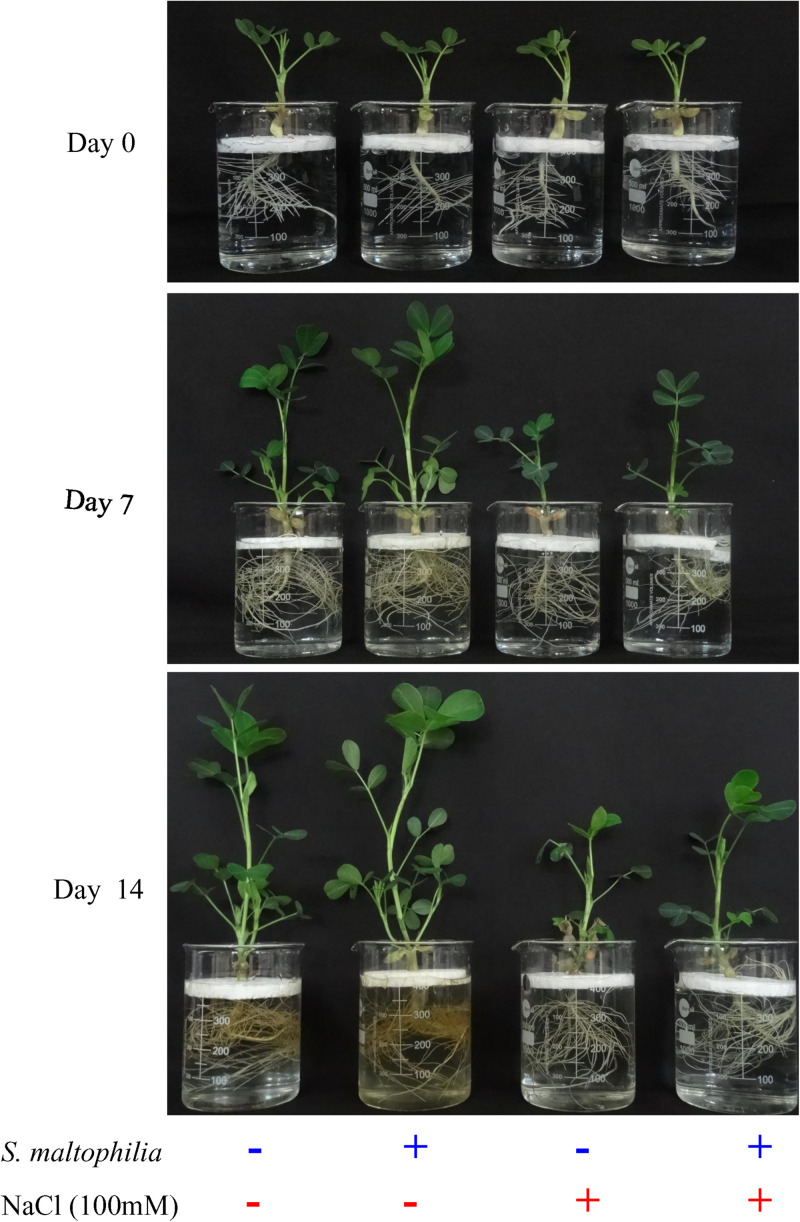
Morphological difference in inoculated and uninoculated plants. Plant grown without NaCl considered as control condition and plant under 100 mM salt considered as stressed conditions. “+” represents the presence of bacteria or NaCl, whereas “-” represents the absence of NaCl or bacteria.
FIGURE 2
FIGURE 2
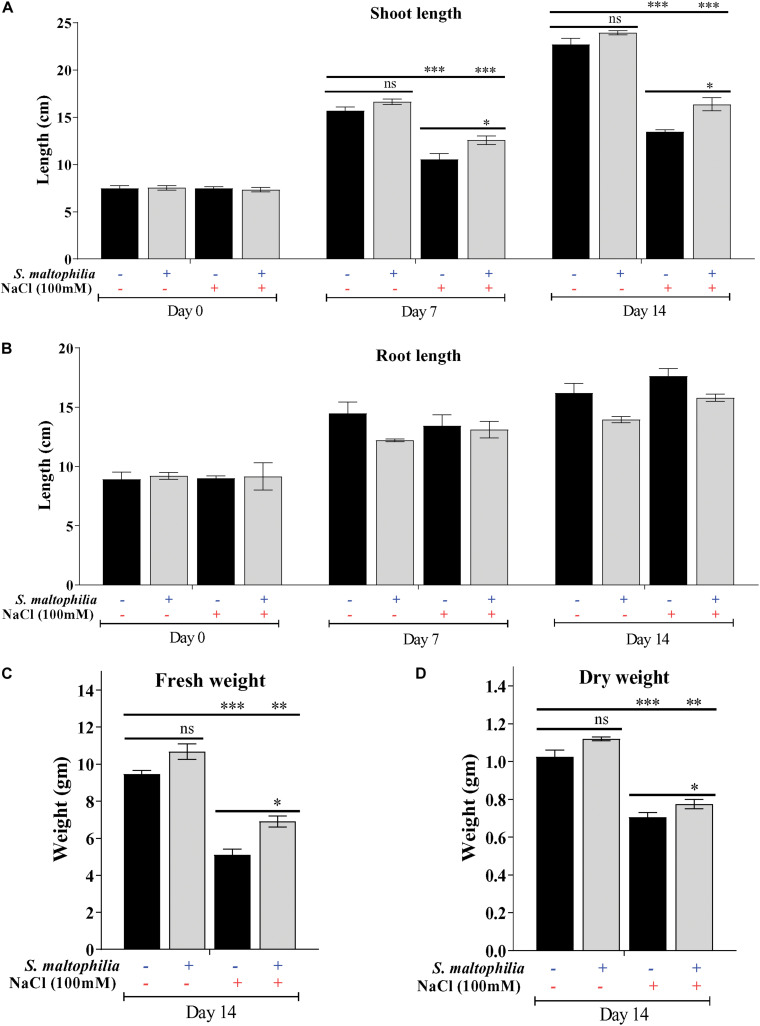
Difference in various growth parameters and comparative analysis. Shoot length (A), root length (B) fresh weight (C) dry weight (D) of control, and stressed plants. Plant grown without NaCl considered as control condition and plant under 100 mM salt considered as stressed conditions. “+” represents the presence of bacteria or NaCl whereas “-” represents the absence of NaCl or bacteria. Bars denote means ± SE. ‘*,’ ‘**,’ ‘***’ indicate significant differences at P < 0.05, P < 0.01 and P < 0.001, respectively and ‘ns’ represents no significant difference.
FIGURE 3
FIGURE 3
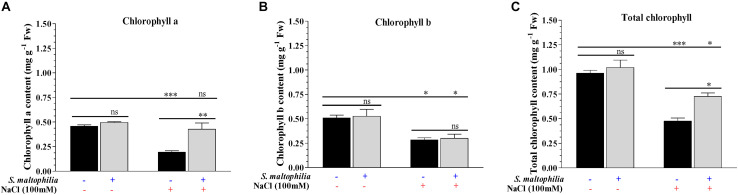
Estimation of photosynthetic pigments. Chlorophyll a contents (A), chlorophyll b contents (B) and total chlorophyll content (C) of inoculated and uninoculated plants. Plant grown without NaCl considered as control condition and plant under 100 mM salt considered as stressed conditions. “+” represents the presence of bacteria or NaCl whereas “-” represents the absence of NaCl or bacteria. Bars denote means ± SE. ‘*,’ ‘**,’ ‘***’ indicate significant differences at P < 0.05, P < 0.01, and P < 0.001, respectively and ‘ns’ represents no significant difference.
FIGURE 4
FIGURE 4
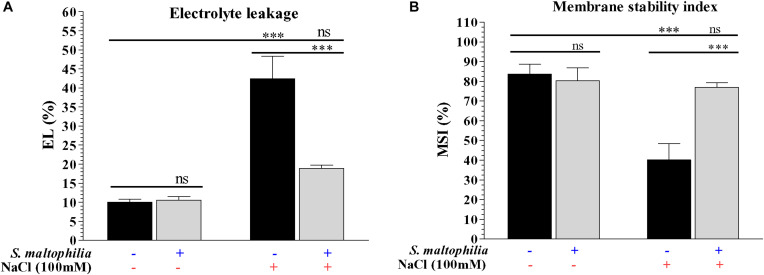
Measurement of physiological parameters. Membrane Stability Index (MSI) (A) and electrolyte leakage (EL) of control and stressed plants (B). Plant grown without NaCl considered as control condition and plant under 100 mM salt considered as stressed conditions. “+” represents the presence of bacteria or NaCl whereas “-” represents the absence of NaCl or bacteria. Bars denote means ± SE. ‘*,’ ‘**,’ ‘***’ indicate significant differences at P < 0.05, P < 0.01, and P < 0.001, respectively and ‘ns’ represents no significant difference.
FIGURE 5
FIGURE 5
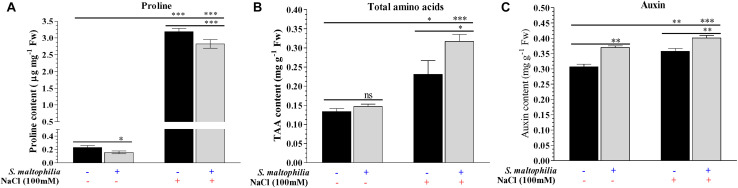
Biochemical changes in plants due to bacterial interaction. Quantification of proline (A), total amino acid (TAA) (B) and auxin (C) concentration of control and treated plants. Plant grown without NaCl considered as control condition and plant under 100 mM salt considered as stressed conditions. “+” represents the presence of bacteria or NaCl whereas - represents the absence of NaCl or bacteria. Bars denote means ± SE. ‘*,’ ‘**,’ ‘***’ indicate significant differences at P < 0.05, P < 0.01, and P < 0.001, respectively and ‘ns’ represents no significant difference.
FIGURE 6
FIGURE 6
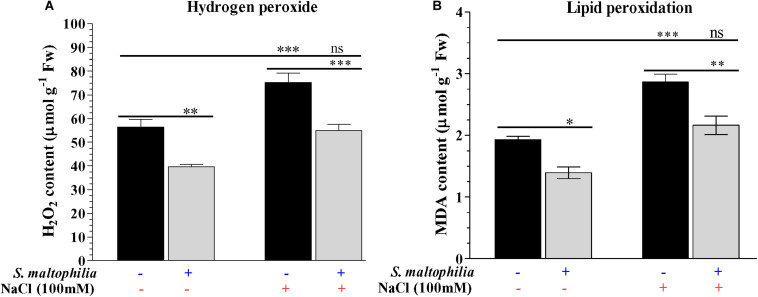
Estimation of reactive oxygen species and lipid peroxidation of the plant. Quantification of hydrogen peroxide (H2O2) (A) and MDA contents (B). Plant grown without NaCl considered as control condition and plant under 100 mM salt considered as stressed conditions. “+” represents the presence of bacteria or NaCl, whereas - represents the absence of NaCl or bacteria. Bars denote means ± SE. ‘*,’ ‘**,’ ‘***’ indicate significant differences at P < 0.05, P < 0.01, and P < 0.001, respectively and ‘ns’ represents no significant difference.
FIGURE 7
FIGURE 7
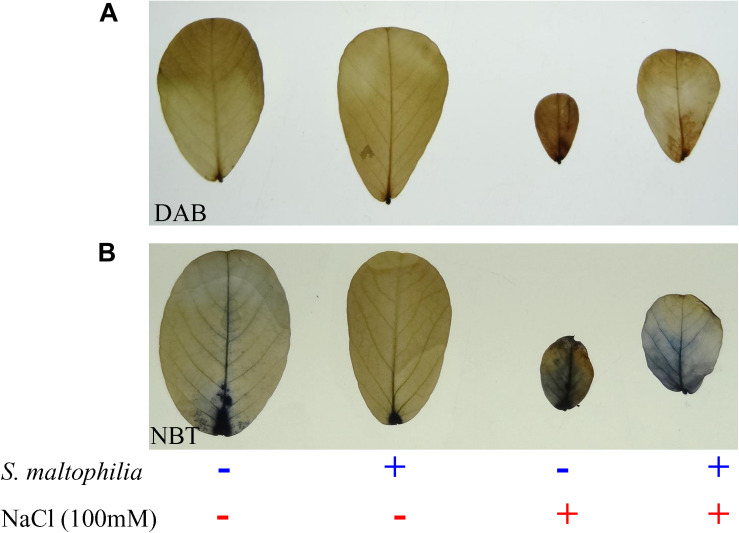
In vivo localization of reactive oxygen species in plant leaves. Staining of peroxide and superoxide free radicals via DAB (A) and NBT (B). Plant grown without NaCl considered as control condition and plant under 100 mM salt considered as stressed conditions. “+” represents the presence of bacteria or NaCl, whereas “-” represents the absence of NaCl or bacteria. Bars denote means ± SE. ‘*,’ ‘**,’ ‘***’ indicate significant differences at P < 0.05, P < 0.01, and P < 0.001, respectively and ‘ns’ represents no significant difference.
FIGURE 8
FIGURE 8
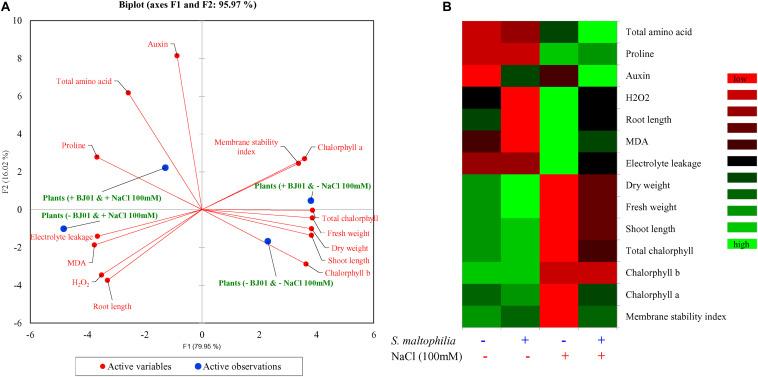
Multivariate data analyses of plant grown with or without bacteria under control and stress conditions. Principal component analysis (A) and integrated heat map (B). Plant grown without NaCl considered as control condition and plant under 100 mM salt considered as stressed conditions. “+” represents the presence of bacteria or NaCl, whereas “-” represents the absence of NaCl or bacteria.

References

    1. Abdelmoteleb A., Gonzalez-Mendoza D. (2020). Isolation and identification of phosphate solubilizing Bacillus spp. from Tamarix ramosissima rhizosphere and their effect on growth of phaseolus vulgaris under salinity stress. Geomicrobiol. J. 11 1–8. 10.1080/01490451.2020.1795321 - DOI
    1. Adhikari A., Khan M. A., Lee K. E., Kang S. M., Dhungana S. K., Bhusal N., et al. (2020). The halotolerant rhizobacterium-Pseudomonas koreensis MU2 enhances inorganic silicon and phosphorus use efficiency and augments salt stress tolerance in soybean (Glycine max L.). Microorganisms 8:1256. 10.3390/microorganisms8091256 - DOI - PMC - PubMed
    1. Alavi P., Starcher M., Zachow C., Müller H., Berg G. (2013). Root-microbe systems: the effect and mode of interaction of stress protecting agent (SPA) Stenotrophomonas rhizophila DSM14405T. Front. Plant Sci. 4:141. 10.3389/fpls.2013.00141 - DOI - PMC - PubMed
    1. Albacete A., Ghanem M. E., Martínez-Andújar C., Acosta M., Sánchez-Bravo J., Martínez V., et al. (2008). Hormonal changes in relation to biomass partitioning and shoot growth impairment in salinized tomato (Solanum lycopersicum L.) plants. J. Exp. Bot. 59 4119–4131. 10.1093/jxb/ern251 - DOI - PMC - PubMed
    1. Alexander A., Mishra A., Jha B. (2019a). “Halotolerant rhizobacteria: a promising probiotic for saline soil-based agriculture,” in Saline Soil-based Agriculture by Halotolerant Microorganisms, eds Etesami H., Kumar V., Kumar M. (Singapore: Springer; ), 53–73. 10.1007/978-981-13-8335-9_3 - DOI

LinkOut - more resources