. 2020 Oct 9:11:566893.
doi: 10.3389/fimmu.2020.566893. eCollection 2020.

β-Glucan-Induced Trained Immunity in Dogs

Affiliations

β-Glucan-Induced Trained Immunity in Dogs

Simon Paris et al. Front Immunol. .

Abstract

Several observations in the world of comparative immunology in plants, insects, fish and eventually mammals lead to the discovery of trained immunity in the early 2010's. The first demonstrations provided evidence that innate immune cells were capable of developing memory after a first encounter with some pathogens. Trained immunity in mammals was initially described in monocytes with the Bacille Calmette-Guerin vaccine (BCG) or prototypical agonists like β-glucans. This phenomenon relies on epigenetic and metabolic modifications leading to an enhanced secretion of inflammatory cytokines when the host encounters homologous or heterologous pathogens. The objective of our research was to investigate the trained immunity, well-described in mouse and human, in other species of veterinary importance. For this purpose, we adapted an in vitro model of trained innate immunity in dogs. Blood enriched monocytes were stimulated with β-glucans and we confirmed that it induced an increased production of pro-inflammatory and anti-microbial compounds in response to bacterial stimuli. These results constitute the first demonstration of trained immunity in dogs and confirm its signatures in other mammalian species, with an implication of cellular mechanisms similar to those described in mice and humans regarding cellular epigenetics and metabolic regulations.

Keywords: canine (dog); comparative immunology; epigenetic; immuno-metabolism; monocytes/macrophages; trained immunity; veterinary immunology.


Figures

Figure 1
Figure 1
Comparison of immune training of macrophages using different stimulating compounds. (A) Experimental design of immune training model in vitro. (B) TNF-α secretion after a full immune training protocol at D8 (Means ± SD). Statistic comparison to BG-Eg primed macrophages. (C) p-values of mixed-effects analysis of one way ANOVA between TNF-α secretions. (D) Ratio of TNF-α secretion between control condition (Mock/LPS) and primed macrophages in different species. 3-D representation of murine Dectin-1 -2CL8 (yellow) co-crystallized with a β-glucan- superimposed with modeling of human (red) and dog (blue) corresponding proteins. (E) Globlal overview of the proteins. (F–I) Focus on amino-acids at 4 angstrom distance from the crystallized β-glucan. Dectin-1 structures from the three species are represented superimposed (F) or individually: murine in yellow (G), human in red (H) and dog in blue (I). ANOVA tests p-values * < 0.05, ** < 0.01, *** < 0.001, **** < 0.0001.
Figure 2
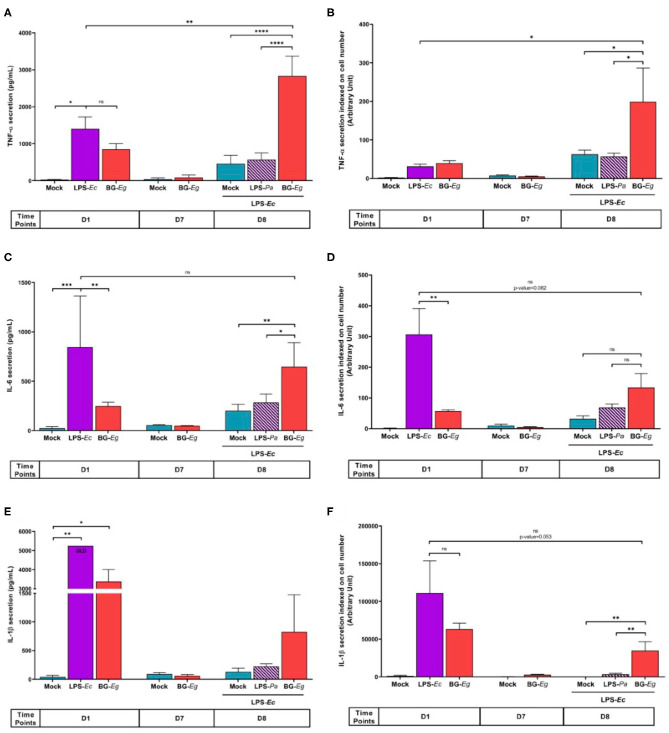
Figure 2
Trained immunity cytokinic signature throughout an immune training protocol. (A) TNF-α secretion (Means ± SD). (B) TNF-α secretion indexed on cell numbers. (C) IL-6 secretion (Means ± SD). (D) IL-6 secretion indexed on cell numbers. (E) IL-1β secretion (Means ± SD). (F) IL-1β secretion indexed on cell numbers. ANOVA tests p-values * < 0.05, ** < 0.01, *** < 0.001, **** < 0.0001.
Figure 3
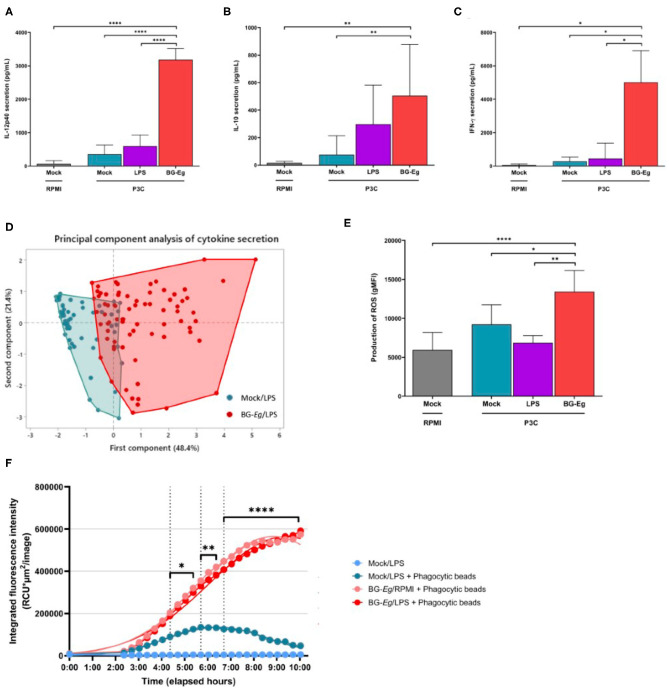
Figure 3
Pro-inflammatory and anti-microbial responses of canine macrophages after a full immune training. (A) IL12p40 secretion (Means ± SD). (B) IL-10 secretion (Means ± SD). (C) IFN-γ secretion (Means ± SD). (D) Principal component analysis of IL-6, IL-10, TNF-α and IFN-γ, secretion after a full immune training. (E) ROS production (geometric mean of fluorescence intensity ± SD). (F) Phagocytic activity (Total intensity of fluorescence of E. coli beads integrated per number of red-fluorescing cells). ANOVA tests p-values * < 0.05, ** < 0.01, *** < 0.001, **** < 0.0001.
Figure 4
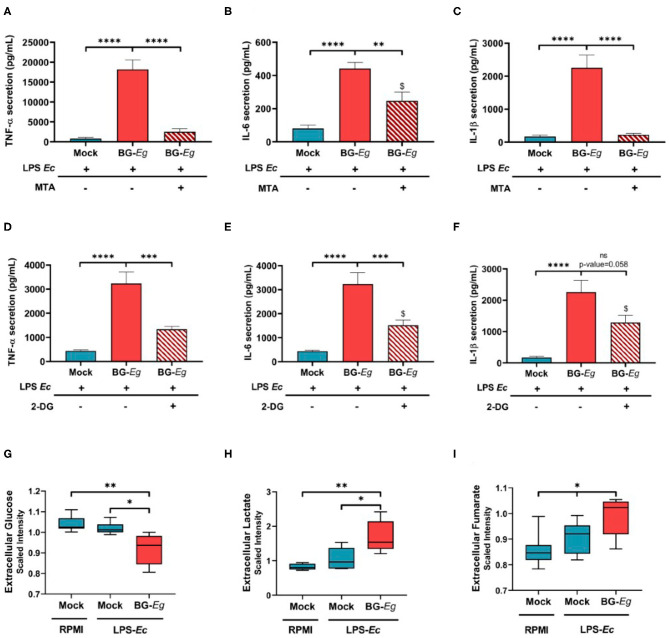
Figure 4
Epigenetic and metabolic features regulate trained immunity implementation in canine macrophages. (A–C) Inhibition of histone methylation by MTA abrogates the enhanced cytokine production (Means ± SD). (D–F) Inhibition of glycolysis by 2-DG abrogates the enhanced cytokine production (Means ± SD). (G–I) Glycolytic flux is increased by full immune training (Means of scaled intensity ± SD). ANOVA tests p-values * < 0.05, ** < 0.01, *** < 0.001, **** < 0.0001.

References

    1. Lemaitre B, Nicolas E, Michaut L, Reichhart JM, Hoffmann JA. The dorsoventral regulatory gene cassette spätzle/Toll/cactus controls the potent antifungal response in Drosophila adults. Cell. (1996) 86:973–83. 10.1016/S0092-8674(00)80172-5 - DOI - PubMed
    1. O'neill LA, Golenbock D, Bowie AG. The history of Toll-like receptors - redefining innate immunity. Nat Rev Immunol. (2013) 13:453–60. 10.1038/nri3446 - DOI - PubMed
    1. Durrant WE, Dong X. Systemic acquired resistance. Annu Rev Phytopathol. (2004) 42:185–209. 10.1146/annurev.phyto.42.040803.140421 - DOI - PubMed
    1. Ferro K, Peuss R, Yang W, Rosenstiel P, Schulenburg H, Kurtz J. Experimental evolution of immunological specificity. Proc Natl Acad Sci USA. (2019) 116:20598–604. 10.1073/pnas.1904828116 - DOI - PMC - PubMed
    1. Petit J, Embregts CWE, Forlenza M, Wiegertjes GF. Evidence of trained immunity in a fish: conserved features in carp macrophages. J Immunol. (2019) 203:216–24. 10.4049/jimmunol.1900137 - DOI - PMC - PubMed

LinkOut - more resources