


A review of performance assessment tools for rescuer response in opioid overdose simulations and training programs
- PMID: 33163333
- PMCID: PMC7610043
- DOI: 10.1016/j.pmedr.2020.101232
A review of performance assessment tools for rescuer response in opioid overdose simulations and training programs
Abstract
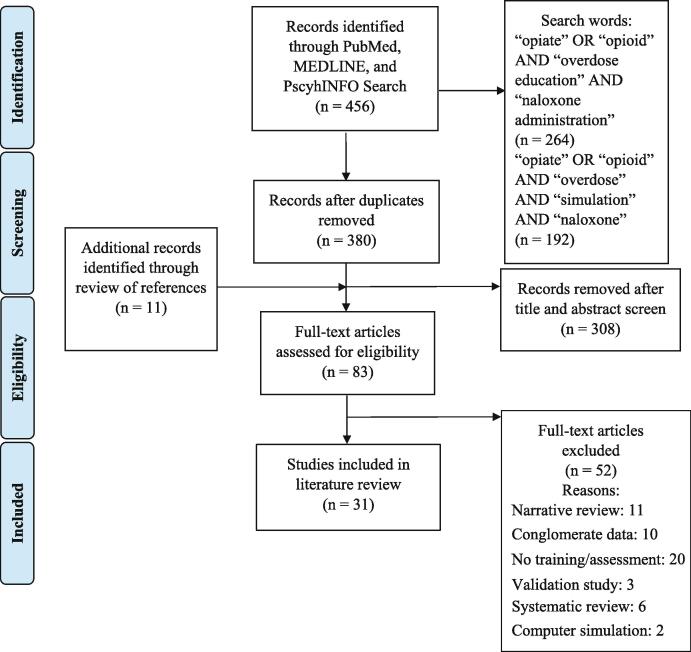
Since the 1990s, more than 600 overdose response training and education programs have been implemented to train participants to respond to an opioid overdose in the United States. Given this substantial investment in overdose response training, valid assessment of a potential rescuers' proficiency in responding to an opioid overdose is important. The aim of this article is to review the current state of the literature on outcome measures utilized in opioid overdose response training. Thirty-one articles published between 2014 and 2020 met inclusion criteria. The reviewed articles targeted laypersons, healthcare providers, and first responders. The assessment tools included five validated questionnaires, fifteen non-validated questionnaires, and nine non-validated simulation-based checklists (e.g., completion of critical tasks and time to completion). Validated multiple choice knowledge assessment tools were commonly used to assess the outcomes of training programs. It is unknown how scores on these assessment tools may correlate with actual rescuer performance responding to an overdose. Seven studies reported ceiling effects most likely attributed to participants' background medical knowledge or experience. The inclusion of simulation-based outcome measures of performance, including the commission of critical errors and the time to naloxone administration, provides better insight into rescuer skill proficiency.
Keywords: Naloxone; Outcome measures; Overdose response training; Proficiency; Simulation.
© 2020 The Authors. Published by Elsevier Inc.
Conflict of interest statement
The authors declare that they have no known competing financial interests or personal relationships that could have appeared to influence the work reported in this paper.
Figures
References
-
- Aizen R., Marcu G., Misra A., Sieber G., Schwartz D., Roth A. Designing an Emergency Response Community for Opioid Overdoses in Philadelphia. Association for Computing Machinery; 2018. - DOI
-
- Ashrafioun, L., Gamble, S., Herrmann, M., Baciewicz, G., 2016. Evaluation of knowledge and confidence following opioid overdose prevention training: A comparison of types of training participants and naloxone administration methods. Subst Abus 37(1):76–81. DOI: 10.1080/08897077.2015.1110550. - PubMed
-
- Behar, E., Santos, G.M., Wheeler, E., Rowe, C., Coffin, P.O., 2015. Brief overdose education is sufficient for naloxone distribution to opioid users. Drug Alcohol Depend 148:209–12. DOI: 10.1016/j.drugalcdep.2014.12.009. - PubMed
Publication types
LinkOut - more resources
Full Text Sources
Miscellaneous
