Editorial
doi: 10.21037/hbsn.2019.10.18.
Clinical implications of the dual blockade of the PD-1/PD-L1 and vascular endothelial growth factor axes in the treatment of hepatocellular carcinoma
Affiliations
- PMID: 33163513
- PMCID: PMC7603925
- DOI: 10.21037/hbsn.2019.10.18
Item in Clipboard
Editorial
Clinical implications of the dual blockade of the PD-1/PD-L1 and vascular endothelial growth factor axes in the treatment of hepatocellular carcinoma
Hepatobiliary Surg Nutr.
2020 Oct.
No abstract available
Conflict of interest statement
Conflicts of Interest: The author has completed the ICMJE uniform disclosure form (available at http://dx.doi.org/10.21037/hbsn.2019.10.18). The author has no conflicts of interest to declare.
Figures
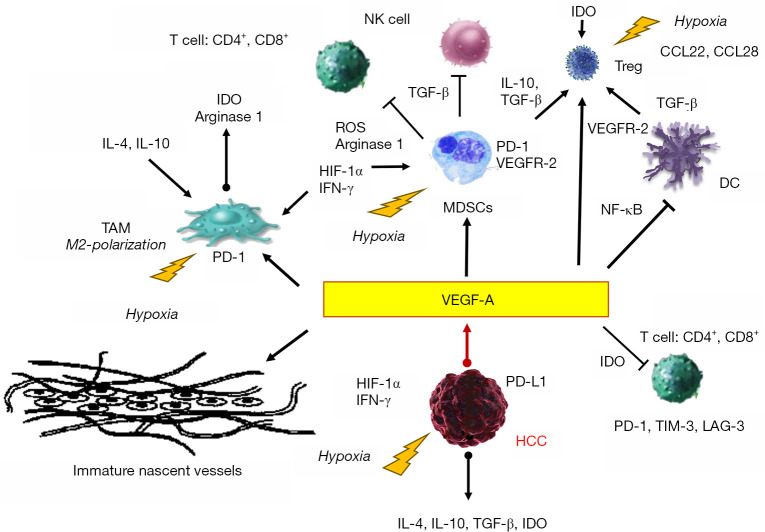
Involvement of cellular and humoral components of immunosuppressive microenvironment of HCC under hypoxia and VEGF. Mutual interactions between cellular components and humoral mediators, and induction of the immune suppressive molecules under hypoxia are shown. The oxygen supply from blood of tumor neo-vasculatures generally, can not compensate the increased oxygen consumption of tumors; pruning of tumor vessel aggravates tumor hypoxia. Hypoxia and subsequent induction of VEGF-A play a central role for establishment of immunosuppressive microenvironment of HCC. The arrows indicate the promotion of activation and the T-bar arrow head shows inhibitor of each immune cell components, respectively. CCL22 and 28, chemokine motif ligand-22 and -28; DC, dendric cell; HIF-1α, hypoxia-inducible factor-1α; IDO, indoleamine 2,3-dioxygenase; LAG-3, lymphocyte activating gene 3; MDSC, myeloid-derived suppressor cells; TAM, tumor-associated macrophage; TIM-3, T-cell immunoglobulin and mucin domain 3; Treg, regulatory T cell; ROS, reactive oxygen species.
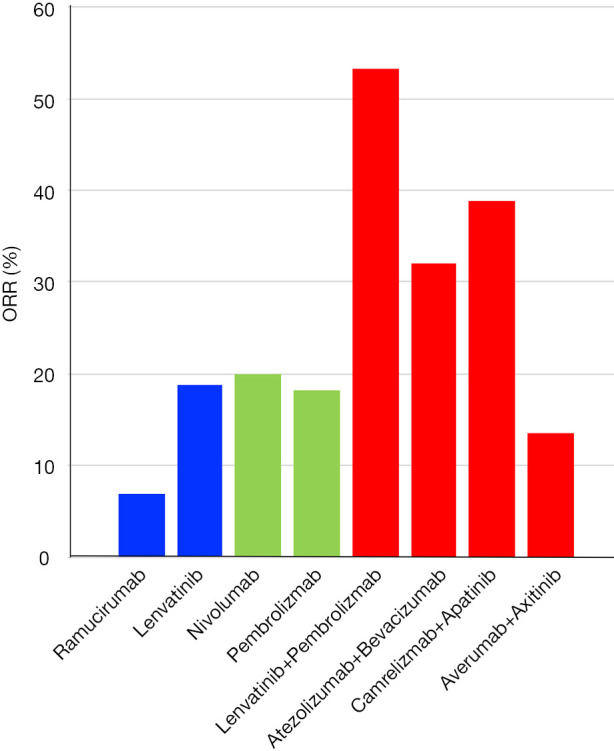
ORRs of anti-angiogenesis agent, anti-PD-1/PD-L1 monotherapies, and combination therapies. The blue bar indicates ORRs of anti-angiogenesis agent monotherapy. Similarly, the green bar shows ORRs of anti-PD-1/PD-L1 monotherapies, and the red bar shows those of combination therapies, respectively. ORR, objective response rate.
Comment on
-
Dual Programmed Death Receptor-1 and Vascular Endothelial Growth Factor Receptor-2 Blockade Promotes Vascular Normalization and Enhances Antitumor Immune Responses in Hepatocellular Carcinoma.Hepatology. 2020 Apr;71(4):1247-1261. doi: 10.1002/hep.30889. Epub 2019 Oct 14. Hepatology. 2020. PMID: 31378984 Free PMC article.
References
Publication types
LinkOut - more resources
Full Text Sources
Research Materials