


Cole Relaxation Frequency as a Prognostic Parameter for Breast Cancer
- PMID: 33163555
- PMCID: PMC7644131
- DOI: 10.17294/2330-0698.1794
Cole Relaxation Frequency as a Prognostic Parameter for Breast Cancer
Abstract
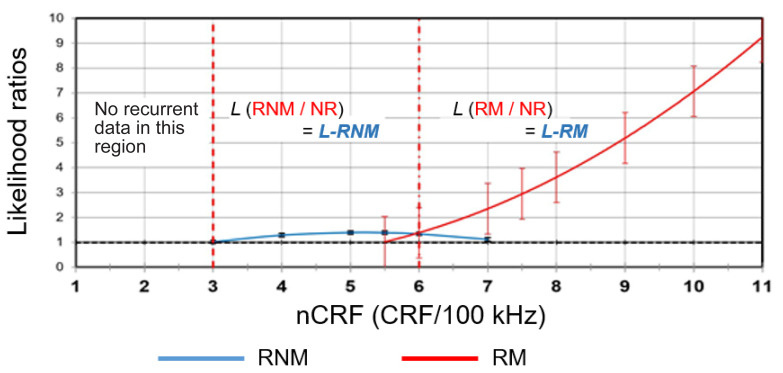
We previously reported successful classification of breast cancer versus benign tissue using the Cole relaxation frequency measured on tissue excised during breast surgery as part of a study at two urban hospitals in the U.S. Midwest. Using that health system's cancer registry, we have discovered retrospectively that outcomes for patients who participated in the initial study can be classified correctly in 3 well-differentiated categories: nonrecurrent (NR); recurrent with no metastasis (RNM); and recurrent with metastasis (RM). As Cole relaxation frequency increases, the classification moves from NR to RNM and finally to RM. Multivariate analysis showed a significant association of "time-cancer-free" for all patients in these recurrent categories, with P-values ranging between 0.0001 to 0.0047. Thus, this follow-up report shows the potential feasibility of using Cole relaxation frequency as a prognostic parameter in a larger prospective study.
Keywords: Cole relaxation frequency; bioelectrical impedance; breast cancer; prognosis; recurrence.
© 2020 Aurora Health Care, Inc.
Conflict of interest statement
Conflicts of Interest William Gregory and Shahila Mehboob Christie are employed at NovaScan, Inc., and Gregory and John Shell are stockholders in the company. NovaScan has patents pending on technology related to the research reported here. Advocate Aurora Health is a stockholder in NovaScan, but Wendy Mikkelson has no financial interest in the company. The remaining authors (Maharaj Singh and Georges Nahhas) have no conflicts of interest to report.
Figures

References
Grants and funding
LinkOut - more resources
Full Text Sources
Research Materials