


Inhibition of SARS-CoV-2 in Vero cell cultures by peptide-conjugated morpholino oligomers
- PMID: 33164048
- PMCID: PMC7717290
- DOI: 10.1093/jac/dkaa460
Inhibition of SARS-CoV-2 in Vero cell cultures by peptide-conjugated morpholino oligomers
Abstract
Background: As the causative agent of COVID-19, SARS-CoV-2 is a pathogen of immense importance to global public health. Development of innovative direct-acting antiviral agents is sorely needed to address this virus. Peptide-conjugated morpholino oligomers (PPMO) are antisense compounds composed of a phosphorodiamidate morpholino oligomer covalently conjugated to a cell-penetrating peptide. PPMO require no delivery assistance to enter cells and are able to reduce expression of targeted RNA through sequence-specific steric blocking.
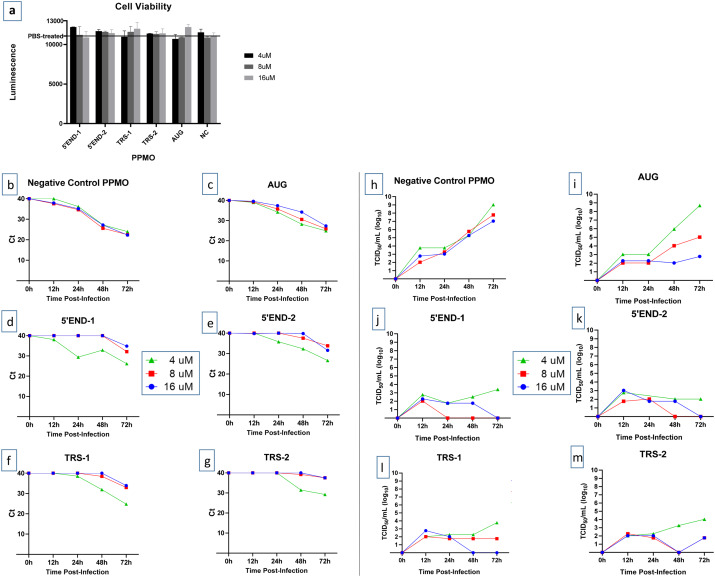
Methods: Five PPMO designed against sequences of genomic RNA in the SARS-CoV-2 5'-untranslated region and a negative control PPMO of random sequence were synthesized. Each PPMO was evaluated for its effect on the viability of uninfected cells and its inhibitory effect on the replication of SARS-CoV-2 in Vero-E6 cell cultures. Cell viability was evaluated with an ATP-based method using a 48 h PPMO treatment time. Viral growth was measured with quantitative RT-PCR and TCID50 infectivity assays from experiments where cells received a 5 h PPMO treatment time.
Results: PPMO designed to base-pair with sequence in the 5' terminal region or the leader transcription regulatory sequence region of SARS-CoV-2 genomic RNA were highly efficacious, reducing viral titres by up to 4-6 log10 in cell cultures at 48-72 h post-infection, in a non-toxic and dose-responsive manner.
Conclusions: The data indicate that PPMO have the ability to potently and specifically suppress SARS-CoV-2 growth and are promising candidates for further preclinical development.
© The Author(s) 2020. Published by Oxford University Press on behalf of the British Society for Antimicrobial Chemotherapy. All rights reserved. For permissions, please email: journals.permissions@oup.com.
Figures
Update of
-
Inhibition of SARS-CoV-2 in Vero cell cultures by peptide-conjugated morpholino-oligomers.bioRxiv [Preprint]. 2020 Sep 30:2020.09.29.319731. doi: 10.1101/2020.09.29.319731. bioRxiv. 2020. Update in: J Antimicrob Chemother. 2021 Jan 19;76(2):413-417. doi: 10.1093/jac/dkaa460. PMID: 33024974 Free PMC article. Updated. Preprint.
References
-
- Moulton HM, Moulton JD. Morpholinos and their peptide conjugates: therapeutic promise and challenge for Duchenne muscular dystrophy. Biochim Biophys Acta 2010; 1798: 2296–303. - PubMed
-
- Moulton HM, Moulton JD, Antisense morpholino oligomers and their peptide conjugates In: Kurreck J, ed. Therapeutic Oligonucleotides. Royal Society of Chemistry, 2008; 43–79.
-
- Abes S, Moulton HM, Clair P. et al. Vectorization of morpholino oligomers by the (R-Ahx-R)4 peptide allows efficient splicing correction in the absence of endosomolytic agents. J Control Release 2006; 116: 304–13. - PubMed
-
- Stein DA. Inhibition of RNA virus infections with peptide-conjugated morpholino oligomers. Curr Pharm Des 2008; 14: 2619–34. - PubMed
-
- Gabriel G, Nordmann A, Stein DA. et al. Morpholino oligomers targeting the PB1 and NP genes enhance the survival of mice infected with highly pathogenic influenza A H7N7 virus. J Gen Virol 2008; 89: 939–48. - PubMed
Publication types
MeSH terms
Substances
LinkOut - more resources
Full Text Sources
Other Literature Sources
Medical
Research Materials
Miscellaneous
