. 2021 Mar 1;28(3):487-493.
doi: 10.1093/jamia/ocaa241.

The emerging role of clinical informatics fellows in service learning during the COVID-19 pandemic

Affiliations

The emerging role of clinical informatics fellows in service learning during the COVID-19 pandemic

Meera Subash et al. J Am Med Inform Assoc. .

Abstract

Objective: The study sought to describe the contributions of clinical informatics (CI) fellows to their institutions' coronavirus disease 2019 (COVID-19) response.

Materials and methods: We designed a survey to capture key domains of health informatics and perceptions regarding fellows' application of their CI skills. We also conducted detailed interviews with select fellows and described their specific projects in a brief case series.

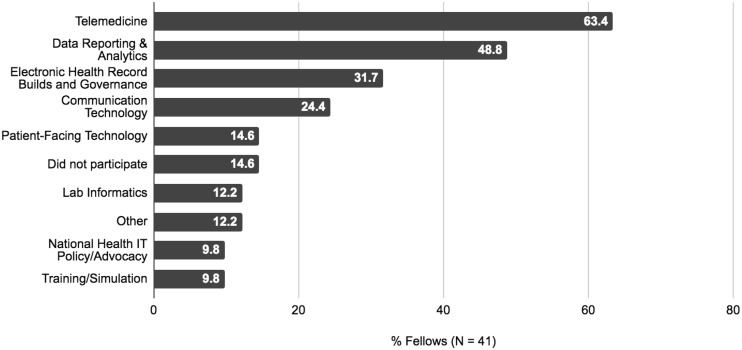
Results: Forty-one of the 99 CI fellows responded to our survey. Seventy-five percent agreed that they were "able to apply clinical informatics training and interest to the COVID-19 response." The most common project types were telemedicine (63%), reporting and analytics (49%), and electronic health record builds and governance (32%). Telehealth projects included training providers on existing telehealth tools, building entirely new virtual clinics for video triage of COVID-19 patients, and pioneering workflows and implementation of brand-new emergency department and inpatient video visit types. Analytics projects included reports and dashboards for institutional leadership, as well as developing digital contact tracing tools. For electronic health record builds, fellows directly contributed to note templates with embedded screening and testing guidance, adding COVID-19 tests to order sets, and validating clinical triage workflows.

Discussion: Fellows were engaged in projects that span the breadth of the CI specialty and were able to make system-wide contributions in line with their educational milestones.

Conclusions: CI fellows contributed meaningfully and rapidly to their institutions' response to the COVID-19 pandemic.

Keywords: clinical informatics; graduate medical education; medical informatics; questionnaires and surveys.


Figures

Figure 1.
Figure 1.
Fellows’ project types in their home institution’s COVID-19 (coronavirus disease 2019) response: multiple efforts by fellows were included. The majority of fellows (63%) were involved in telemedicine implementation at their institution, followed by data reporting and analytics (49%) and electronic health record builds and governance (32%). Examples of “other” included creating crisis management tools, helping with provider workflow management, and performing clinical work. IT: information technology.
Figure 2.
Figure 2.
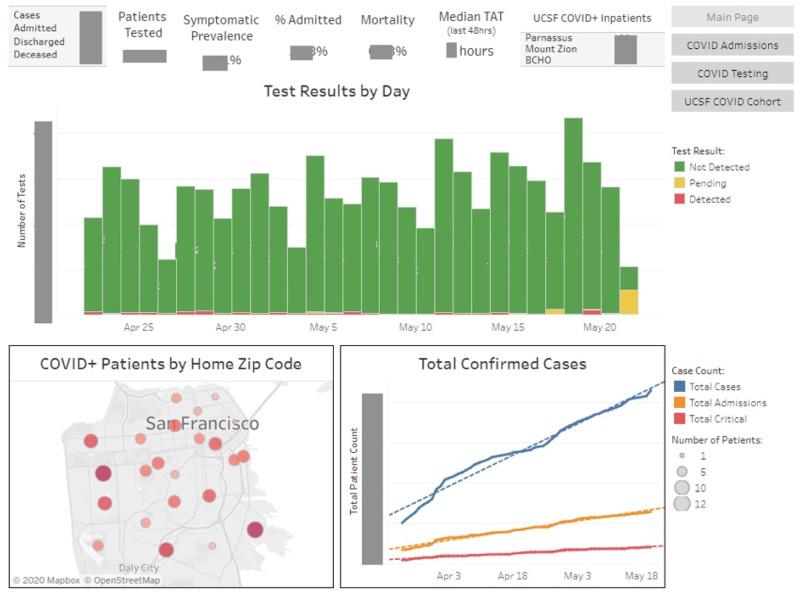
Hospital medicine dashboard for tracking test results, confirmed case numbers, and patient zip codes. Survey results indicated that 49% of clinical informatics fellows reported involvement in coronavirus disease 2019 (COVID-19)–related data reporting and analytics efforts at their home institutions. Data dashboards such as Figure 2 were created by fellows to assist with tracking of COVID-19 testing, new cases, hospitalizations, surgical case volume, and other valuable metrics.TAT: turnaround time; UCSF, University of California, San Francisco.
Figure 3.
Figure 3.
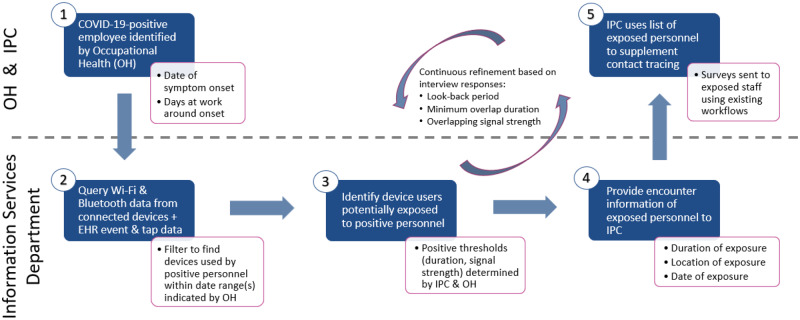
Workflow for digital contact tracing for coronavirus disease 2019 (COVID-19) using electronic health record (EHR) event data, Wi-Fi access logs, and Bluetooth data. Fellows identified “digital breadcrumbs” of interpersonal interactions to supplement their hospital’s contact tracing efforts in identifying staff with potential infectious exposures. IPC: infection prevention and control; OH, occupational health.
Figure 4.
Figure 4.
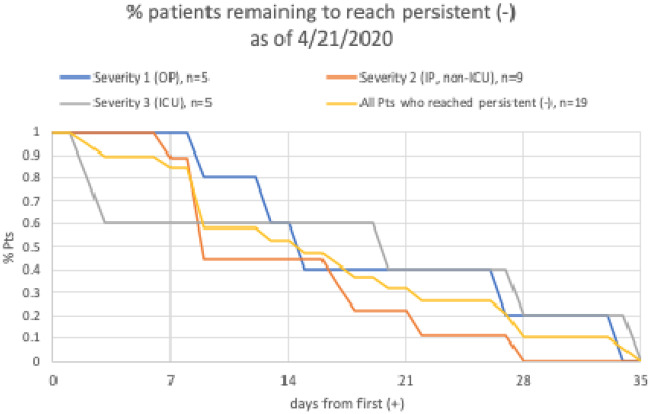
Sensitivity chart of polymerase chain reaction sample types, time to negative relative to encounter types. One clinical informatics fellow reported comparing the sensitivities of polymerase chain reaction sample types (eg, nasopharyngeal swab) and assessed the time to consistent negative results. ICU: intensive care unit; IP: inpatient; OP, outpatient.

Similar articles

Cited by

References

    1. Russell SW, Ahuja N, Patel A, et al.Peabody’s paradox: balancing patient care and medical education in a pandemic. J Grad Med Educ 2020; 12 (3): 264–8. doi : 10.4300/JGME-D-20-00251.1. - PMC - PubMed
    1. Geha R, Dhaliwal G.. Pilot virtual clerkship curriculum during a pandemic: podcasts, peers, and problem-solving. Med Educ 2020; 54 (9): 855–6. - PubMed

    1. Soled D, Goel S, Barry D, et al.Medical student mobilization during a crisis: lessons from a COVID-19 medical student response team. Acad Med 2020; 95 (9): 1384–7. doi: 10.1097/ACM.0000000000003401. - PMC - PubMed
    1. Almarzooq ZI, Lopes M, Kochar A.. Virtual learning during the COVID-19 pandemic: a disruptive technology in graduate medical education. J Am Coll Cardiol 2020; 75 (20): 2635–8. - PMC - PubMed
    1. Chick R, Clifton G, Peace K, et al.Using technology to maintain the education of residents during the COVID-19 pandemic. J Surg Educ 2020; 77 (4): 729–32. - PMC - PubMed