


Invasive pneumococcal disease in children with cancer: Incidence density, risk factors and isolated serotypes
- PMID: 33164827
- PMCID: PMC9392108
- DOI: 10.1016/j.bjid.2020.09.003
Invasive pneumococcal disease in children with cancer: Incidence density, risk factors and isolated serotypes
Abstract
Background: Pediatric oncology patients (POP) have a high risk of infections due to impaired immunity. Invasive pneumococcal disease (IPD) is an important cause of severe infection in these patients and it is associated with high mortality. This study aimed to evaluate the incidence and risk factors associated with IPD at a Pediatric Oncology Center in Brazil.
Methods: This was a retrospective case-control study. All IPD cases in children with cancer from 2005 through 2016 were reviewed. Each case of IPD was matched with two controls from a cohort of patients matched for year of IPD, age and disease in order to assess risk factors. The incidence density was calculated as the number of IPD per 100,000 patients-year.
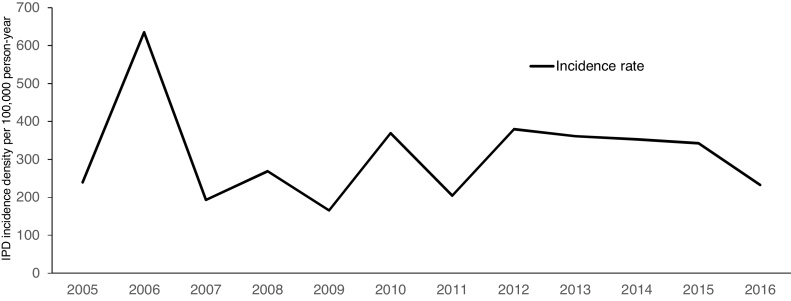
Results: A total of 51 episodes of IPD in 49 patients was identified. All pneumococci were isolated from blood cultures. The median age was five years and 67% were male; mortality rate was 7.8%. The IPD incidence density rate in POP was 311.21 per 100,000 patients-year, significantly higher than the rate in the general pediatric population. Severe neutropenia was the only risk factor associated with IPD, after multivariate conditional logistic regression analysis.
Conclusion: Although pneumococcal disease decreased after the introduction of 10-valent pneumococcal vaccine in the Brazilian national immunization schedule in 2010, there was no decrease in the IPD incidence rate in our cohort. A higher coverage rate of pneumococcal vaccination in children in the general population might be necessary to reduce the incidence rate in this high-risk population.
Keywords: Invasive pneumococcal disease; Pediatric cancer; Pneumococcal vaccines.
Copyright © 2020 Sociedade Brasileira de Infectologia. Published by Elsevier España, S.L.U. All rights reserved.
Figures
References
-
- Robinson K., Baughman W., Rothrock G., et al. Epidemiology of invasive Streptococcus pneumoniae infections in the United States, 1995-1998: opportunities for prevention in the conjugate vaccine era. JAMA. 2001;285:1729–1735. - PubMed
-
- Strasser-Weippl K., Chavarri-Guerra Y., Villarreal-Garza C., et al. Progress and remaining challenges for cancer control in Latin America and the Caribbean. Lancet Oncol. 2015;16:1405–1438. - PubMed
-
- Vento S., Cainelli F. Infections in patients with cancer undergoing chemotherapy: aetiology, prevention, and treatment. Lancet Oncol. 2003;4:595–604. - PubMed
MeSH terms
Substances
LinkOut - more resources
Full Text Sources
Medical
