doi: 10.1001/jamainternmed.2020.5333.
Implications of Early Health Care Spending Reductions for Expected Spending as the COVID-19 Pandemic Evolves
Affiliations
- PMID: 33165504
- PMCID: PMC7653535
- DOI: 10.1001/jamainternmed.2020.5333
Item in Clipboard
Implications of Early Health Care Spending Reductions for Expected Spending as the COVID-19 Pandemic Evolves
JAMA Intern Med.
.
Erratum in
-
Error in Author Order of the Byline.JAMA Intern Med. 2021 Jan 1;181(1):144. doi: 10.1001/jamainternmed.2020.7772. JAMA Intern Med. 2021. PMID: 33284313 Free PMC article. No abstract available.
Abstract
This cohort study examines how early spending changes vary by incidence of coronavirus disease 2019 and how implementation of policies to limit transmission affect health care spending as the pandemic evolves.
Conflict of interest statement
Figures
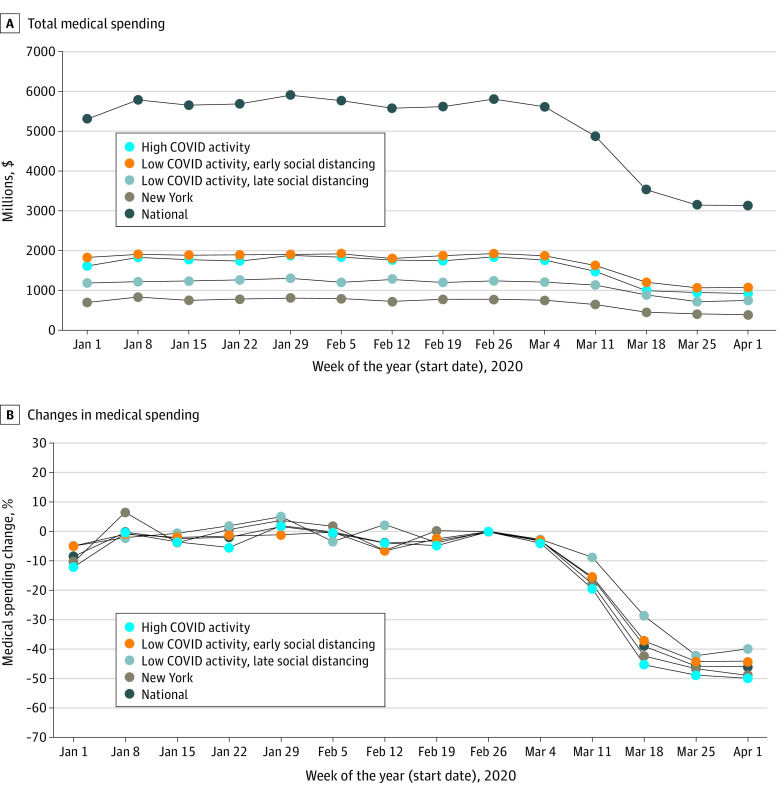
A, Total medical spending in dollars and (B) relative to week 9. High-activity refers to high cumulative incidence of confirmed COVID-19 cases by April 7, 2020. Early vs late social distancing refers to state order to stay at home, shelter in place, or close nonessential businesses before vs after April 1, 2020. Lower spending during the week of January 1, 2020, is consistent with overlap with a national holiday (utilization was consistently lower in 2019 during holiday weeks). COVID-19 indicates coronavirus disease 2019.
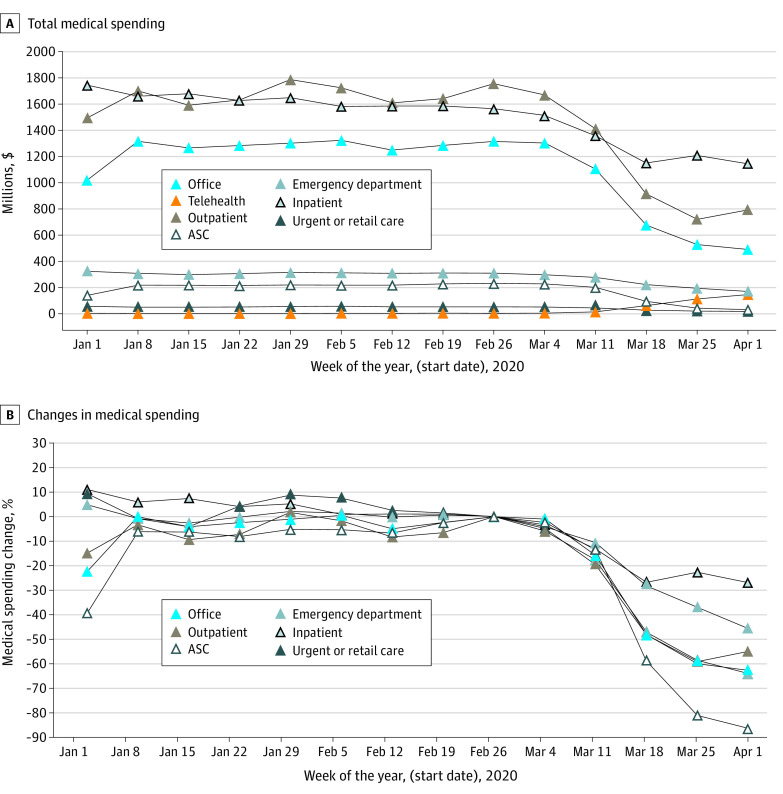
A, Aggregate medical spending in dollars and (B) spending relative to week 9. Weekly aggregate spending is displayed by type of care: acute inpatient, emergency department, ambulatory surgery center (ASC), outpatient care in hospital-owned facilities, outpatient care in office setting, telehealth, urgent care centers, and retail clinics. Post-acute spending is not displayed because it constituted a small proportion of spending for the predominantly non-elderly, commercially insured population. Enrollees aged 65 years or older accounted for approximately 16% of spending, as expected from the smaller share of the total Medicare population covered by FAIR Health data relative to the share of the commercially insured. The week of January 1, 2020, was lower for some spending categories owing to overlap with the holiday period. Telemedicine is not shown in panel B because the level of growth from week 9 exceeded 1000%.
Comment in
-
Socioeconomic Factors, Urological Epidemiology and Practice Patterns.J Urol. 2021 Aug;206(2):466-468. doi: 10.1097/JU.0000000000001862. Epub 2021 May 13. J Urol. 2021. PMID: 33983044 No abstract available.
References
-
- Raifman J, Nocka K. COVID-19 US State Policy Database. Boston University School of Public Health. Updated July 2, 2020. Accessed July 9, 2020. https://docs.google.com/spreadsheets/d/1zu9qEWI8PsOI_i8nI_S29HDGHlIp2lfV...
-
- New ICD-10-CM code for the 2019 Novel Coronavirus (COVID-19). Centers for Disease Control and Prevention. Updated April 1, 2020. Accessed July 9, 2020. https://www.cdc.gov/nchs/data/icd/Announcement-New-ICD-code-for-coronavi...
-
- Healthcare Facilities: Managing Operations During the COVID-19 Pandemic. Centers for Disease Control and Prevention. Updated June 28, 2020. Accessed July 9, 2020. https://www.cdc.gov/coronavirus/2019-ncov/hcp/guidance-hcf.html
-
- Mehrotra A, Chernew ME, Linetsky D, Hatch H, Cutler D The Impact of the COVID-19 Pandemic on Outpatient Visits: Practices Are Adapting to the New Normal. The Commonwealth Fund. Updated June 25, 2020. Accessed July 9, 2020. https://www.commonwealthfund.org/publications/2020/jun/impact-covid-19-p...
-
- Dafny LS, McWilliams JM Primary Care Is Hurting: Why Aren’t Private Insurers Pitching In? Health Affairs Blog. Updated May 21, 2020. Accessed July 9, 2020. https://www.healthaffairs.org/do/10.1377/hblog20200519.916904/full/ - DOI
MeSH terms
LinkOut - more resources
Full Text Sources
Other Literature Sources
Medical