


Quality of life among patients seeking treatment for substance use disorder, as measured with the EQ-5D-3L
- PMID: 33165764
- PMCID: PMC7652980
- DOI: 10.1186/s41687-020-00247-0
Quality of life among patients seeking treatment for substance use disorder, as measured with the EQ-5D-3L
Abstract
Purpose: There is a need to assess the quality of treatment for Substance Use Disorder (SUD), and document SUD patients' health-related quality of life (HRQoL). The study aims to describe Norwegian SUD patients' HRQoL as measured by EQ-5D, compared to a general population sample, and discuss the potential usefulness of the EQ-5D to monitor HRQoL for SUD patients.
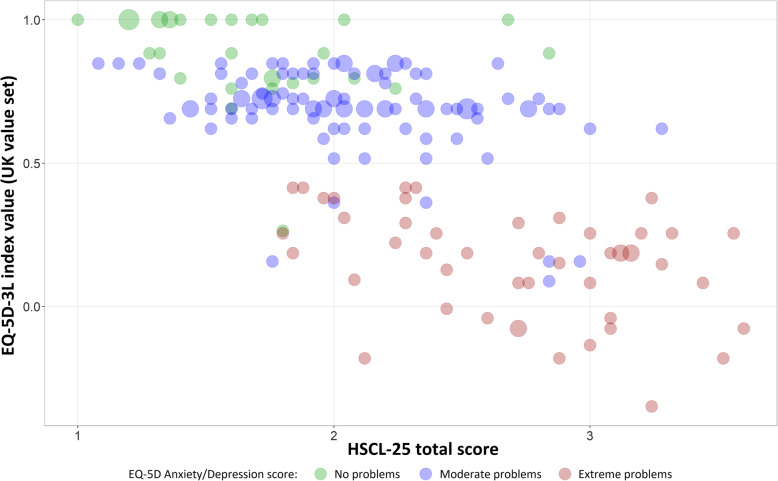
Methods: One hundred seventy eight SUD patients (66.3% male) were administered the EQ-5D-3L at treatment start. Patients and general population samples were compared in terms of reported EQ-5D-3L health states, problems by dimension, UK index values, and EQ VAS scores. We investigated specific drug dependence, mental health disorders, sex, age, and education as predictors of EQ-5D-3L values and EQ VAS scores. Anxiety/depression dimension scores were compared to Hopkins symptom Checklist (HSCL-25) scores.
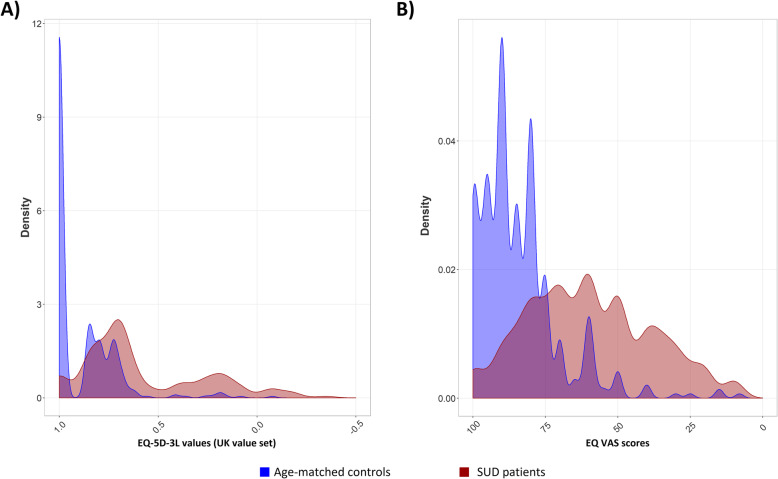
Results: 91.6% of the patient sample reported problems on the EQ-5D-3L, with 29.8% reporting extreme problem, compared to 39.8% and 3.0% in the general population sample. Mean index (EQ VAS) score among SUD patients was .59 (59.9) compared to .90 (84.1) in the general population. Regression analyses identified phobic anxiety and cocaine dependence as statistically significant predictors of higher EQ-5D-3L index scores.
Conclusion: SUD patients report substantially reduced HRQoL, as measured using the EQ-5D-3L. The most frequently reported problems were for the anxiety/depression, pain/discomfort, and usual activities dimensions. The EQ-5D may be a useful and practical instrument for monitoring HRQoL in SUD patients.
Keywords: Drug addiction; EQ-5D; HRQoL; SUD; Substance use disorder.
Conflict of interest statement
KR is a member of the EuroQol Group, a not-for-profit research foundation which develops, owns, and licenses the EQ-5D. The EuroQol Group has no involvement with the study beyond funding. No other competing interests.
Figures
References
-
- National Collaborating Centre for Mental Health . Drug misuse:-psychosocial interventions (NICE clinical guidelines CG51) London: National Institute of Health and Care Excellence; 2007. - PubMed
-
- Walderhaug, E., Seim-Wikse, K. J., Enger, A., & Milin, O. (2019). Polydrug use – Prevalence and registration. Tidsskrift for Den norske legeforening. 10.4045/tidsskr.19.0251. - PubMed
Grants and funding
LinkOut - more resources
Full Text Sources
