. 2020 Nov 9;16(11):e1009121.
doi: 10.1371/journal.pgen.1009121. eCollection 2020 Nov.

A frog with three sex chromosomes that co-mingle together in nature: Xenopus tropicalis has a degenerate W and a Y that evolved from a Z chromosome

Affiliations

A frog with three sex chromosomes that co-mingle together in nature: Xenopus tropicalis has a degenerate W and a Y that evolved from a Z chromosome

Benjamin L S Furman et al. PLoS Genet. .

Abstract

In many species, sexual differentiation is a vital prelude to reproduction, and disruption of this process can have severe fitness effects, including sterility. It is thus interesting that genetic systems governing sexual differentiation vary among-and even within-species. To understand these systems more, we investigated a rare example of a frog with three sex chromosomes: the Western clawed frog, Xenopus tropicalis. We demonstrate that natural populations from the western and eastern edges of Ghana have a young Y chromosome, and that a male-determining factor on this Y chromosome is in a very similar genomic location as a previously known female-determining factor on the W chromosome. Nucleotide polymorphism of expressed transcripts suggests genetic degeneration on the W chromosome, emergence of a new Y chromosome from an ancestral Z chromosome, and natural co-mingling of the W, Z, and Y chromosomes in the same population. Compared to the rest of the genome, a small sex-associated portion of the sex chromosomes has a 50-fold enrichment of transcripts with male-biased expression during early gonadal differentiation. Additionally, X. tropicalis has sex-differences in the rates and genomic locations of recombination events during gametogenesis that are similar to at least two other Xenopus species, which suggests that sex differences in recombination are genus-wide. These findings are consistent with theoretical expectations associated with recombination suppression on sex chromosomes, demonstrate that several characteristics of old and established sex chromosomes (e.g., nucleotide divergence, sex biased expression) can arise well before sex chromosomes become cytogenetically distinguished, and show how these characteristics can have lingering consequences that are carried forward through sex chromosome turnovers.


Conflict of interest statement

The authors have declared that no competing interests exist.

Figures
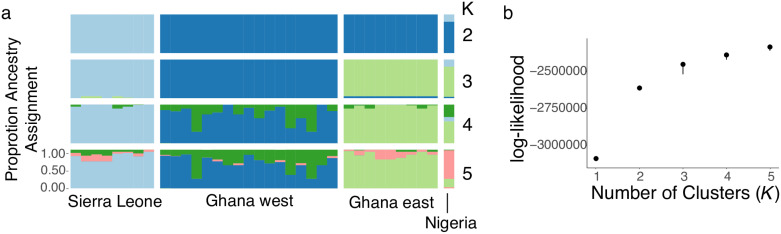
Fig 1
Fig 1. Genetic cluster analysis of RRGS data illustrates geographic structure of wild X. tropicalis.
(a) Ancestry assignments of individual samples for 2–5 populations (K). (b) log-likelihood of values of K from 1–5.
Fig 2
Fig 2
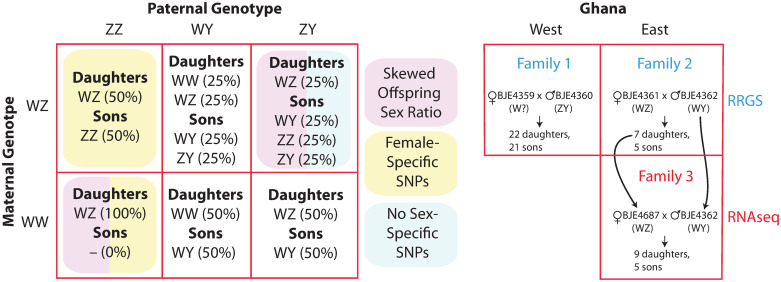
The three sex chromosomes of X. tropicalis can be crossed in six ways to produce offspring with different types of sex-linkage and/or skewed offspring sex ratios (left). Crosses on the left that are not shaded are expected to have male-specific SNPs passed from father to all sons in the male-specific portion of the Y chromosome. We generated three laboratory families from west and east Ghana for RRGS and RNAseq analyses (right). For the RNAseq analysis (Family 3), offspring were analyzed from a cross between the father and a daughter from Family 2 (indicated with arrows). On the right, putative sex chromosome genotypes described in main text are in parentheses with a question mark indicating either a W or a Z chromosome.
Fig 3
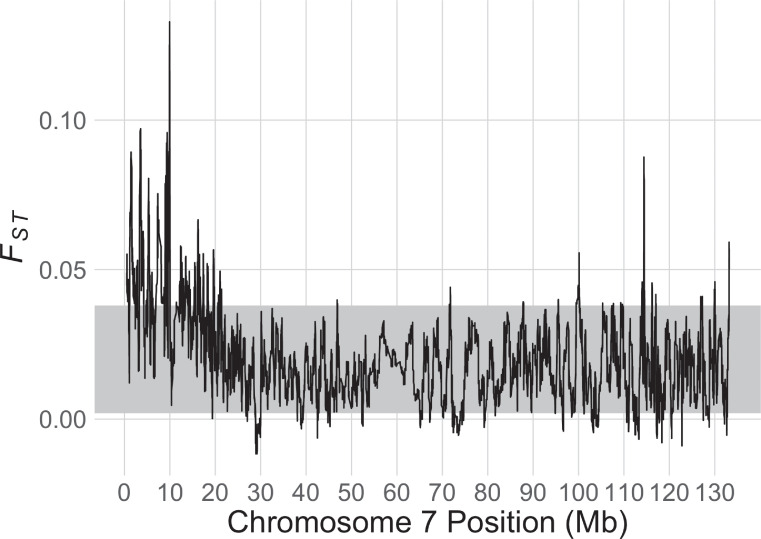
Fig 3. FST between females and males for X. tropicalis chromosome 7 of wild samples from Ghana, and georeferenced lab strains from Nigeria and Sierra Leone.
The grey band represents the whole genome bootstrap confidence intervals for the mean FST that were generated by resampling FST measured on the autosomes.
Fig 4
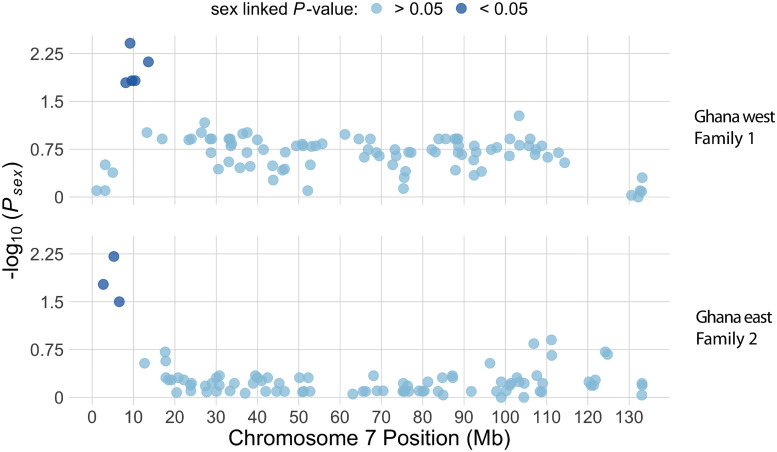
Fig 4. Manhattan plot of association between genotype and sex phenotype for chromosome 7 in Family 1 from Ghana west (top) and Family 2 from Ghana east (bottom) for paternal heterozygous sites.
For both families, light dots indicate variants that are not significantly associated with sex, and dark dots indicate significant associations with sex after FDR correction (top) or before FDR correction (bottom). As discussed in the main text, we did not apply FDR correction for Family 2 due to a smaller dataset.
Fig 5
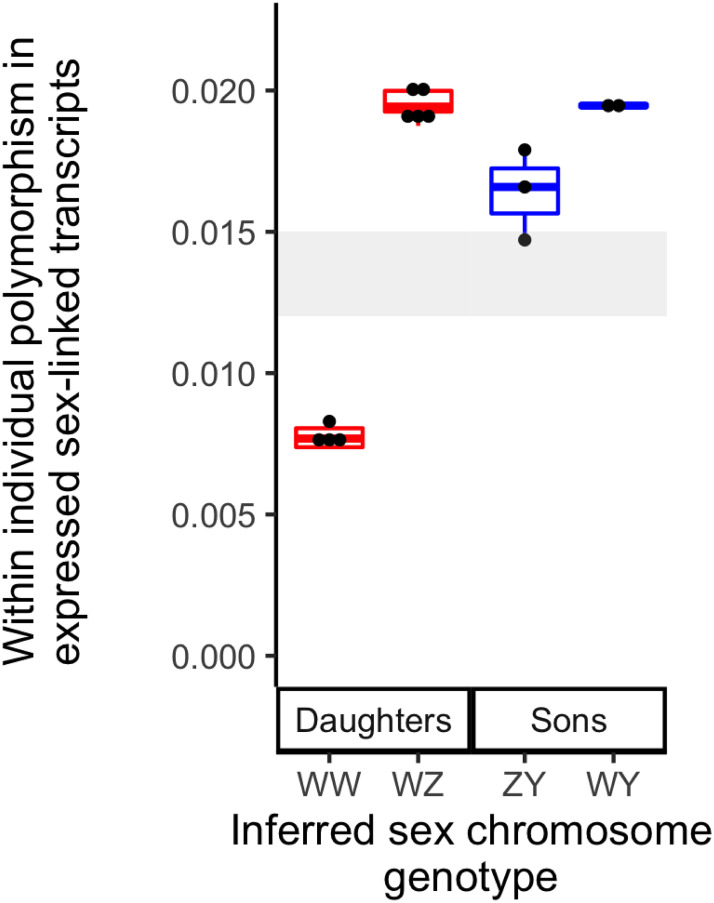
Fig 5. In daughters and sons of Family 3, two distinct levels of within individual polymorphism in expressed sex-linked transcripts imply that there are two distinct sex chromosome genotypes in offspring of each sex.
Inferred sex chromosome genotypes (x-axis) are based on within individual polymorphism of expressed sex-linked transcripts (y-axis). The range of pairwise nucleotide diversity for non-sex-linked transcripts in the 14 individuals for which RNAseq was performed is depicted in gray.
Fig 6
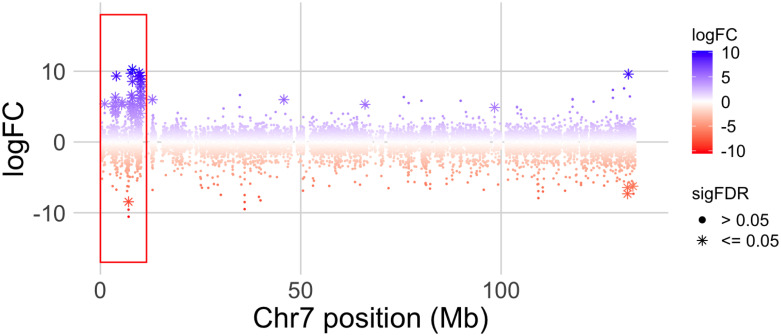
Fig 6. Log2 transformed male/female transcript expression ratio (logFC) along X. tropicalis chromosome 7 in offspring of Family 3.
The x-axis indicates the genomic coordinates in millions of base pairs (Mb). Small dots represent individual transcripts and * represent transcripts that are significantly differentially expressed after FDR correction (sigFDR). Positive values reflect male biased expression, negative values are female biased. A red box highlights a cluster of genes on the sex-linked portion of chromosome 7 with mostly male-biased expression.
Fig 7
Fig 7
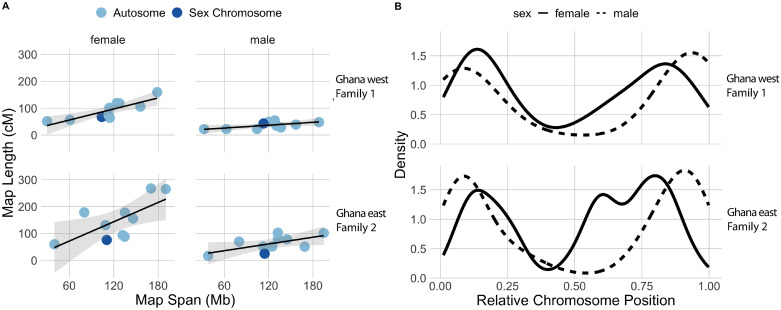
A) Linkage map length in centimorgans (cM) is positively correlated with the length of the genomic region in millions of base pairs (Mb) in females (left) but not in males (right) from Family 1 and Family 2 (top and bottom rows, respectively). B) Crossover density is more strongly biased towards chromosome tips in males than females in Family 1 and Family 2.

References

    1. Bachtrog D, Mank JE, Peichel CL, Kirkpatrick M, Otto SP, Ashman TL, et al. Sex determination: Why so many ways of doing it? PLoS Biology. 2014;12(7):e1001899 10.1371/journal.pbio.1001899 - DOI - PMC - PubMed
    1. Lahn BT, Page DC. Four evolutionary strata on the human X chromosome. Science. 1999;286(5441):964–967. 10.1126/science.286.5441.964 - DOI - PubMed
    1. Zhou Q, Zhang J, Bachtrog D, An N, Huang Q, Jarvis ED, et al. Complex evolutionary trajectories of sex chromosomes across bird taxa. Science. 2014;346(6215):1246338 10.1126/science.1246338 - DOI - PMC - PubMed
    1. Matsubara K, Tarui H, Toriba M, Yamada K, Nishida-Umehara C, Agata K, et al. Evidence for different origin of sex chromosomes in snakes, birds, and mammals and step-wise differentiation of snake sex chromosomes. Proceedings of the National Academy of Sciences. 2006;103(48):18190–18195. 10.1073/pnas.0605274103 - DOI - PMC - PubMed
    1. Bachtrog D. Y-chromosome evolution: Emerging insights into processes of Y-chromosome degeneration. Nature Reviews Genetics. 2013;14(2):113–124. 10.1038/nrg3366 - DOI - PMC - PubMed

Publication types