


Human mobility trends during the early stage of the COVID-19 pandemic in the United States
- PMID: 33166301
- PMCID: PMC7652287
- DOI: 10.1371/journal.pone.0241468
Human mobility trends during the early stage of the COVID-19 pandemic in the United States
Abstract
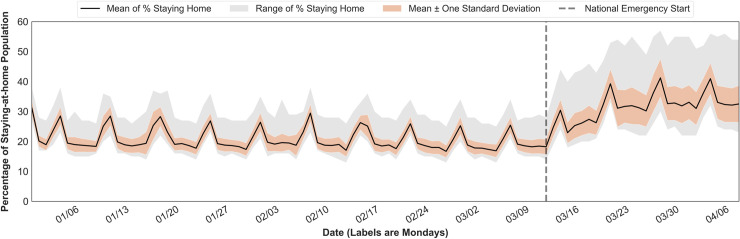
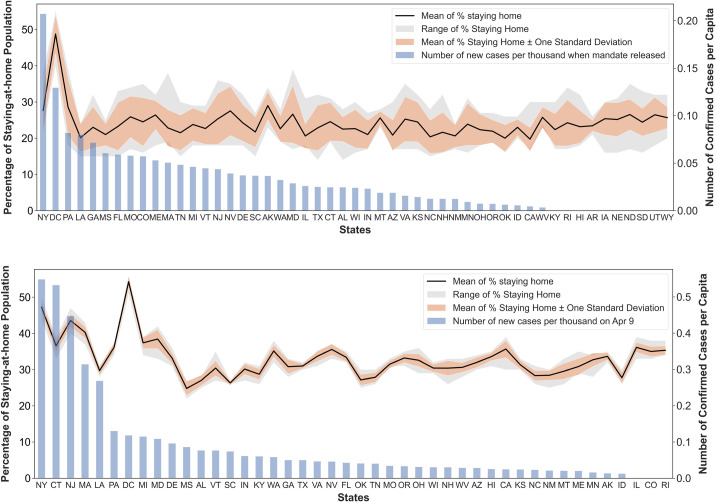
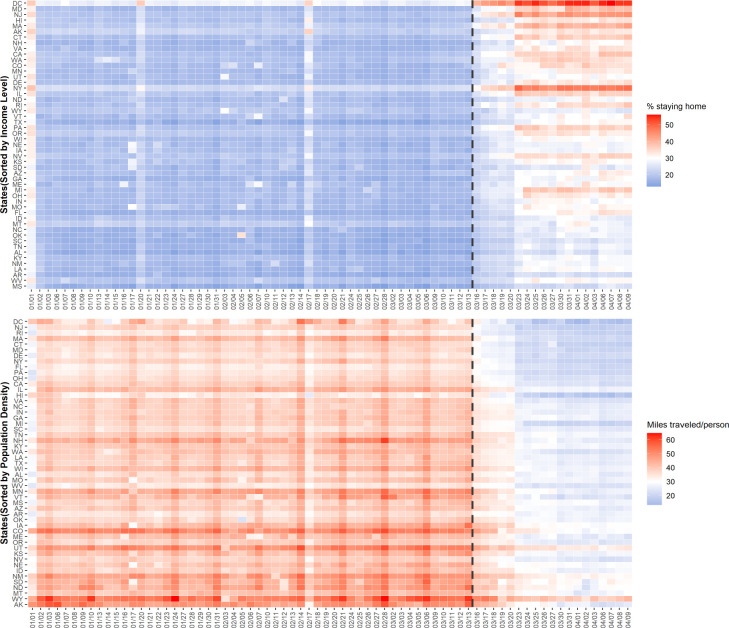
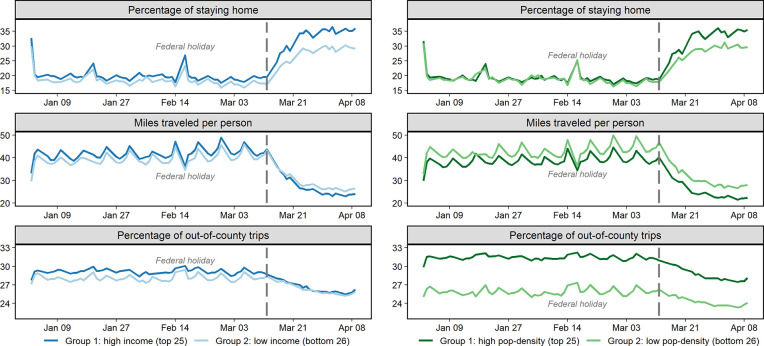
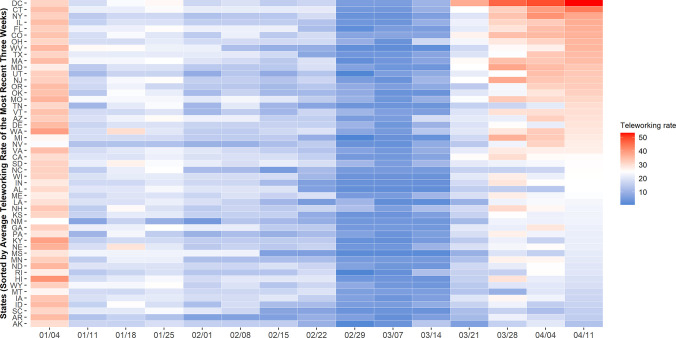
In March of this year, COVID-19 was declared a pandemic, and it continues to threaten public health. This global health crisis imposes limitations on daily movements, which have deteriorated every sector in our society. Understanding public reactions to the virus and the non-pharmaceutical interventions should be of great help to fight COVID-19 in a strategic way. We aim to provide tangible evidence of the human mobility trends by comparing the day-by-day variations across the U.S. from January 2020 to early April 2020. Large-scale public mobility at an aggregated level is observed by leveraging mobile device location data and the measures related to social distancing. Our study captures spatial and temporal heterogeneity as well as the sociodemographic variations and teleworking trends regarding the pandemic propagation and the non-pharmaceutical mobility interventions. All metrics adapted capture decreased public movements after the national emergency declaration. The population staying home has increased in all states before the stay-at-home mandates implemented and becomes more stable after the order with a smaller range of fluctuation. The public had been taking active responses, voluntarily staying home more, to the in-state confirmed cases while the stay-at-home orders stabilize the variations. As the estimated teleworking rates also continue to incline throughout the study period, the teleworking trend can be another driving factor for the growing stay-at-home population. We confirm that there exists overall mobility heterogeneity between the income or population density groups. The study suggests that public mobility trends are in line with the government message urging to stay home. We anticipate our data-driven analysis offers integrated perspectives and serves as evidence to raise public awareness and, consequently, reinforce the importance of social distancing while assisting policymakers.
Conflict of interest statement
The authors have declared that no competing interests exist.
Figures
References
-
- COVID-19 Dashboard [Internet]. The Center for Systems Science and Engineering at Johns Hopkins University. [Cited 2020 March 30]. Available from: https://www.arcgis.com/apps/opsdashboard/index.html#/bda7594740fd4029942...
-
- Liu Q, Liu Z, Zhu J, Zhu Y, Li D, Gao Z, et al. Assessing the global tendency of COVID-19 outbreak. medRxiv [Preprint]. 2020. [posted 2020 Mar 20; revised 2020 Mar 29; revised 2020 Apr 7; cited 2020 Apr 15]: [21 p.]. Available from: https://www.medrxiv.org/content/10.1101/2020.03.18.20038224v3 - DOI
Publication types
MeSH terms
LinkOut - more resources
Full Text Sources
Research Materials
Miscellaneous
