


Disorder-specific brain volumetric abnormalities in Attention-Deficit/Hyperactivity Disorder relative to Autism Spectrum Disorder
- PMID: 33166335
- PMCID: PMC7652272
- DOI: 10.1371/journal.pone.0241856
Disorder-specific brain volumetric abnormalities in Attention-Deficit/Hyperactivity Disorder relative to Autism Spectrum Disorder
Abstract
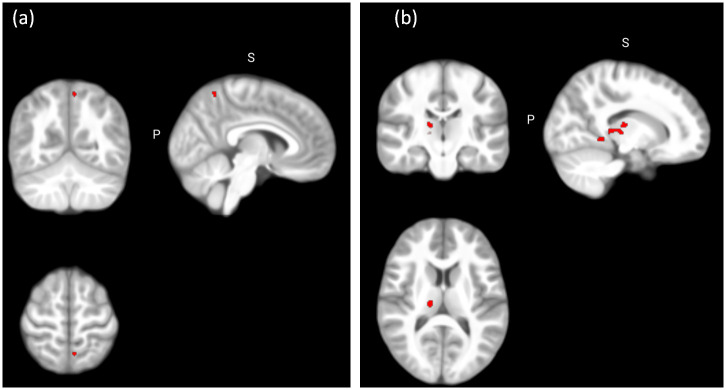
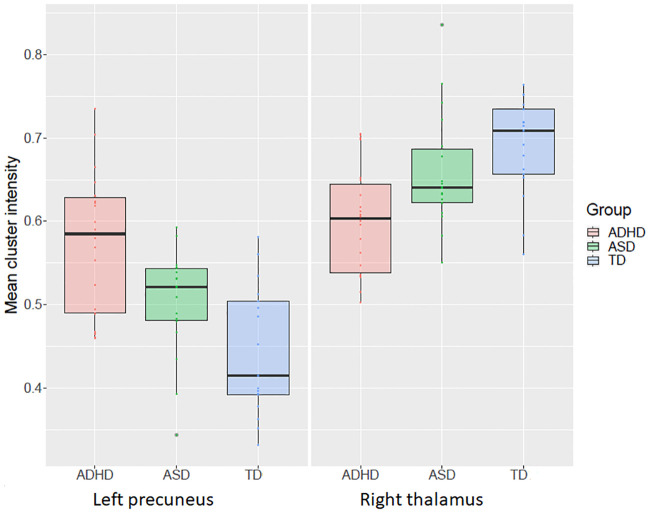
The overlap/distinctiveness between Attention-Deficit/Hyperactivity Disorder (ADHD) and Autism Spectrum Disorder (ASD) has been increasingly investigated in recent years, particularly since the DSM-5 allows the dual diagnosis of ASD and ADHD, but the underlying brain mechanisms remain unclear. Although both disorders are associated with brain volumetric abnormalities, it is necessary to unfold the shared and specific volume abnormalities that could contribute to explain the similarities and differences in the clinical and neurocognitive profiles between ADHD and ASD. In this voxel-based morphometry (VBM) study, regional grey matter volumes (GMV) were compared between 22 children with ADHD, 18 children with ASD and 17 typically developing (TD) children aged 8 to 12 years old, controlling for age and total intracranial volume. When compared to TD children or children with ASD, children with ADHD had a larger left precuneus, and a smaller right thalamus, suggesting that these brain abnormalities are specific to ADHD relative to ASD. Overall, this study contributes to the delineation of disorder-specific structural abnormalities in ADHD and ASD.
Conflict of interest statement
Isabelle Massat received an investigator-initiated research grant from Shire Pharmaceutical Development Limited, a member of the Takeda group of companies (Study ID: IST-BEL- 00520). This does not alter our adherence to PLOS ONE policies on sharing data and materials. Ariadna Albajara Sáenz is supported by a grant from the Belgian Kids’ Fund (www.belgiankidsfund.be), the David et Alice Van Buuren Fund and by the Fondation Jaumotte-Demoulin. Isabelle Massat and Ariadna Albajara Sáenz are supported by the Fonds National de la Recherche Scientifique (FNRS)-Belgium and the Fonds Erasme. The funders had no role in the study design, the data collection and analysis, the decision to publish, or the preparation of the manuscript.
Figures
References
-
- American Psychiatric Association. Diagnostic and statistical manual of mental disorders (5th ed). Arlington, VA: Author; 2013.
-
- Antshel KM, Russo N. Autism Spectrum Disorders and ADHD: Overlapping Phenomenology, Diagnostic Issues, and Treatment Considerations. Curr Psychiatry Rep. 2019;21(5). - PubMed
