


Systematic Review: Assessment of Sluggish Cognitive Tempo Over the Past Decade
- PMID: 33166623
- PMCID: PMC8099929
- DOI: 10.1016/j.jaac.2020.10.016
Systematic Review: Assessment of Sluggish Cognitive Tempo Over the Past Decade
Abstract
Objective: To conduct a systematic review of the measures designed to assess sluggish cognitive tempo (SCT) since the first SCT scale using careful test-construction procedures was published in 2009.
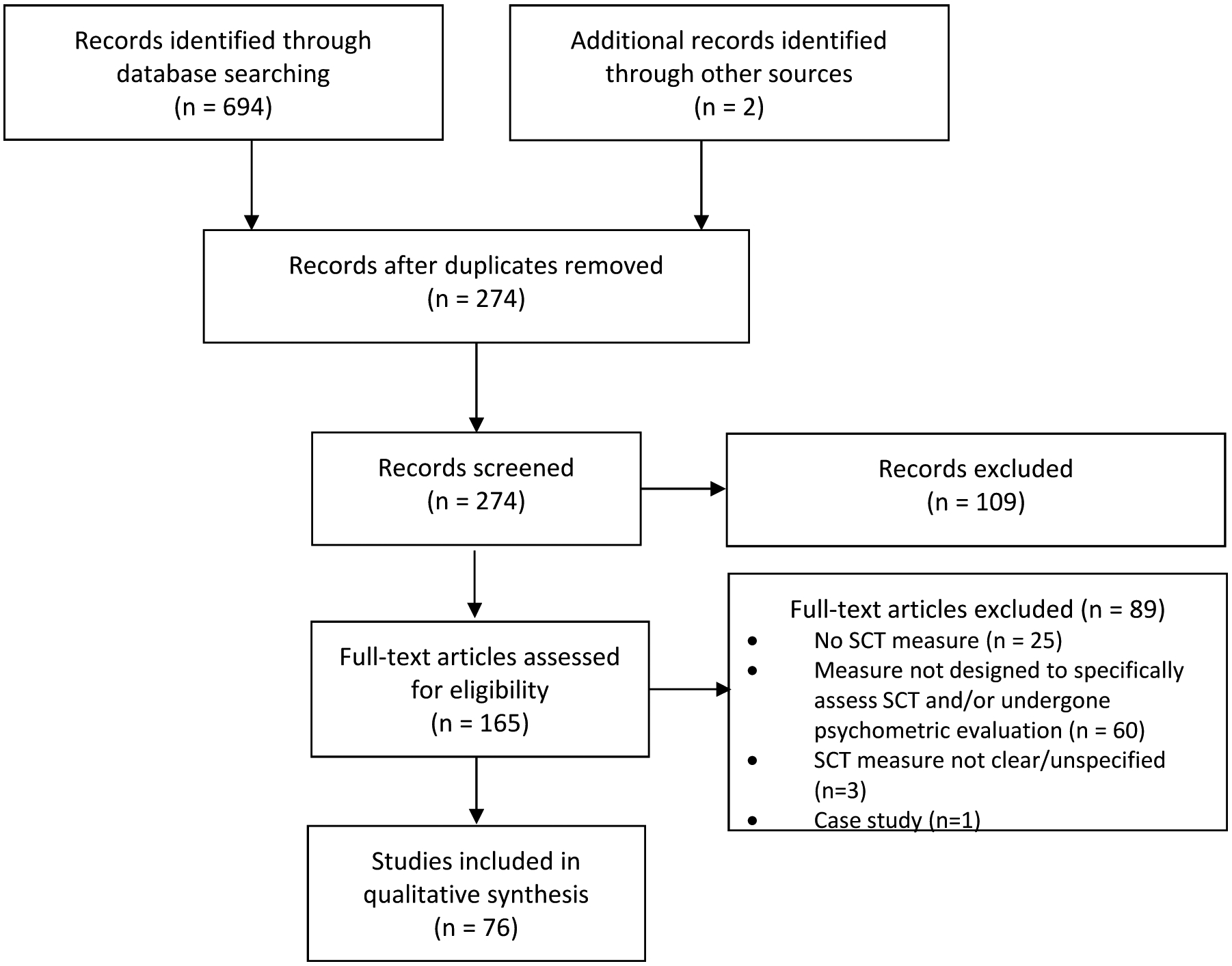
Method: MEDLINE (PubMed), Embase, PsychINFO, and Web of Science databases were searched from September 2009 through December 2019. Articles reporting on reliability (internal consistency, test-retest, and interrater reliability), structural validity (an aspect of construct validity focused on items' convergent and discriminant validity), concurrent and longitudinal external validity, invariance, or intervention/experimental findings were included.
Results: Full criteria for data extraction and inclusion were met by 76 studies. Nine measures for assessing SCT were identified (7 assessing parent report, teacher report, and/or self-report in children and 2 assessing self-report and/or collateral informant report in adults). Each measure demonstrated acceptable to excellent reliability. All or at least the majority of SCT items on each measure also had structural validity (high loadings on an SCT factor and low loadings on an attention-deficit/hyperactivity disorder [ADHD] inattention factor). Studies have supported the invariance of SCT across sex and time, and there is initial evidence of invariance across informants, youths with ADHD and youths without ADHD, and ADHD presentations. The Child and Adolescent Behavior Inventory (CABI), Child Concentration Inventory, Second Edition (CCI-2), and Barkley Adult ADHD Rating Scale-IV (BAARS-IV) have particularly strong support for assessing parent/teacher-reported, youth self-reported, and adult self-reported SCT, respectively.
Conclusion: The SCT measures included in this review share numerous positive properties, have promising psychometric support, and have proven useful for examining the external correlates of SCT across the life span. Although substantial progress has been made over the last decade, work remains to be done to further improve the assessment of SCT and key directions for future research are provided.
Keywords: attention-deficit/hyperactivity disorder; measurement; psychopathology; sluggish cognitive tempo; systematic review.
Copyright © 2020 American Academy of Child and Adolescent Psychiatry. Published by Elsevier Inc. All rights reserved.
Comment in
-
Editorial: A Review of Sluggish Cognitive Tempo Measures That Will Benefit Researchers and Clinicians.J Am Acad Child Adolesc Psychiatry. 2021 Jun;60(6):678-679. doi: 10.1016/j.jaac.2021.01.007. Epub 2021 Jan 20. J Am Acad Child Adolesc Psychiatry. 2021. PMID: 33484792
References
-
- Becker SP, Marshall SA, McBurnett K. Sluggish cognitive tempo in abnormal child psychology: an historical overview and introduction to the special section. J Abnorm Child Psychol. 2014;42:1–6. - PubMed
-
- Milich R, Balentine AC, Lynam DR. ADHD combined type and ADHD predominantly inattentive type are distinct and unrelated disorders. Clinical Psychology-Science and Practice. 2001;8:463–488.
-
- Todd RD, Rasmussen ER, Wood C, Levy F, Hay DA. Should sluggish cognitive tempo symptoms be included in the diagnosis of attention-deficit/hyperactivity disorder? J Am Acad Child Adolesc Psychiatry. 2004;43:588–597. - PubMed
-
- Harrington KM, Waldman ID. Evaluating the utility of sluggish cognitive tempo in discriminating among DSM-IV ADHD subtypes. J Abnorm Child Psychol. 2010;38:173–184. - PubMed
Publication types
MeSH terms
Grants and funding
LinkOut - more resources
Full Text Sources
Other Literature Sources
Medical
Miscellaneous
