Review
. 2020 Nov 5;21(21):8290.
doi: 10.3390/ijms21218290.

An Overview of the Main Genetic, Epigenetic and Environmental Factors Involved in Autism Spectrum Disorder Focusing on Synaptic Activity

Affiliations
Review

An Overview of the Main Genetic, Epigenetic and Environmental Factors Involved in Autism Spectrum Disorder Focusing on Synaptic Activity

Elena Masini et al. Int J Mol Sci. .

Abstract

Autism spectrum disorder (ASD) is a neurodevelopmental disorder that affects social interaction and communication, with restricted interests, activity and behaviors. ASD is highly familial, indicating that genetic background strongly contributes to the development of this condition. However, only a fraction of the total number of genes thought to be associated with the condition have been discovered. Moreover, other factors may play an important role in ASD onset. In fact, it has been shown that parental conditions and in utero and perinatal factors may contribute to ASD etiology. More recently, epigenetic changes, including DNA methylation and micro RNA alterations, have been associated with ASD and proposed as potential biomarkers. This review aims to provide a summary of the literature regarding ASD candidate genes, mainly focusing on synapse formation and functionality and relevant epigenetic and environmental aspects acting in concert to determine ASD onset.

Keywords: ASD; CNV; SNP; autism spectrum disorder; environmental factors; epigenetic factors; gene fusion; genetic factors; pervasive developmental disorder; post-synaptic density.


Conflict of interest statement

The authors declare no conflict of interest.

Figures
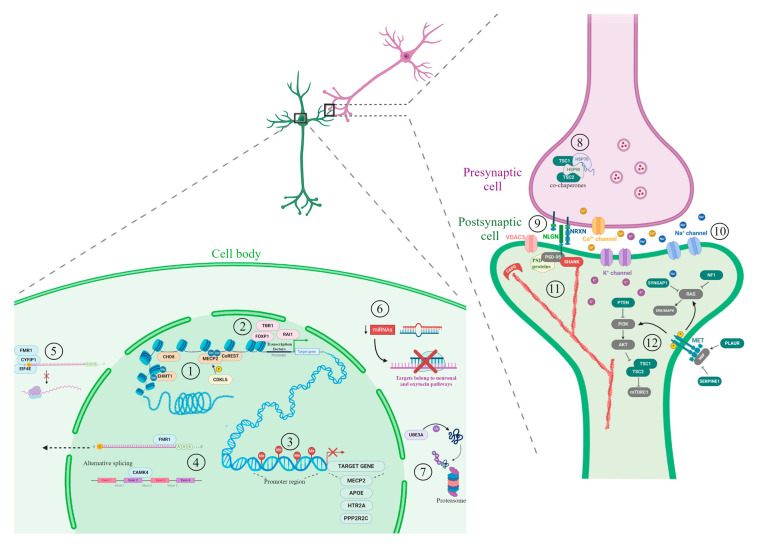
Figure 1
Figure 1
Candidate genes and epigenetic factors representative of the main processes involved in autism spectrum disorder (ASD) development. The illustration shows a synapse between neurons (presynaptic cell in violet and postsynaptic cell in green). On the bottom-left, a cell body of a neuron including different nuclear and cytoplasmic mechanisms involved in ASD. In the nucleus, several processes implicated in gene expression regulation are shown: (1) chromatin packaging and factors involved in chromatin remodeling; (2) gene transcription regulated by transcription factors; (3) DNA methylation at promoter region associated with transcription inhibition of target genes; (4) alternative splicing and mRNA export to the cytoplasm. In the cytoplasm, the following mechanisms are shown: (5) regulation of protein translation by the CYFIP1-EIF4E-FMR1 complex; (6) post-transcriptional regulation by miRNA; (7) protein ubiquitination and degradation by proteasome. On the right, the synapse architecture and functionality mechanisms associated with ASD. In the presynaptic cell, (8) TSC proteins and co-chaperons. (9) The neurexin/neuroligin transsynaptic complex and (10) the voltage-gated ion channels are represented. In the postsynaptic cell, (11) actin filaments, capping proteins and scaffold proteins; (12) some members of PI3K/AKT pathway, RAS signal transduction pathway and MET receptor tyrosine kinase pathway. Chromatin remodelers are indicated in beige, transcription factors in pink, proteins involved in RNA binding and export in light blue, protein ubiquitination in purple, scaffold proteins in red, cell growth and proliferation proteins in green and their related pathway members in grey. A more comprehensive list of ASD candidate genes can be found in Table 1 and along the text. Figure created using BioRender.com images.
Figure 2
Figure 2
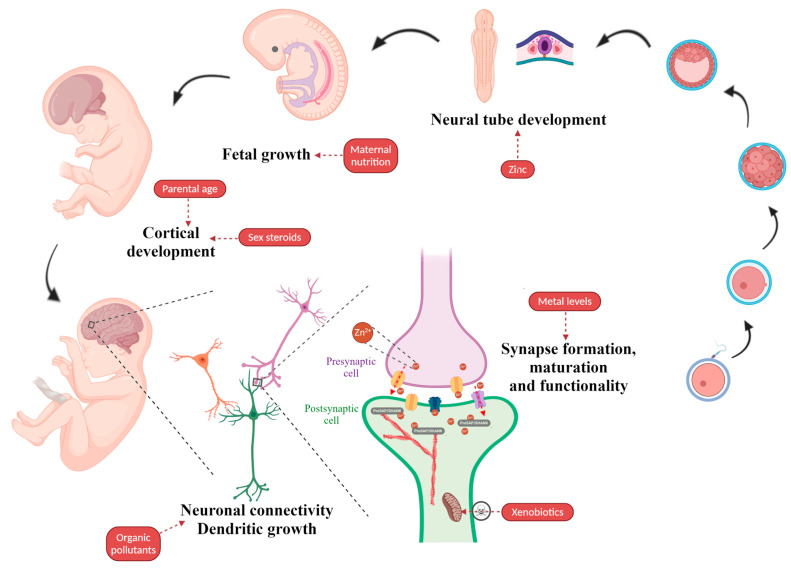
Environmental factors associated with ASD. The illustration indicates the putative impact of environmental factors on embryonic and fetal development with a particular focus on neuronal development and synaptic function. Figure created using BioRender.com images.

References

    1. Kana R.K., Uddin L.Q., Ekenet T., Echugani D., Müller R.-A. Brain connectivity in autism. Front. Hum. Neurosci. 2014;8:349. doi: 10.3389/fnhum.2014.00349. - DOI - PMC - PubMed
    1. Narzisi A., Muratori F., Calderoni S., Fabbro F., Urgesi C. Neuropsychological Profile in High Functioning Autism Spectrum Disorders. J. Autism Dev. Disord. 2012;43:1895–1909. doi: 10.1007/s10803-012-1736-0. - DOI - PubMed
    1. Goin-Kochel R.P., Myers B.J. Congenital Versus Regressive Onset of Autism Spectrum Disorders. Focus Autism Other Dev. Disabil. 2005;20:169–179. doi: 10.1177/10883576050200030501. - DOI
    1. Tamouza R., Fernell E., Eriksson M.A., Anderlid B., Manier C., Mariaselvam C.M., Boukouaci W., Leboyer M., Gillberg C. HLA Polymorphism in Regressive and Non-Regressive Autism: A Preliminary Study. Autism Res. 2019;13:182–186. doi: 10.1002/aur.2217. - DOI - PubMed
    1. Cohen J., Eyu S., Efu Y., Eli X. Synaptic proteins and receptors defects in autism spectrum disorders. Front. Cell. Neurosci. 2014;8:276. doi: 10.3389/fncel.2014.00276. - DOI - PMC - PubMed

MeSH terms