


Machine Learned Cellular Phenotypes in Cardiomyopathy Predict Sudden Death
- PMID: 33167779
- PMCID: PMC7855939
- DOI: 10.1161/CIRCRESAHA.120.317345
Machine Learned Cellular Phenotypes in Cardiomyopathy Predict Sudden Death
Abstract
Rationale: Susceptibility to VT/VF (ventricular tachycardia/fibrillation) is difficult to predict in patients with ischemic cardiomyopathy either by clinical tools or by attempting to translate cellular mechanisms to the bedside.
Objective: To develop computational phenotypes of patients with ischemic cardiomyopathy, by training then interpreting machine learning of ventricular monophasic action potentials (MAPs) to reveal phenotypes that predict long-term outcomes.
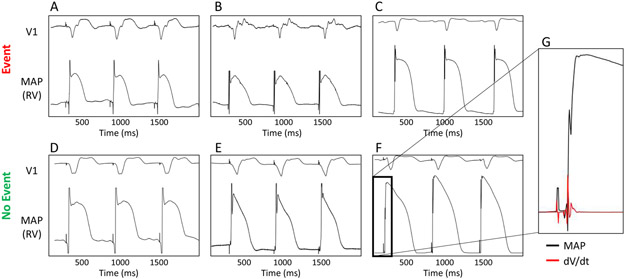
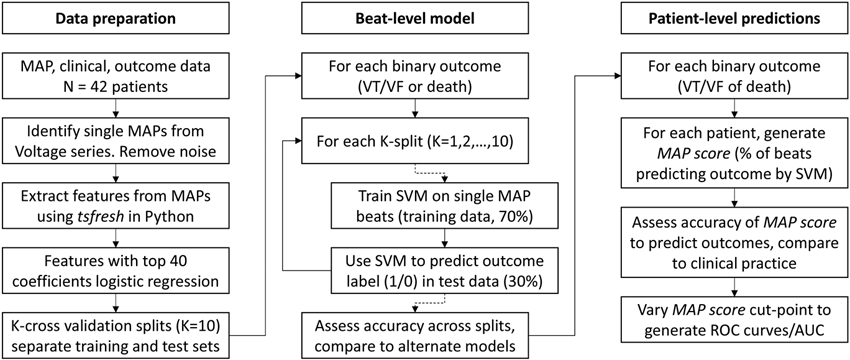
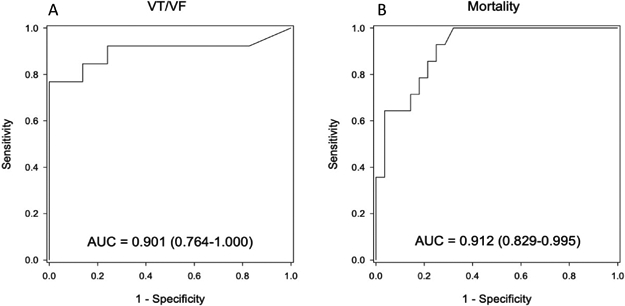
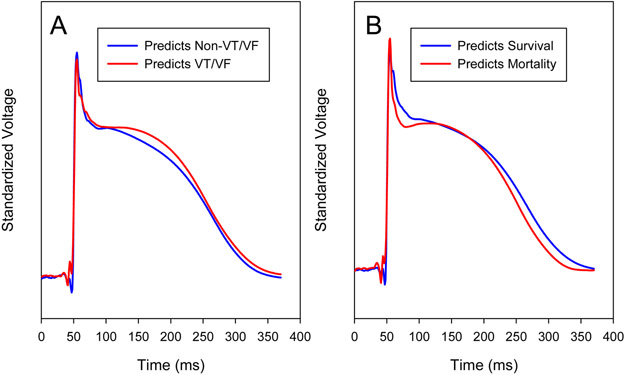
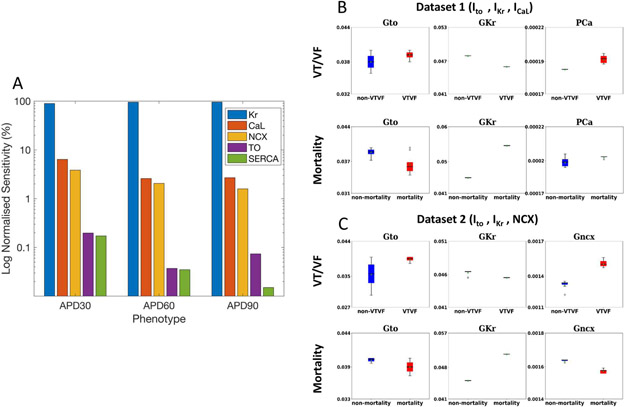
Methods and results: We recorded 5706 ventricular MAPs in 42 patients with coronary artery disease and left ventricular ejection fraction ≤40% during steady-state pacing. Patients were randomly allocated to independent training and testing cohorts in a 70:30 ratio, repeated K=10-fold. Support vector machines and convolutional neural networks were trained to 2 end points: (1) sustained VT/VF or (2) mortality at 3 years. Support vector machines provided superior classification. For patient-level predictions, we computed personalized MAP scores as the proportion of MAP beats predicting each end point. Patient-level predictions in independent test cohorts yielded c-statistics of 0.90 for sustained VT/VF (95% CI, 0.76-1.00) and 0.91 for mortality (95% CI, 0.83-1.00) and were the most significant multivariate predictors. Interpreting trained support vector machine revealed MAP morphologies that, using in silico modeling, revealed higher L-type calcium current or sodium-calcium exchanger as predominant phenotypes for VT/VF.
Conclusions: Machine learning of action potential recordings in patients revealed novel phenotypes for long-term outcomes in ischemic cardiomyopathy. Such computational phenotypes provide an approach which may reveal cellular mechanisms for clinical outcomes and could be applied to other conditions.
Keywords: artificial intelligence; coronary disease; death, sudden, cardiac; heart failure; ion channels; systems biology.
Figures
Comment in
-
Learning for Prevention of Sudden Cardiac Death.Circ Res. 2021 Jan 22;128(2):185-187. doi: 10.1161/CIRCRESAHA.120.318576. Epub 2021 Jan 21. Circ Res. 2021. PMID: 33476206 Free PMC article. No abstract available.
References
-
- Benjamin EJ, Virani SS, Callaway CW, et al. Heart Disease and Stroke Statistics—2018 Update: A Report From the American Heart Association. Circulation. 2018;137:E67–E492. - PubMed
-
- Goldberger JJ, Basu A, Boineau R, et al. Risk Stratification for Sudden Cardiac Death: A Plan for the Future. Circulation. 2014;129:516–526. - PubMed
-
- Waks JW, Buxton AE. Risk Stratification for Sudden Cardiac Death After Myocardial Infarction. Annu Rev Med. 2018;69:147–164. - PubMed
Publication types
MeSH terms
Grants and funding
LinkOut - more resources
Full Text Sources
Other Literature Sources
Medical
