


Trends in the diagnosis of diseases of despair in the United States, 2009-2018: a retrospective cohort study
- PMID: 33168586
- PMCID: PMC7654125
- DOI: 10.1136/bmjopen-2020-037679
Trends in the diagnosis of diseases of despair in the United States, 2009-2018: a retrospective cohort study
Abstract
Background and objective: Increasing mortality and decreasing life expectancy in the USA are largely attributable to accidental overdose, alcohol-related disease and suicide. These 'deaths of despair' often follow years of morbidity, yet little is known about trends in the clinical recognition of 'diseases of despair'. The objective of this study is to characterise rates of clinically documented diseases of despair over the last decade and identify sociodemographic risk factors.
Design: Retrospective study using a healthcare claims database with 10 years of follow-up.
Setting: Participants resided nationwide but were concentrated in US states disproportionately affected by deaths of despair, including Pennsylvania, West Virginia and Delaware.
Participants: Cohort included 12 144 252 participants, with no restriction by age or gender.
Outcome measures: Diseases of despair were defined as diagnoses related to alcohol misuse, substance misuse and suicide ideation/behaviours. A lookback period was used to identify incident diagnoses. Annual and all-time incidence/prevalence estimates were computed, along with risk for current diagnosis and patterns of comorbidity.
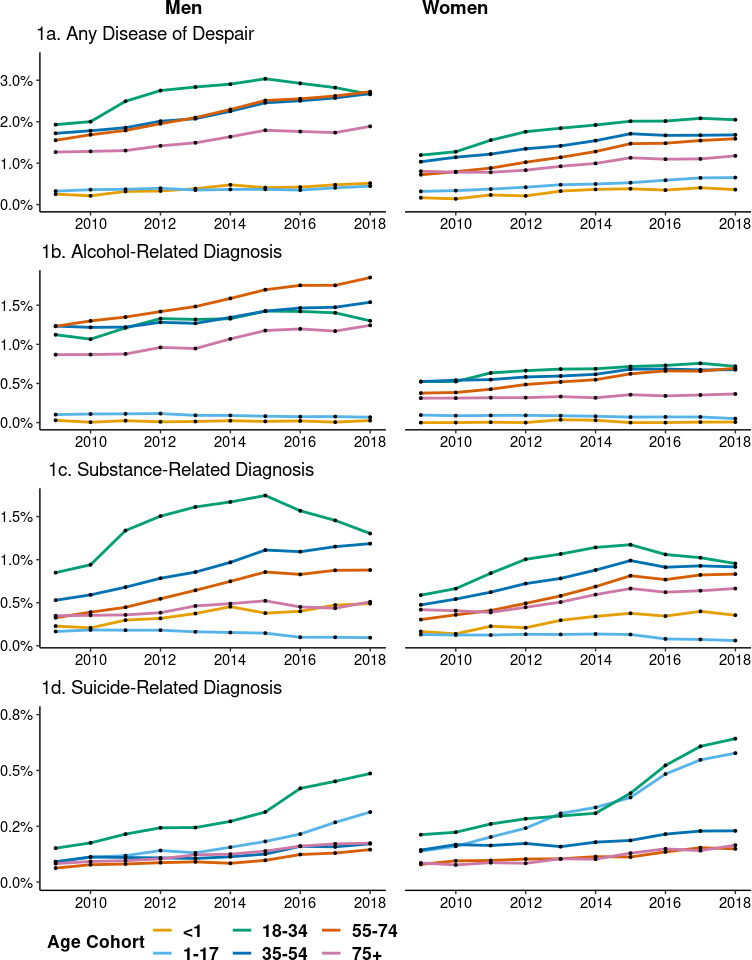
Results: 515 830 participants received a disease of despair diagnosis (58.5% male, median 36 years). From 2009 to 2018, the prevalence of alcohol-related, substance-related and suicide-related diagnoses respectively increased by 37%, 94%, and 170%. Ages 55-74 had the largest increase in alcohol/substance-related diagnoses (59% and 172%). Ages <18 had the largest increase in suicide-related diagnoses (287%). Overall, odds for current-year diagnosis were higher among men (adjusted OR (AOR) 1.49, 95% CI 1.47 to 1.51), and among those with Affordable Care Act or Medicare coverage relative to commercial coverage (AOR 1.30, 1.24 to 1.37; AOR 1.51, 1.46 to 1.55).
Conclusions: Increasing clinical rates of disease of despair diagnoses largely mirror broader societal trends in mortality. While the opioid crisis remains a top public health priority, parallel rises in alcohol-related diagnoses and suicidality must be concurrently addressed. Findings suggest opportunities for healthcare systems and providers to deploy targeted prevention to mitigate the progression of morbidities towards mortality.
Keywords: epidemiology; mental health; preventive medicine; public health; risk management; social medicine.
© Author(s) (or their employer(s)) 2020. Re-use permitted under CC BY-NC. No commercial re-use. See rights and permissions. Published by BMJ.
Conflict of interest statement
Competing interests: None declared.
Figures
Comment in
-
Psychotherapy of Children in the Age of COVID-19.Psychiatry. 2021 Summer;84(2):134-136. doi: 10.1080/00332747.2021.1925506. Psychiatry. 2021. PMID: 34293275 No abstract available.
References
-
- Murphy SL, Xu J, Kochanek KD, et al. Mortality in the United States, 2017, 2018: 1–8. - PubMed
Publication types
MeSH terms
Grants and funding
LinkOut - more resources
Full Text Sources
Medical
