Review
. 2020 Nov 7;9(11):1627.
doi: 10.3390/foods9111627.

Grape Pomace Valorization: A Systematic Review and Meta-Analysis

Affiliations
Review

Grape Pomace Valorization: A Systematic Review and Meta-Analysis

Bojan Antonić et al. Foods. .

Abstract

This systematic review aimed to collect data and analyze the possible use of grape pomace, a winemaking industry byproduct, in the production of fortified foods. The English articles found in Web of Science, Scopus, and Google Scholar, from January 2006 until May 2020, were used for the conduction of overview tables and meta-analysis. The systematic review emphasized the two main issues concerning grape pomace application to other food products: (i) grape pomace contains high amounts of health promoting compounds; and (ii) the use of grape pomace is influencing the waste management. The grape pomace has been used in the fortification of plant origin food, meat, fish, and dairy products, mainly due to higher polyphenols and dietary fiber contents. The fortification was declared as successful in all studied food types. The change of color, caused by polyphenolic compounds, was mainly observed as an adverse effect of the fortification. Higher levels of fortification also caused notable undesirable changes in texture. The most valuable influence of the grape pomace addition according to included papers and meta-analysis is certainly a higher nutritional quality and oxidative stability of fortified products, reflected as higher polyphenol and total dietary fiber content.

Keywords: byproduct; food fortification; grape pomace; polyphenolic content; total dietary fiber; waste management.


Conflict of interest statement

The authors declare no conflict of interest.

Figures
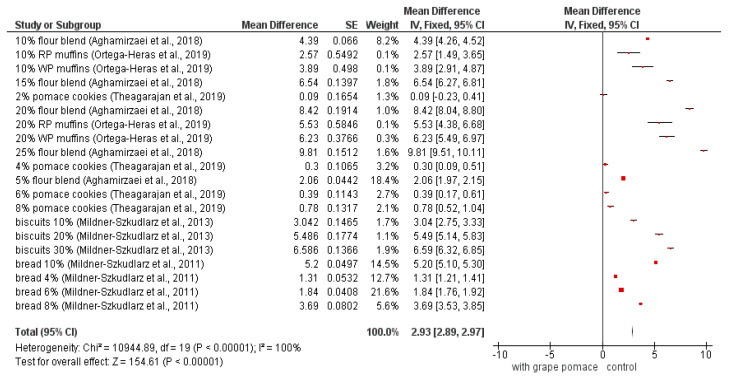
Figure 1
Figure 1
Meta-analysis of TDF in fortified products [20,23,43,45,75]; RP—red grape pomace; WP—white grape pomace; SE: standard error.
Figure 2
Figure 2
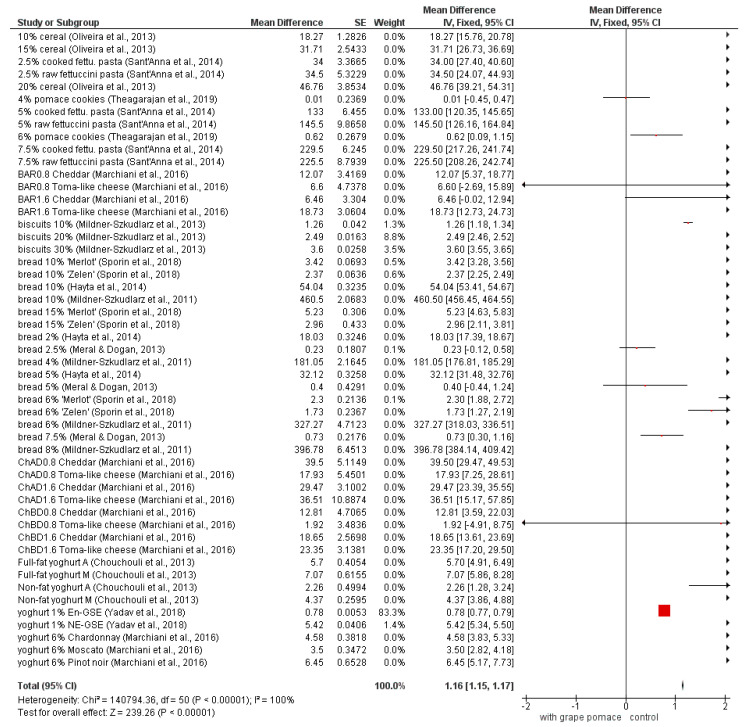
Meta-analysis of TPC in fortified products [20,21,23,45,46,47,50,53,69,71,73]; BAR—Barbera; ChAD—Chardonnay after distillation; ChBD—Chardonnay before distillation; En-GSE—encapsulated grape seed extract; NE-GSE—nonencapsulated grape seed extract; A—Agiorgitiko seed extracts; M—Moschofilero seed extracts.
Figure 3
Figure 3
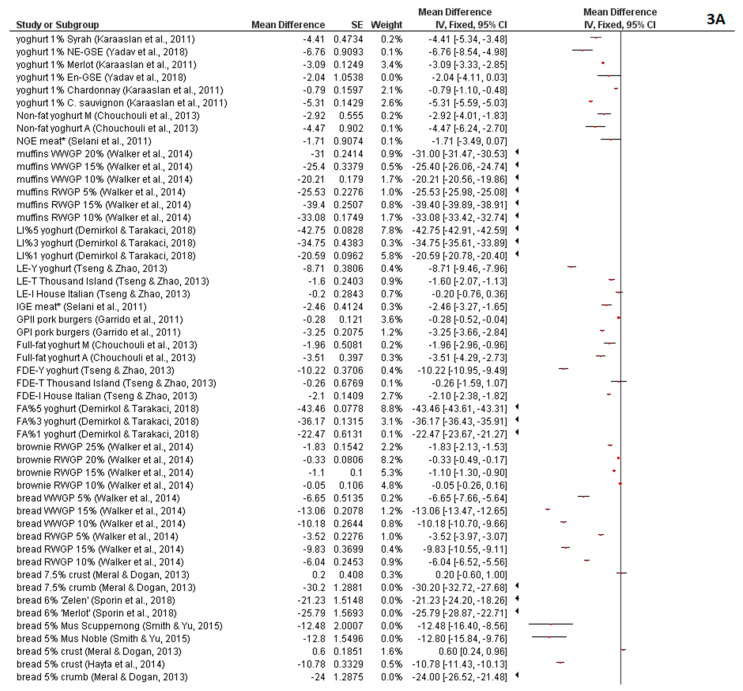
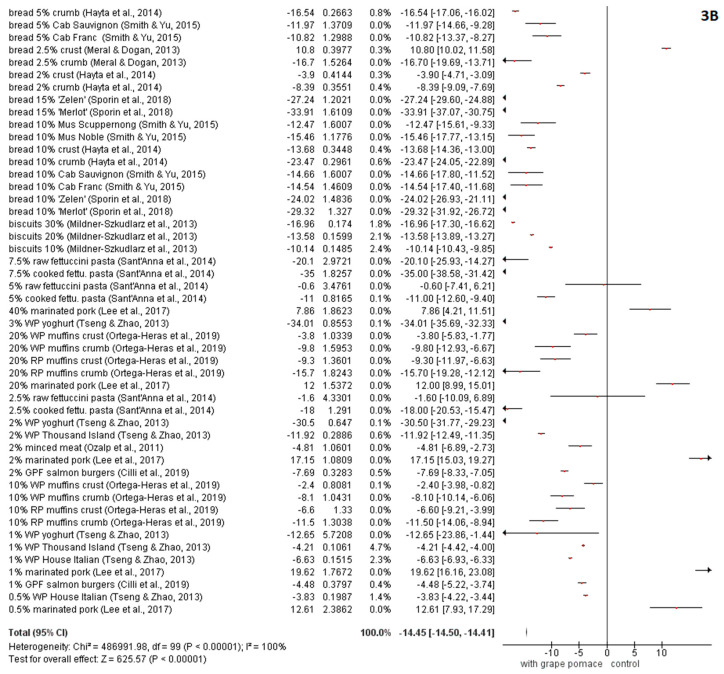
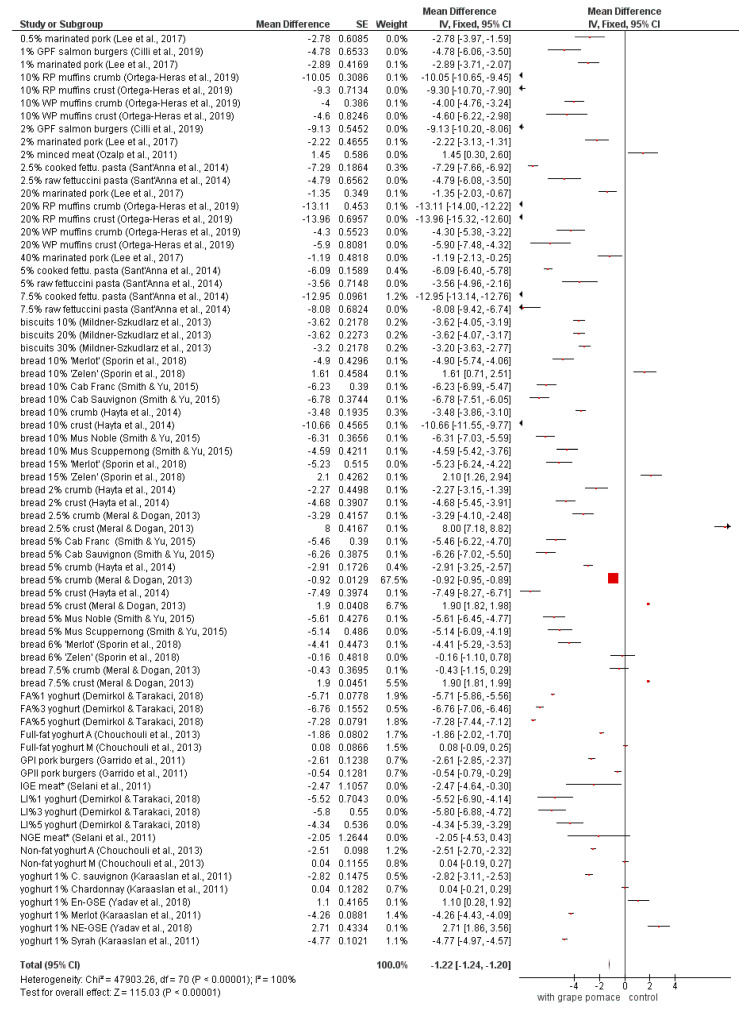
(A,B) Meta-analysis of L value in fortified products [13,19,21,22,23,43,44,46,47,48,53,60,63,64,69,70,72,73]; * En-GSE—encapsulated grape seed extract in yoghurt; NE-GSE—nonencapsulated grape seed extract in yoghurt; RP—red grape pomace; WP—white grape pomace; GPF—grape pomace flour; RWG—Pinot Noir wine grape pomace; WWGP—Pinot Grigio wine grape pomace; FA—forced air-dried grape pomace; LI—lyophilized grape pomace; A—Agiorgitiko seed extracts; M—Moschofilero seed extracts; LE—liquid pomace extract; FDE—freeze-dried pomace extract; GPI—grape pomace extract Type I (high-low instantaneous pressure (HLIP) + methanolic extraction); GPII—Grape pomace extract Type II (methanolic extraction; GPII); IGE—Isabel grape seed and peel extract; NGE—Niagara grape seed and peel extract.
Figure 3
Figure 3
(A,B) Meta-analysis of L value in fortified products [13,19,21,22,23,43,44,46,47,48,53,60,63,64,69,70,72,73]; * En-GSE—encapsulated grape seed extract in yoghurt; NE-GSE—nonencapsulated grape seed extract in yoghurt; RP—red grape pomace; WP—white grape pomace; GPF—grape pomace flour; RWG—Pinot Noir wine grape pomace; WWGP—Pinot Grigio wine grape pomace; FA—forced air-dried grape pomace; LI—lyophilized grape pomace; A—Agiorgitiko seed extracts; M—Moschofilero seed extracts; LE—liquid pomace extract; FDE—freeze-dried pomace extract; GPI—grape pomace extract Type I (high-low instantaneous pressure (HLIP) + methanolic extraction); GPII—Grape pomace extract Type II (methanolic extraction; GPII); IGE—Isabel grape seed and peel extract; NGE—Niagara grape seed and peel extract.
Figure 4
Figure 4
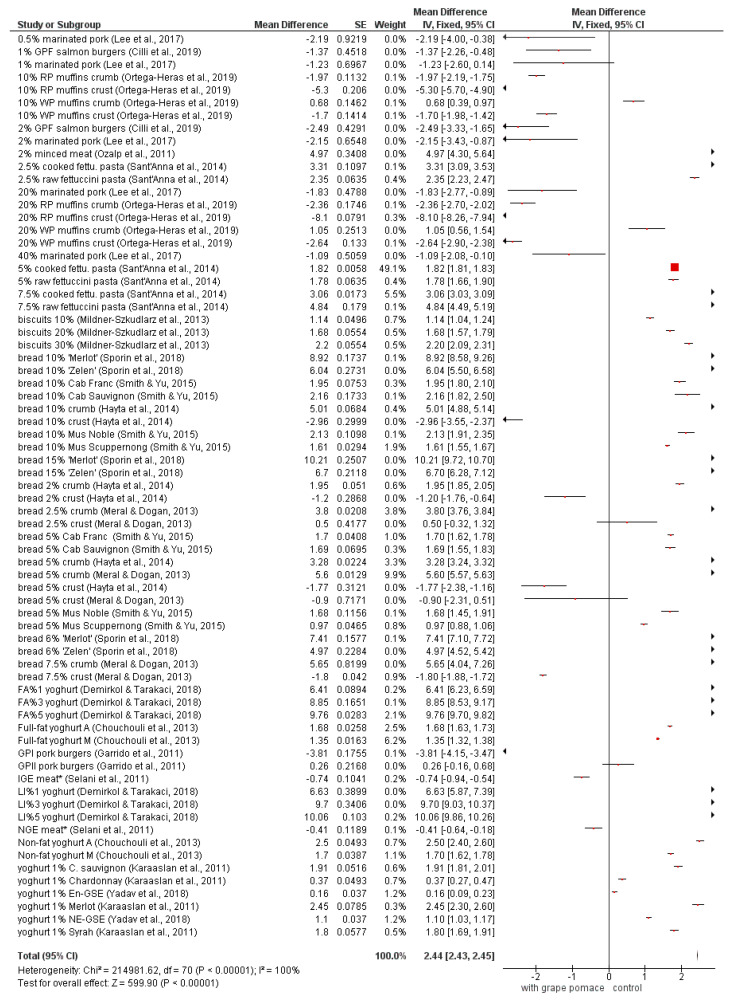
Meta-analysis of a value in fortified products [13,19,21,23,43,46,47,53,60,63,64,69,70,72,73]; * En-GSE—encapsulated grape seed extract in yoghurt; NE-GSE—nonencapsulated grape seed extract in yoghurt; RP—red grape pomace; WP—white grape pomace; GPF—grape pomace flour; FA—forced air-dried grape pomace; LI—lyophilized grape pomace; A—Agiorgitiko seed extracts; M—Moschofilero seed extracts; GPI—grape pomace extract Type I (high-low instantaneous pressure (HLIP) + methanolic extraction); GPII—Grape pomace extract Type II (methanolic extraction; GPII); IGE—Isabel grape seed and peel extract; NGE—Niagara grape seed and peel extract.
Figure 5
Figure 5
Meta-analysis of b value in fortified products [13,19,21,23,43,46,47,48,53,60,63,64,69,70,72,73]; * En-GSE—encapsulated grape seed extract in yoghurt; NE-GSE—nonencapsulated grape seed extract in yoghurt; RP—red grape pomace; WP—white grape pomace; GPF—grape pomace flour; FA—forced air dried grape pomace; LI—lyophilized grape pomace; A—Agiorgitiko seed extracts; M—Moschofilero seed extracts; GPI—grape pomace extract Type I (high-low instantaneous pressure (HLIP) + methanolic extraction); GPII—Grape pomace extract Type II (methanolic extraction; GPII); IGE—Isabel grape seed and peel extract; NGE—Niagara grape seed and peel extract.

References

    1. Food and Agriculture Organization of the United Nations; 2018. [(accessed on 31 July 2020)]. FAOSTAT. Available online: http://www.fao.org/faostat/en/#data/QC.
    1. Sousa E.C., Uchôa-Thomaz A.M.A., Carioca J.O.B., Morais S.M.D., Lima A.D., Martins C.G., Alexandrino C.D., Ferreira P.A.T., Rodrigues A.L.M., Rodrigues S.P., et al. Chemical composition and bioactive compounds of grape pomace (Vitis vinifera L.), Benitaka variety, grown in the semiarid region of Northeast Brazil. Food Sci. Technol. 2014;34:135–142. doi: 10.1590/S0101-20612014000100020. - DOI
    1. García-Lomillo J., González-SanJosé M.L. Applications of wine pomace in the food industry: Approaches and functions. Compr. Rev. Food Sci. Food Saf. 2017;16:3–22. doi: 10.1111/1541-4337.12238. - DOI - PubMed
    1. Bender A.B., Speroni C.S., Salvador P.R., Loureiro B.B., Lovatto N.M., Goulart F.R., Lovatto M.T., Miranda M.Z., Silva L.P., Penna N.G. Grape pomace skins and the effects of its inclusion in the technological properties of muffins. J. Culin. Sci. Technol. 2017;15:143–157. doi: 10.1080/15428052.2016.1225535. - DOI
    1. Balbinoti T.C.V., Stafussa A.P., Haminiuk C.W.I., Maciel G.M., Sassaki G.L., Jorge L.M.D.M., Jorge R.M.M. Addition of grape pomace in the hydration step of parboiling increases the antioxidant properties of rice. Int. J. Food Sci. Technol. 2020;55:2370–2380. doi: 10.1111/ijfs.14481. - DOI

LinkOut - more resources