


Sedentary Patterns Are Associated with Bone Mineral Density and Physical Function in Older Adults: Cross-Sectional and Prospective Data
- PMID: 33171963
- PMCID: PMC7664175
- DOI: 10.3390/ijerph17218198
Sedentary Patterns Are Associated with Bone Mineral Density and Physical Function in Older Adults: Cross-Sectional and Prospective Data
Abstract
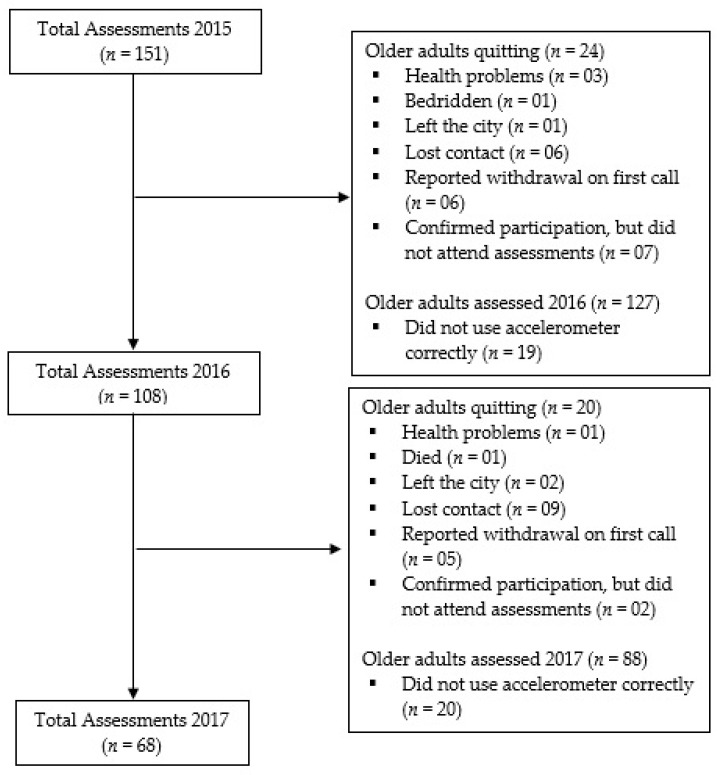
Aging causes some unfavorable morphological and functional changes, such as the decline in bone mineral density (BMD) and physical function. Moderate-to-vigorous physical activity (MVPA) and sedentary time seem to be related with these alterations, but the impact of distinct patterns remains unclear. The aim of this study was to cross-sectionally and prospectively assess the association between objectively measured MVPA and sedentary patterns (bouts and breaks) with BMD and physical function in older adults. The study considered 151 Brazilians (aged ≥ 60 years), out of which 68 participants completed 2-year follow-up measurements. MVPA and sedentary patterns were measured by means of accelerometry, BMD-(total proximal femur and lumbar spine (L1-L4)) by means of dual-energy X-ray absorptiometry (DXA), and physical function-by means of physical tests. In older women, sedentary bouts >60 min were inversely associated with handgrip strength (β = -2.03, 95% CI: from -3.43 to -0.63). The prospective analyses showed that changes in sedentary bouts (20 to 30 min and >60 min) were inversely associated with changes in the lumbar spine's BMD (β = -0.01, 95% CI: from -0.01 to -0.00 and β = -0.03, 95% CI: from -0.06 to -0.01) and the lumbar spine's T-score (β = -0.06, 95% CI: from -0.10 to -0.01 and β = -0.27, 95% CI: from -0.49 to -0.04), respectively. In older women, sedentary patterns are cross-sectionally associated with handgrip strength and prospectively associated with BMD independent of MVPA.
Keywords: acceleration; bone health; exercise; physical health; sedentary living.
Conflict of interest statement
The authors declare no conflict of interest.
Figures
References
-
- Daly R.M., Rosengren B.E., Alwis G., Ahlborg H.G., Sernbo I., Karlsson M.K. Gender specific age-related changes in bone density, muscle strength and functional performance in the elderly: A-10 year prospective population-based study. BMC Geriatr. 2013;13:71. doi: 10.1186/1471-2318-13-71. - DOI - PMC - PubMed
-
- Wu F., Wills K., Laslett L.L., Oldenburg B., Jones G., Winzenberg T. Moderate-to-vigorous physical activity but not sedentary time is associated with musculoskeletal health outcomes in a cohort of Australian middle-aged women. J. Bone Miner. Res. 2017;32:708–715. doi: 10.1002/jbmr.3028. - DOI - PubMed
Publication types
MeSH terms
Grants and funding
LinkOut - more resources
Full Text Sources
Medical
