


Exercise and/or Genistein Treatment Impact Gut Microbiota and Inflammation after 12 Weeks on a High-Fat, High-Sugar Diet in C57BL/6 Mice
- PMID: 33172007
- PMCID: PMC7694625
- DOI: 10.3390/nu12113410
Exercise and/or Genistein Treatment Impact Gut Microbiota and Inflammation after 12 Weeks on a High-Fat, High-Sugar Diet in C57BL/6 Mice
Abstract
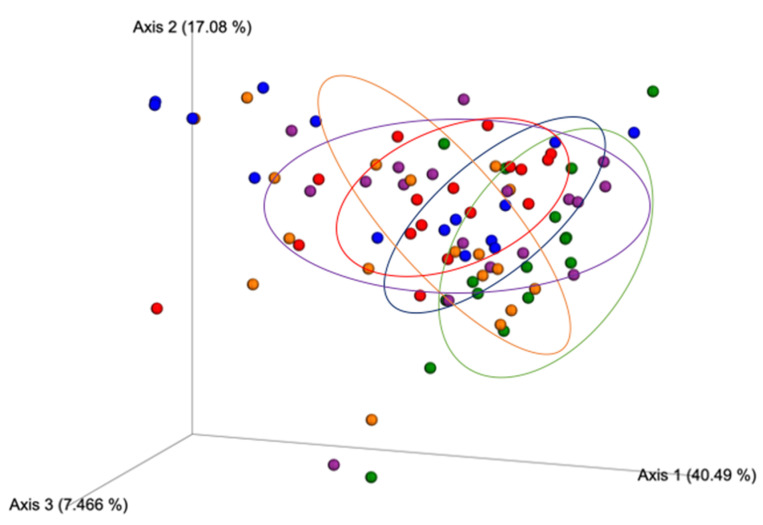
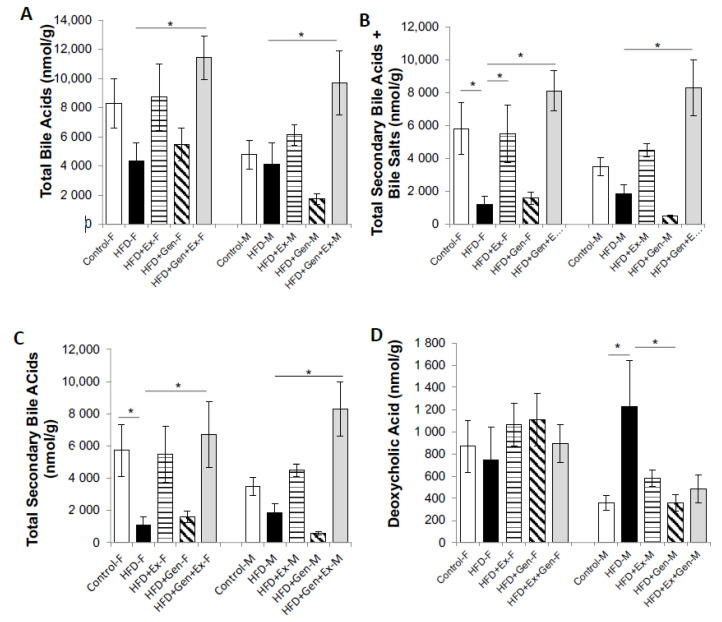
Genistein (Gen) and exercise (Exe) have been postulated as potential strategies to ameliorate obesity, inflammation, and gut microbiota (GM) with promising results. However, the impact of the combination of both Exe and Gen is yet to be investigated. We aimed to analyze the impacts of Exe, Gen, and their combined effects on GM and inflammation in mice after a 12-week high-fat, high-sugar diet (HFD). Eighty-three C57BL/6 mice were randomized to control, HFD, HFD + Exe, HFD + Gen, or HFD + Exe + Gen. The V4 region of the 16S rRNA gene was analyzed with Illumina MiSeq. Serum samples were used to analyze interleukin (Il)-6 and Tumor Necrosis Factor alpha (TNF-alpha). The HFD + Exe and HFD + Exe + Gen treatments resulted in significantly greater microbial richness compared to HFD. All the treatments had a significantly different impact on the GM community structure. Ruminococcus was significantly more abundant after the HFD + Exe + Gen treatment when compared to all the other HFD groups. Exe + Gen resulted in serum Il-6 concentrations similar to that of controls. TNF-alpha concentrations did not differ by treatment. Overall, Exe had a positive impact on microbial richness, and Ruminococcus might be the driving bacteria for the GM structure differences. Exe + Gen may be an effective treatment for preventing HFD-induced inflammation.
Keywords: Western diet; exercise; genistein; gut microbiota; high-fat diet; inflammation.
Conflict of interest statement
The authors declare no conflict of interest. The funders had no role in the design of the study; in the collection, analyses, or interpretation of data; in the writing of the manuscript; or in the decision to publish the results.
Figures


References
-
- Macia L., Thorburn A.N., Binge L.C., Marino E., Rogers K.E., Maslowski K.M., Vieira A.T., Kranich J., Mackay C.R. Microbial influences on epithelial integrity and immune function as a basis for inflammatory diseases. Immunol. Rev. 2012;245:164–176. doi: 10.1111/j.1600-065X.2011.01080.x. - DOI - PubMed
-
- Haro C., Montes-Borrego M., Rangel-Zúñiga O.A., Alcalá-Díaz J.F., Gómez-Delgado F., Pérez-Martínez P., Delgado-Lista J., Quintana-Navarro G.M., Tinahones F.J., Landa B.B., et al. Two Healthy Diets Modulate Gut Microbial Community Improving Insulin Sensitivity in a Human Obese Population. J. Clin. Endocrinol. Metab. 2016;101:233–242. doi: 10.1210/jc.2015-3351. - DOI - PubMed
-
- Kong C., Li Z., Han B., Zhang Z., Chen H., Zhang S., Xu J., Mao Y., Zhao Y., Wang L. Diet Consisting of Balanced Yogurt, Fruit and Vegetables Modifies the Gut Microbiota and Protects Mice Against Nonalcoholic Fatty Liver Disease. Mol. Nutr. Food Res. 2019;63:1900249. doi: 10.1002/mnfr.201900249. - DOI - PubMed
MeSH terms
Substances
Grants and funding
LinkOut - more resources
Full Text Sources
