. 2020 Nov 6;9(11):2428.
doi: 10.3390/cells9112428.

Uremic Toxins Affecting Cardiovascular Calcification: A Systematic Review

Affiliations

Uremic Toxins Affecting Cardiovascular Calcification: A Systematic Review

Jana Holmar et al. Cells. .

Abstract

Cardiovascular calcification is highly prevalent and associated with increased morbidity in chronic kidney disease (CKD). This review examines the impact of uremic toxins, which accumulate in CKD due to a failing kidney function, on cardiovascular calcification. A systematic literature search identified 41 uremic toxins that have been studied in relation to cardiovascular calcification. For 29 substances, a potentially causal role in cardiovascular calcification was addressed in in vitro or animal studies. A calcification-inducing effect was revealed for 16 substances, whereas for three uremic toxins, namely the guanidino compounds asymmetric and symmetric dimethylarginine, as well as guanidinosuccinic acid, a calcification inhibitory effect was identified in vitro. At a mechanistic level, effects of uremic toxins on calcification could be linked to the induction of inflammation or oxidative stress, smooth muscle cell osteogenic transdifferentiation and/or apoptosis, or alkaline phosphatase activity. For all middle molecular weight and protein-bound uremic toxins that were found to affect cardiovascular calcification, an increasing effect on calcification was revealed, supporting the need to focus on an increased removal efficiency of these uremic toxin classes in dialysis. In conclusion, of all uremic toxins studied with respect to calcification regulatory effects to date, more uremic toxins promote rather than reduce cardiovascular calcification processes. Additionally, it highlights that only a relatively small part of uremic toxins has been screened for effects on calcification, supporting further investigation of uremic toxins, as well as of associated post-translational modifications, on cardiovascular calcification processes.

Keywords: cardiovascular calcification; cardiovascular disease; chronic kidney disease; uremic toxins.


Conflict of interest statement

The authors declare no conflict of interest.

Figures
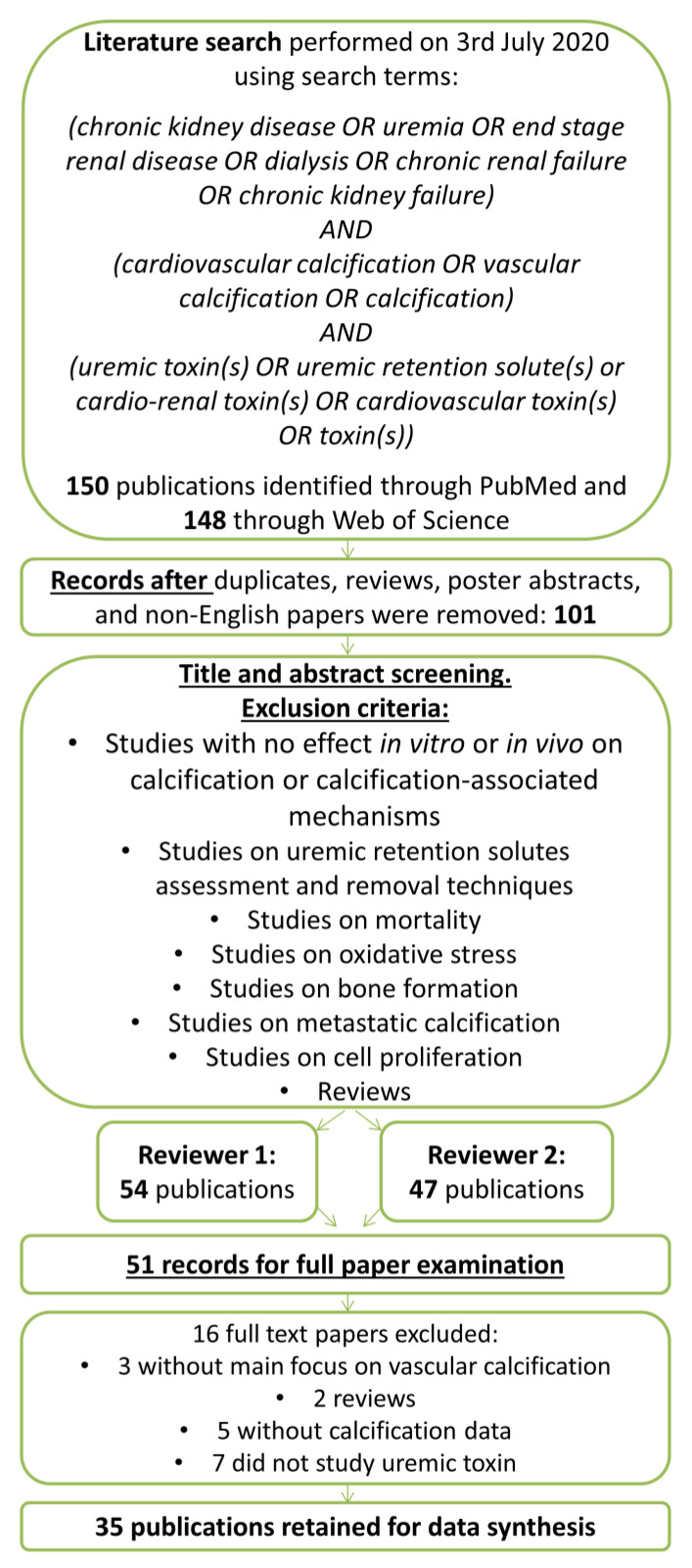
Figure 1
Figure 1
Flow diagram for original paper selection for the systematic review on uremic toxins and cardiovascular calcification.
Figure 2
Figure 2
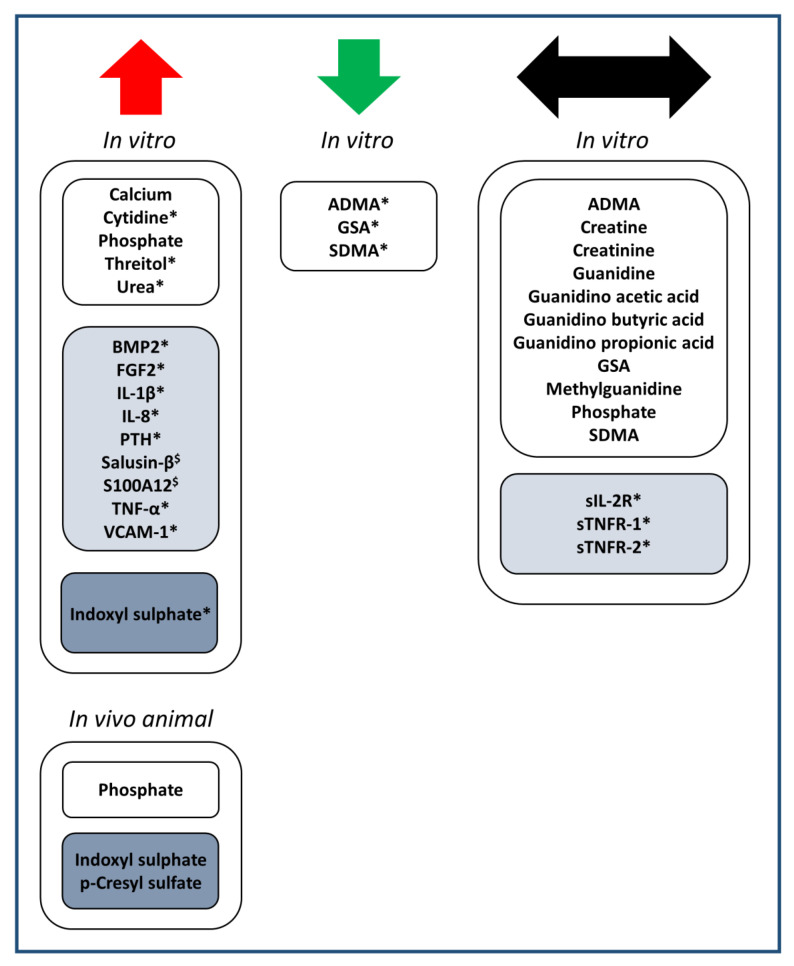
Overview of uremic toxins studied for potentially causal effects on vascular calcification in in vitro or animal studies. The effect on calcification is indicated with arrows in red (increased calcification), green (decreased calcification) or black (no effect). Multiple listing is possible in case of contrasting published findings. Uremic toxins are classified as low molecular weight (white boxes), middle molecular weight (light blue boxes) or protein-bound (dark blue boxes). * in pro-calcifying media; $ in pro- as well as non-calcifying media.
Figure 3
Figure 3
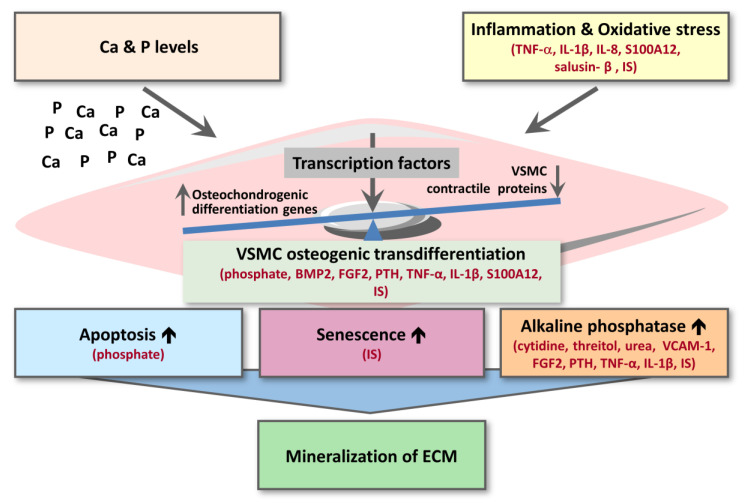
Scheme of uremic toxins affecting different regulatory steps of cardiovascular calcification. For details, we refer to the text. In red are shown the inducers of cardiovascular calcification. BMP2—bone morphogenetic protein 2; Ca—calcium; ECM—extracellular matrix; FGF2—fibroblast growth factor 2; IL-1β—interleukin-1 beta; IL-8—interleukin-8; IS—indoxyl sulphate; P—phosphate; PTH—parathyroid hormone; TNF-α—tumor necrosis factor-alpha; VCAM-1—vascular cell adhesion molecule-1; VSMC—vascular smooth muscle cell.

References

    1. Hill N.R., Fatoba S.T., Oke J.L., Hirst J.A., O’Callaghan C.A., Lasserson D.S., Hobbs F.D. Global Prevalence of Chronic Kidney Disease—A Systematic Review and Meta-Analysis. PLoS ONE. 2016;11:e0158765. doi: 10.1371/journal.pone.0158765. - DOI - PMC - PubMed
    1. Thompson S., James M., Wiebe N., Hemmelgarn B., Manns B., Klarenbach S., Tonelli M., Alberta Kidney Disease N. Cause of Death in Patients with Reduced Kidney Function. J. Am. Soc. Nephrol. 2015;26:2504–2511. doi: 10.1681/ASN.2014070714. - DOI - PMC - PubMed
    1. Wilson P.W., Kauppila L.I., O’Donnell C.J., Kiel D.P., Hannan M., Polak J.M., Cupples L.A. Abdominal aortic calcific deposits are an important predictor of vascular morbidity and mortality. Circulation. 2001;103:1529–1534. doi: 10.1161/01.CIR.103.11.1529. - DOI - PubMed
    1. Wayhs R., Zelinger A., Raggi P. High coronary artery calcium scores pose an extremely elevated risk for hard events. J. Am. Coll. Cardiol. 2002;39:225–230. doi: 10.1016/S0735-1097(01)01737-5. - DOI - PubMed
    1. Otto C.M., Lind B.K., Kitzman D.W., Gersh B.J., Siscovick D.S. Association of aortic-valve sclerosis with cardiovascular mortality and morbidity in the elderly. N. Engl. J. Med. 1999;341:142–147. doi: 10.1056/NEJM199907153410302. - DOI - PubMed

Publication types

MeSH terms