Review
. 2020 Nov 6;9(11):2430.
doi: 10.3390/cells9112430.

New Insights on Molecular Mechanism of Hepatitis B Virus Covalently Closed Circular DNA Formation

Affiliations
Review

New Insights on Molecular Mechanism of Hepatitis B Virus Covalently Closed Circular DNA Formation

Alexander L Marchetti et al. Cells. .

Abstract

The chronic factor of the Hepatitis B Virus (HBV), specifically the covalently closed circular DNA (cccDNA), is a highly stable and active viral episomal genome established in the livers of chronic hepatitis B patients as a constant source of disease. Being able to target and eliminate cccDNA is the end goal for a genuine cure for HBV. Yet how HBV cccDNA is formed from the viral genomic relaxed circular DNA (rcDNA) and by what host factors had been long-standing research questions. It is generally acknowledged that HBV hijacks cellular functions to turn the open circular DNA conformation of rcDNA into cccDNA through DNA repair mechanisms. With great efforts from the HBV research community, there have been several recent leaps in our understanding of cccDNA formation. It is our goal in this review to analyze the recent reports showing evidence of cellular factor's involvement in the molecular pathway of cccDNA biosynthesis.

Keywords: DNA repair; covalently closed circular DNA; hepatitis B virus; replication.


Conflict of interest statement

The authors declare no conflict of interest. The funders had no role in the design of the study; in the collection, analyses, or interpretation of data; in the writing of the manuscript, or in the decision to publish the results.

Figures
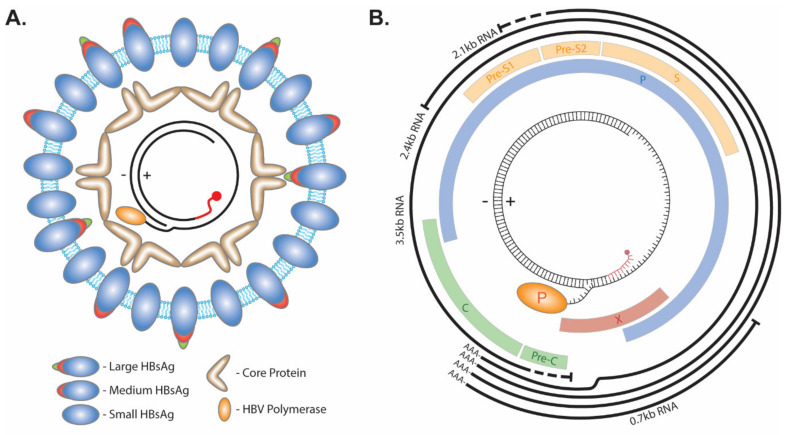
Figure 1
Figure 1
HBV structure and genome. (A) The envelope of HBV virion consists of lipids and the large, medium, and small viral surface proteins. Within the lumen of the virus, core protein forms an icosahedral capsid around the rcDNA genome which has the viral polymerase covalently attached to the 5′ end of the (−) strand and a capped RNA primer (red) attached to the 5′ end of the (+) strand. (B) The 3.2 kb HBV genome encodes four overlapping ORFs (Pre-Core/Core (Pre-C/C), Polymerase (P), Pre-S1/Pre-S2/S, and X) and four mRNA transcripts with an overlapping 3′ end (3.5 kb, 2.4 kb, 2.1 kb, and 0.7 kb).
Figure 2
Figure 2
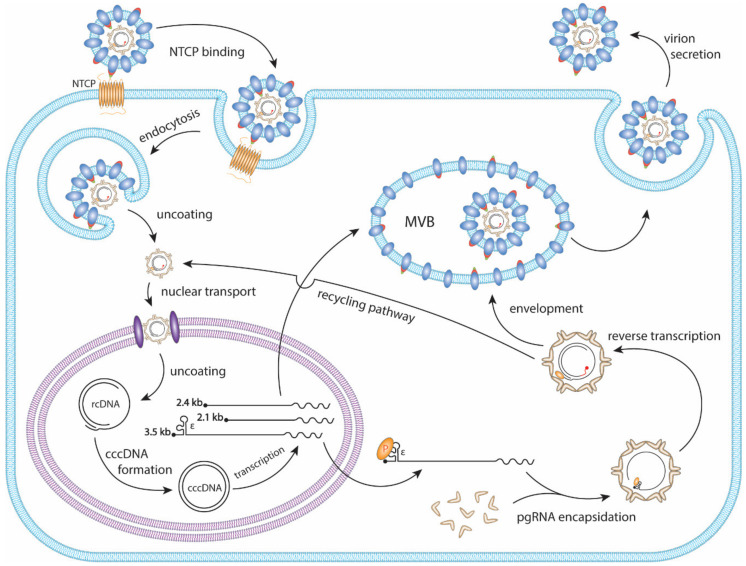
The HBV replication cycle. The HBV virion binds to the hepatic NTCP protein and is endocytosed. The viral membrane then fuses with the endosome, releasing the capsid into the cytoplasm, followed by nuclear import. The rcDNA is released into the nucleus where it uses host DNA repair mechanisms to form cccDNA. Viral mRNAs are transcribed from the cccDNA and are translated to viral proteins. In the cytoplasm, the viral polymerase binds to the epsilon (ε) structure of pgRNA and is encapsidated by core proteins. Within the nucleocapsid the pgRNA undergoes reverse transcription to form rcDNA. The mature capsid is enveloped and secreted as a virion particle through the MVB secretory pathway. The mature capsid can also be shuttled to the nucleus where it will amplify cccDNA through a process termed the rcDNA recycling pathway.
Figure 3
Figure 3
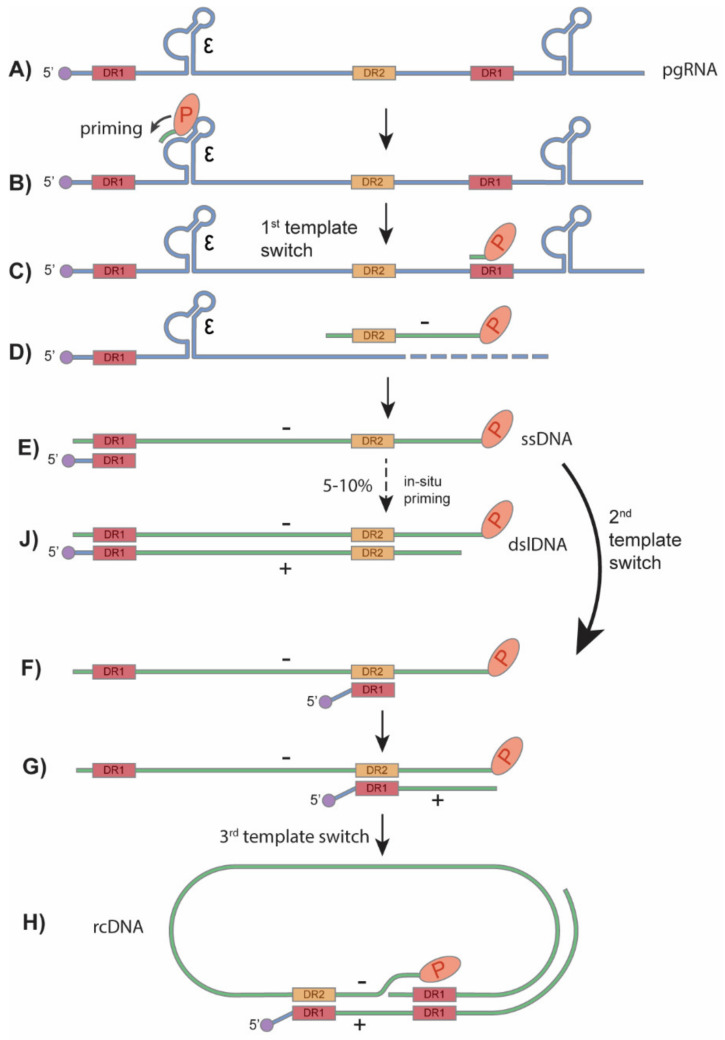
HBV rcDNA and dslDNA synthesis. (A) The encapsidated pgRNA is the template for HBV reverse transcription. (B) Inside of viral capsid, HBV polymerase binds to the ε structure of the pgRNA and begins priming with 3 nucleotides. (C) The first template switch occurs and the polymerase along with the covalently attached primed DNA move to the direct repeat 1 (DR1) motif at the 3′ end of the pgRNA. (D,E) The polymerase continues to synthesize the (−) strand DNA and digest the read RNA until it reaches the 5′ end of the pgRNA. (F) The second template switch occurs when the uncleaved 5′ DR1 region of pgRNA moves to the DR2 region of the newly synthesized (−) strand DNA. (G,H) Plus strand DNA synthesis then begins and undergoes a 3rd template switch to the 3′ end of the (−) strand, circularizing the double-stranded DNA and forming the rcDNA. (J) At a low frequency, the second template switch fails to occur, and the RNA primer undergoes an in situ priming to synthesize the HBV dslDNA. Adapted from Flint et al. [41].
Figure 4
Figure 4
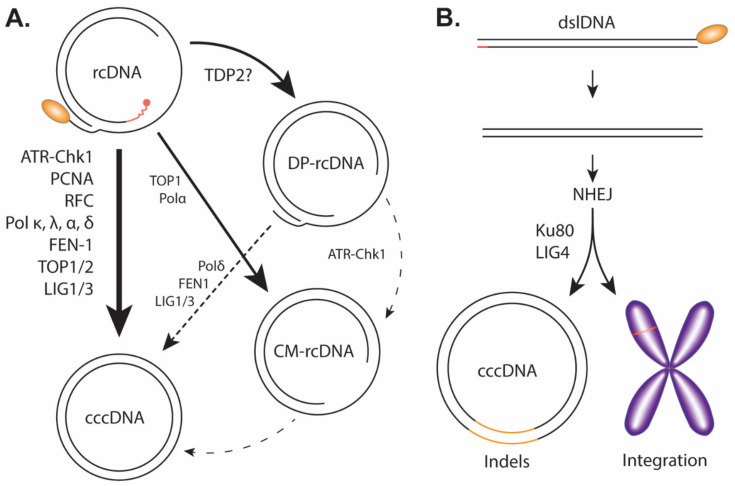
Proposed pathway of cccDNA formation. (A) Genuine cccDNA would be classified as cccDNA converted from rcDNA and would therefore have to undergo a relatively high-fidelity DNA repair. The host factors listed have been heavily implicated in the formation of genuine cccDNA. It is important to note the exact temporal/mechanistic relationship these factors have with cccDNA formation is yet to be fully explored or explained. DP-rcDNA and CM-rcDNA have been thoroughly shown to be downstream of rcDNA. Though there is credible evidence to suggest DP-rcDNA, or an unclassified subset of DP-rcDNA, is necessary for cccDNA formation, it remains uncertain if these populations including CM-rcDNA are actual genuine intermediates to cccDNA. The lines drawn between the HBV DNA populations correspond to the certainty (solid lines) and uncertainty (dotted lines) of their relationships, and the host DNA repair enzymes that have been implicated in each DNA transitions are indicated. (B) Through non-homologous end joining (NHEJ) mechanism, the HBV dslDNA can be integrated into the host genome or circularized to a pseudo cccDNA with substantial indels.

References

    1. Revill P.A., Chisari F.V., Block J.M., Dandri M., Gehring A.J., Guo H., Hu J., Kramvis A., Lampertico P., Janssen H.L.A., et al. A global scientific strategy to cure hepatitis B. Lancet Gastroenterol. Hepatol. 2019;4:545–558. doi: 10.1016/S2468-1253(19)30119-0. - DOI - PMC - PubMed
    1. Hyun Kim B., Ray Kim W. Epidemiology of hepatitis B virus infection in the United States. Clin. Liver Dis. 2018;12:1–4. doi: 10.1002/cld.732. - DOI - PMC - PubMed
    1. Ganem D., Prince A.M. Hepatitis B virus infection—Natural history and clinical consequences. N. Engl. J. Med. 2004;350:1118–1129. doi: 10.1056/NEJMra031087. - DOI - PubMed
    1. Locarnini S., Hatzakis A., Chen D.S., Lok A. Strategies to control hepatitis B: Public policy, epidemiology, vaccine and drugs. J. Hepatol. 2015;62:S76–S86. doi: 10.1016/j.jhep.2015.01.018. - DOI - PubMed
    1. Ott J.J., Stevens G.A., Groeger J., Wiersma S.T. Global epidemiology of hepatitis B virus infection: New estimates of age-specific HBsAg seroprevalence and endemicity. Vaccine. 2012;30:2212–2219. doi: 10.1016/j.vaccine.2011.12.116. - DOI - PubMed

Publication types

LinkOut - more resources