. 2020 Nov 10;11(6):e02302-20.
doi: 10.1128/mBio.02302-20.

Identification of Zinc-Dependent Mechanisms Used by Group B Streptococcus To Overcome Calprotectin-Mediated Stress

Affiliations

Identification of Zinc-Dependent Mechanisms Used by Group B Streptococcus To Overcome Calprotectin-Mediated Stress

Lindsey R Burcham et al. mBio. .

Abstract

Nutritional immunity is an elegant host mechanism used to starve invading pathogens of necessary nutrient metals. Calprotectin, a metal-binding protein, is produced abundantly by neutrophils and is found in high concentrations within inflammatory sites during infection. Group B Streptococcus (GBS) colonizes the gastrointestinal and female reproductive tracts and is commonly associated with severe invasive infections in newborns such as pneumonia, sepsis, and meningitis. Although GBS infections induce robust neutrophil recruitment and inflammation, the dynamics of GBS and calprotectin interactions remain unknown. Here, we demonstrate that disease and colonizing isolate strains exhibit susceptibility to metal starvation by calprotectin. We constructed a mariner transposon (Krmit) mutant library in GBS and identified 258 genes that contribute to surviving calprotectin stress. Nearly 20% of all underrepresented mutants following treatment with calprotectin are predicted metal transporters, including known zinc systems. As calprotectin binds zinc with picomolar affinity, we investigated the contribution of GBS zinc uptake to overcoming calprotectin-imposed starvation. Quantitative reverse transcriptase PCR (qRT-PCR) revealed a significant upregulation of genes encoding zinc-binding proteins, adcA, adcAII, and lmb, following calprotectin exposure, while growth in calprotectin revealed a significant defect for a global zinc acquisition mutant (ΔadcAΔadcAIIΔlmb) compared to growth of the GBS wild-type (WT) strain. Furthermore, mice challenged with the ΔadcAΔadcAIIΔlmb mutant exhibited decreased mortality and significantly reduced bacterial burden in the brain compared to mice infected with WT GBS; this difference was abrogated in calprotectin knockout mice. Collectively, these data suggest that GBS zinc transport machinery is important for combatting zinc chelation by calprotectin and establishing invasive disease.IMPORTANCE Group B Streptococcus (GBS) asymptomatically colonizes the female reproductive tract but is a common causative agent of meningitis. GBS meningitis is characterized by extensive infiltration of neutrophils carrying high concentrations of calprotectin, a metal chelator. To persist within inflammatory sites and cause invasive disease, GBS must circumvent host starvation attempts. Here, we identified global requirements for GBS survival during calprotectin challenge, including known and putative systems involved in metal ion transport. We characterized the role of zinc import in tolerating calprotectin stress in vitro and in a mouse model of infection. We observed that a global zinc uptake mutant was less virulent than the parental GBS strain and found calprotectin knockout mice to be equally susceptible to infection by wild-type (WT) and mutant strains. These findings suggest that calprotectin production at the site of infection results in a zinc-limited environment and reveals the importance of GBS metal homeostasis to invasive disease.

Keywords: GBS; calprotectin; meningitis; nutritional immunity; zinc.


Figures

FIG 1
FIG 1
Calprotectin inhibits GBS growth in vitro. Growth of GBS invasive isolates A909 (A), CJB111 (B), and COH1 (C) was assessed by measuring optical density (OD600) following an 8-h incubation with recombinant calprotectin (0 to 480 μg/ml) or by quantitating CFU (D to F). (G) Sensitivity was assessed by OD600 across a panel of vaginal isolates (closed shapes) and invasive isolates (open shapes) following an 8-h incubation with 120 μg/ml calprotectin. Data are displayed as percent growth inhibition compared to that of untreated isolate controls. All experiments were performed in technical triplicates (n = 3), and data were averaged from three independent experiments. Significance for panels A to F was determined by Kruskal-Wallis with Dunn’s multiple-comparison tests comparing treated samples to untreated controls. Significance for panel G was determined by one-way ANOVA with Tukey’s multiple-comparison test. *, P < 0.05; **, P < 0.01; ***, P < 0.001; ****, P < 0.0001.
FIG 2
FIG 2
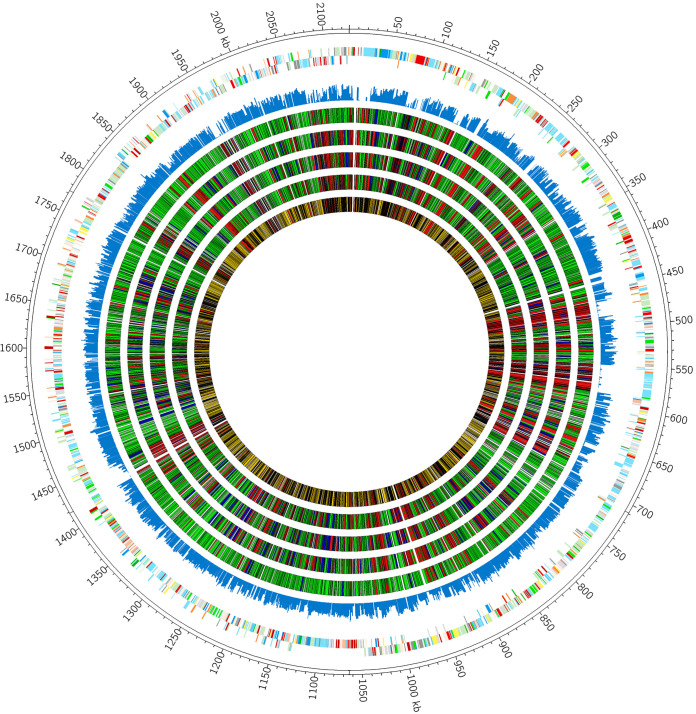
Construction of a saturated Krmit transposon mutant library in GBS. CIRCOS atlas representation of the A909 genome is shown with base pair (bp) ruler on the outer ring. The next two interior circles represent GBS open reading frames on the (+) and (−) strands, with colors depicting COG categories. The next circle (blue) indicates the frequency of Krmit transposon insertion site (TIS) observed in the initial mutant library grown in THY, with 68,857 unique insertion sites detected. The inner four circles present the results of Bayesian analysis of GBS gene essentiality under different growth conditions (THY, mRPMI, mRPMI plus subinhibitory calprotectin, and mRPMI plus inhibitory dose calprotectin, in order toward center; essential genes (red), nonessential genes (green), and excluded genes in either gray (too small for analysis) or black (inconclusive call). The center circle compiles the summary analysis of GBS genes under all four growth conditions, with essential genes under all conditions (red), nonessential genes under all conditions (yellow), and small/inconclusive genes (gray/black).
FIG 3
FIG 3
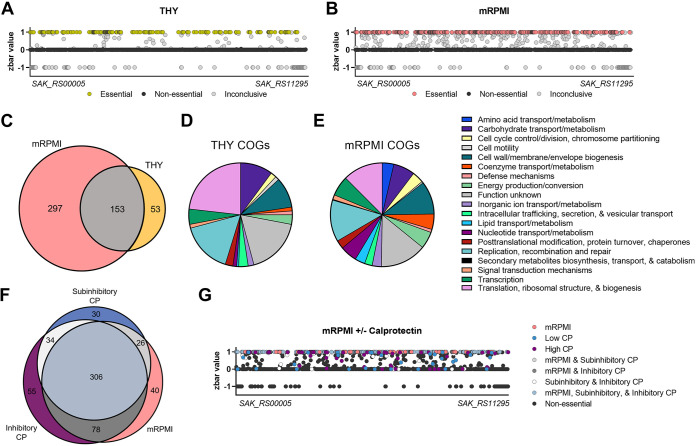
GBS essential genes for growth in vitro. Bayesian analysis of essential genes for growth in THY (A) or mRPMI (B). Essential genes are depicted as yellow (A) or pink (B), nonessential genes are shown in black, and inconclusive genes are shown in gray. The x axis is a linear representation of the A909 genome. EggNOG 5.0 was used to assign COGs to determine functions for essential genes for growth in THY (D) and mRPMI (E). Venn diagrams depict the essential genes for growth in mRPMI and THY (C) or mRPMI and subinhibitory (60 μg/ml) and inhibitory (480 μg/ml) calprotectin (F). (G) Linear map represents Bayesian analyses of essential genes for growth in mRPMI and subinhibitory and inhibitory calprotectin.
FIG 4
FIG 4
GBS genomic fitness screen in calprotectin. Volcano plots identify essential genes for growth in mRPMI and subinhibitory (60 μg/ml) calprotectin (A) and inhibitory (480 μg/ml) calprotectin (pink, blue/purple, and gray) (B) as well as nonessential genes (black) and genes involved in metal transport (red). (39). Essential genes (all but “nonessential” and “metal transport”) were excluded from fitness analyses by DESeq2. (C) Venn diagram depicts the underrepresented mutants detected in low (60 μg/ml) and high calprotectin (480 μg/ml) and common genes important for growth under both conditions. COGs were assigned to genes that contribute to survival in subinhibitory dose (B) and inhibitory dose (C) of calprotectin using EggNOG 5.0. (F) Schematic of GBS metal importers that contribute to survival during calprotectin stress.
FIG 5
FIG 5
Zinc transport contributes to calprotectin resistance. Quantitative RT-PCR was used to assess expression of adcA (A), adcAII (B), and lmb (C) following exposure to 120 μg/ml calprotectin (CP) or 25 μM TPEN (TP). Fold change was calculated by ΔΔCT analysis with gyrA serving as the internal control. Data are displayed as the average fold change from three independent experiments. Significance was determined by unpaired Student’s t tests. **, P < 0.01; ***, P < 0.001; ****, P < 0.0001.
FIG 6
FIG 6
GBS zinc homeostasis contributes to calprotectin survival in vivo. Kaplan-Meier plot showing survival of C57BL/6 (A) or S100A9−/− (E) mice infected with 3 × 108 CFU of WT (solid line) or the ΔadcAΔadcAIIΔlmb mutant (dotted line). Recovered CFU were quantified from brain tissue homogenates (B and F) or blood (C and G). (D and H) Cytokine abundance was quantified from brain tissue homogenates by ELISA. Statistical analyses include log rank (Mantel-Cox) tests for panels A and E and unpaired Student’s t tests for panels B to D and F to H. *, P < 0.05; **, P < 0.01; ns, not significant.
FIG 7
FIG 7
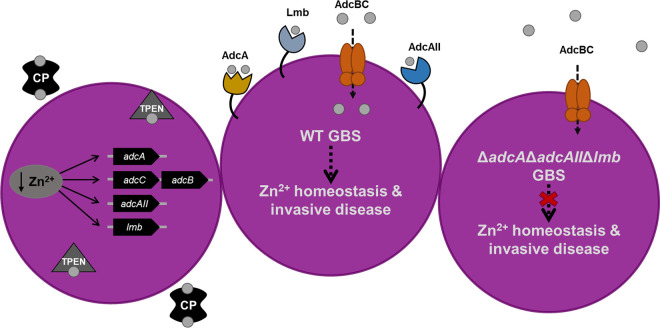
Summary of the GBS zinc-dependent response to calprotectin. GBS senses metal limitation in the presence of calprotectin and induces expression of three zinc-binding proteins to acquire zinc and overcome starvation. GBS that is capable of regulating zinc homeostasis in a zinc-limited environment remains virulent, whereas GBS zinc transport mutant strains are deficient in their ability to cause invasive disease.

References

    1. Andreini C, Bertini I, Cavallaro G, Holliday GL, Thornton JM. 2008. Metal ions in biological catalysis: from enzyme databases to general principles. J Biol Inorg Chem 13:1205–1218. doi:10.1007/s00775-008-0404-5. - DOI - PubMed
    1. Zygiel EM, Nolan EM. 2018. Transition metal sequestration by the host-defense protein calprotectin. Annu Rev Biochem 87:621–643. doi:10.1146/annurev-biochem-062917-012312. - DOI - PMC - PubMed
    1. Waldron KJ, Robinson NJ. 2009. How do bacterial cells ensure that metalloproteins get the correct metal? Nat Rev Microbiol 7:25–35. doi:10.1038/nrmicro2057. - DOI - PubMed
    1. Waldron KJ, Rutherford JC, Ford D, Robinson NJ. 2009. Metalloproteins and metal sensing. Nature 460:823–830. doi:10.1038/nature08300. - DOI - PubMed
    1. Hood MI, Skaar EP. 2012. Nutritional immunity: transition metals at the pathogen-host interface. Nat Rev Microbiol 10:525–537. doi:10.1038/nrmicro2836. - DOI - PMC - PubMed

Publication types

MeSH terms