


Rearing substrate impacts growth and macronutrient composition of Hermetia illucens (L.) (Diptera: Stratiomyidae) larvae produced at an industrial scale
- PMID: 33173088
- PMCID: PMC7655861
- DOI: 10.1038/s41598-020-76571-8
Rearing substrate impacts growth and macronutrient composition of Hermetia illucens (L.) (Diptera: Stratiomyidae) larvae produced at an industrial scale
Abstract
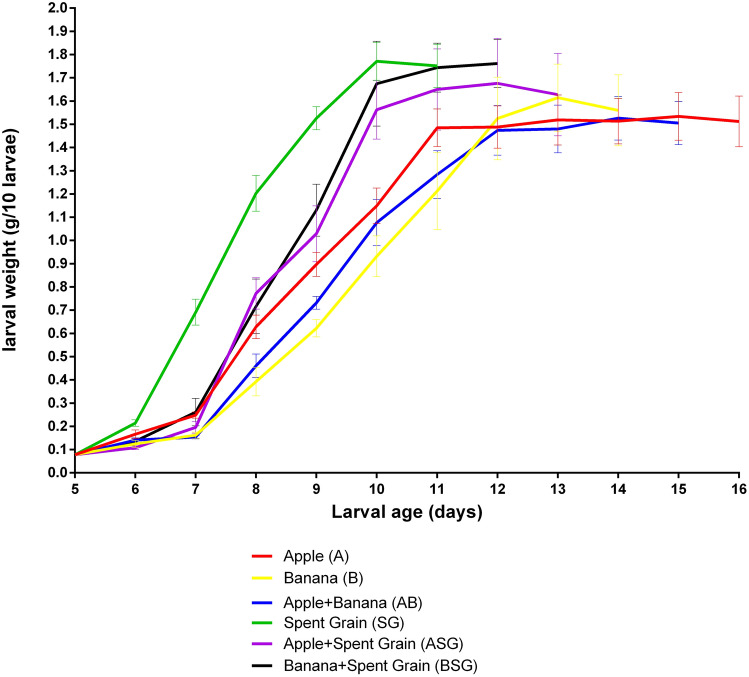
Organic waste is a rapidly increasing problem due to the growth of the agricultural production needed to meet global food demands. Development of sustainable waste management solutions is essential. Black soldier fly, Hermetia illucens (L.) (Diptera: Stratiomyidae) (BSF), larvae are voracious consumers of a wide range of organic materials ranging from fruits and vegetables to animal remains, and manure. Thanks to this ability and considering the larval high protein and lipid content, BSF larvae are a useful additive in animal feeds and biodiesel production. Unfortunately, the feasibility of using the black soldier fly as a tool for waste valorization and feed production has primarily been investigated at the benchtop scale. Thus, mobilization of current practices to an industrial scale is challenging because scaling up from small laboratory studies to large industrial studies is not necessarily linear. The goal of this study was to demonstrate the ability of the BSF to recycle organic waste at an industrial scale. To accomplish this goal, three organic waste streams were used (e.g., apples, bananas, and spent grain from a brewery) to test six diet treatments (1) apple, (2) banana, (3) spent grain, (4) apple and banana, (5) apple and spent grain, and (6) banana and spent grain. Working at scale of 10,000 BSF larvae life history traits, waste valorization, protein and lipid profiles were measured for each diet treatment. Differences were recorded across all variables, except substrate conversion, for larvae fed on fruit and spent grain (alone or with fruit). Growth rate significantly differed across treatments; larvae reared on spent grain grew twice as fast as those fed apples alone, but those reared on the apple and spent grain mixture produced twice as much insect biomass. However, it should be noted that larvae resulting from the apple diet contained 50% more fat than larvae fed the fruit and spent grain mixtures. Commonly-available organic wastes were successfully used at an industrial scale to produce BSF larvae that have the potential to substitute other sources of protein and lipids in different industrial applications. Industrialization efforts are encouraged to assess these impacts when integrating diverse ingredients into larval diets as a means to more precisely predict output, such as larval development time and final larval biomass.
Conflict of interest statement
The authors declare no competing interests.
Figures
References
-
- Otles S, Despoudi S, Bucatariu C, Kartal C. Food waste management, valorization, and sustainability in the food industry. In: Galanakis CM, editor. Food Waste Recovery. London: Academic Press; 2015. pp. 3–23.
-
- Schieber A, Stintzing FC, Carle R. By-products of plant food processing as a source of functional compounds—Recent developments. Trends Food Sci. Technol. 2001;12:401–413. doi: 10.1016/S0924-2244(02)00012-2. - DOI
-
- Gowe C. Review on potential use of fruit and vegetables by-products as a valuable source of natural food additives. Food Sci. Qual. Manag. 2015;45:47–61.
-
- Newman P, Jennings I. Cities as Sustainable Ecosystems: Principles and Practices. Washington, D.C.: Island Press; 2008.
Publication types
MeSH terms
Substances
LinkOut - more resources
Full Text Sources
