Review
. 2020 Sep 23:12:572090.
doi: 10.3389/fnagi.2020.572090. eCollection 2020.

Aging and Neurodegenerative Disease: Is the Adaptive Immune System a Friend or Foe?

Affiliations
Review

Aging and Neurodegenerative Disease: Is the Adaptive Immune System a Friend or Foe?

Katie Mayne et al. Front Aging Neurosci. .

Abstract

Neurodegenerative diseases of the central nervous system (CNS) are characterized by progressive neuronal death and neurological dysfunction, leading to increased disability and a loss of cognitive or motor functions. Alzheimer's disease, Parkinson's disease and amyotrophic lateral sclerosis have neurodegeneration as a primary feature. However, in other CNS diseases such as multiple sclerosis, stroke, traumatic brain injury, and spinal cord injury, neurodegeneration follows another insult, such as demyelination or ischaemia. Although there are different primary causes to these diseases, they all share a hallmark of neuroinflammation. Neuroinflammation can occur through the activation of resident immune cells such as microglia, cells of the innate and adaptive peripheral immune system, meningeal inflammation and autoantibodies directed toward components of the CNS. Despite chronic inflammation being pathogenic in these diseases, local inflammation after insult can also promote endogenous regenerative processes in the CNS, which are key to slowing disease progression. The normal aging process in the healthy brain is associated with a decline in physiological function, a steady increase in levels of neuroinflammation, brain shrinkage, and memory deficits. Likewise, aging is also a key contributor to the progression and exacerbation of neurodegenerative diseases. As there are associated co-morbidities within an aging population, pinpointing the precise relationship between aging and neurodegenerative disease progression can be a challenge. The CNS has historically been considered an isolated, "immune privileged" site, however, there is mounting evidence that adaptive immune cells are present in the CNS of both healthy individuals and diseased patients. Adaptive immune cells have also been implicated in both the degeneration and regeneration of the CNS. In this review, we will discuss the key role of the adaptive immune system in CNS degeneration and regeneration, with a focus on how aging influences this crosstalk.

Keywords: adaptive immune system; aging; degeneration; neurodegenerative diseases; regeneration.


Figures

FIGURE 1
FIGURE 1
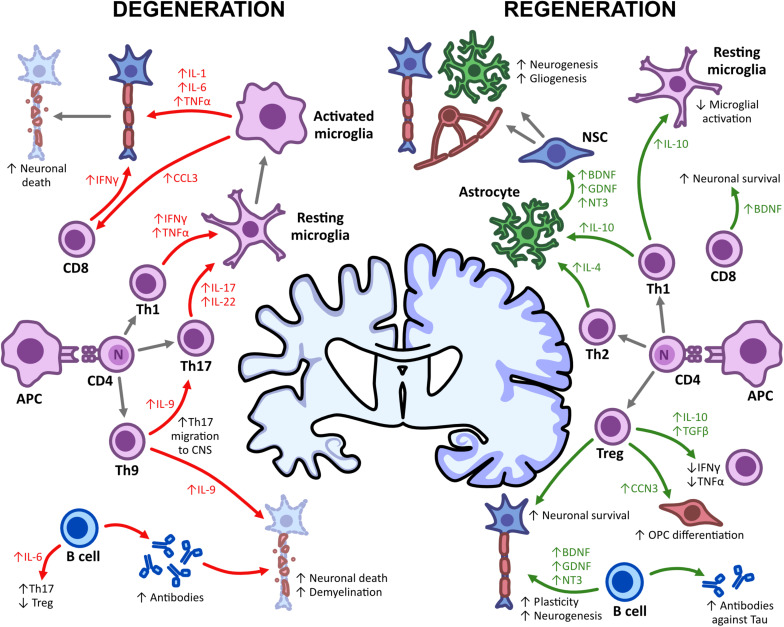
Adaptive immunity in CNS degeneration and regeneration. The damage and repair of the CNS is mediated by immune mechanisms, with both T and B cells having detrimental and regenerative effects. Upon APC-T lymphocyte interactions, T effector cells such as Th1, Th17, and Th9 promote microglial activation through the expression of pro-inflammatory cytokines (IFN-γ, TNFα, IL-9, and IL-17). This subsequently enhances neuronal death and demyelination and leads to a decline in cognitive functioning. Th1, Th2, and Treg cells, however, can also promote regeneration, enhancing neurogenesis, gliogenesis and remyelination upon the secretion of IL-4, IL-10, and TGFβ. Somewhat similar to Th1, CD8+ T cells, and B cells also increase neuronal death but can promote survival through neurotrophic production (BDNF, GDNF, and NT3) and an increased antibody repertoire. This shows the impact of immune-mediated mechanisms on degeneration/regeneration and some possible targets for immunotherapies.
FIGURE 2
FIGURE 2
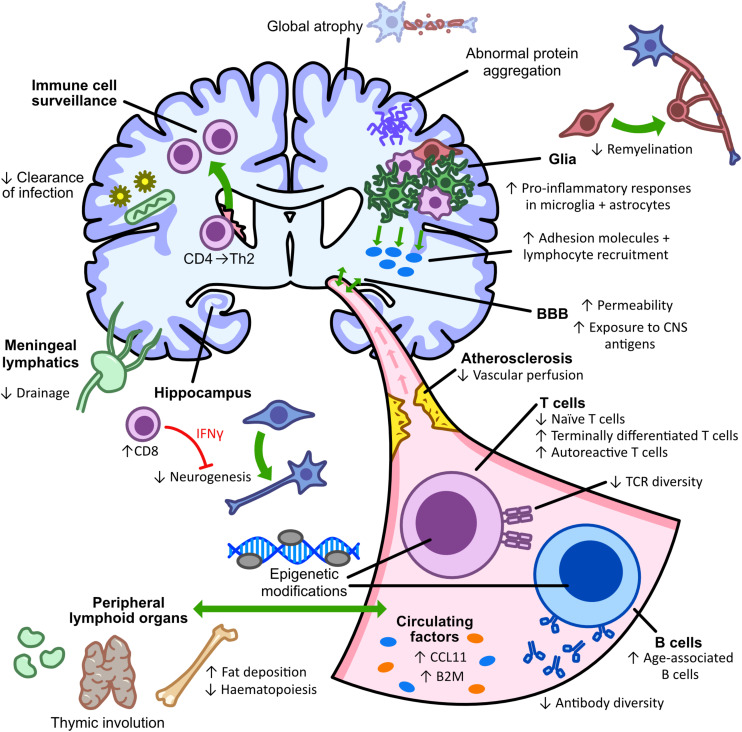
Aging alters CNS-immune interactions in health and disease. Aging is a major risk factor for neurodegeneration that is accompanied by progressive immunosenescence, inflammaging, atrophy, and neuroinflammation. Microglia and astrocytes are thought to respond more to pro-inflammatory cytokines, such as IFNγ and TNFα, and become prone to abnormal inflammatory activation; leading to reduced remyelination and enhanced lymphocytic recruitment. Subsequent aging-related changes in BBB permeability and lymphatic drainage also increase the infiltration of cytotoxic CD8+ T cells to the brain, which can inhibit neurogenesis through IFN-γ signaling. In the periphery, processes such as thymic involution and epigenetic modifications similarly alter the number of naïve CD4+ T cells and can diminish the antibody repertoire following an increase in age-associated pro-inflammatory B cells. By contributing to poor infection clearance, protein aggregation and altered immune cell surveillance, aging therefore has a detrimental impact on both the immune system and cognitive functioning.

References

    1. Acevedo-Arozena A., Kalmar B., Essa S., Ricketts T., Joyce P., Kent R., et al. (2011). A comprehensive assessment of the SOD1G93A low-copy transgenic mouse, which models human amyotrophic lateral sclerosis. Dis. Model. Mech. 4 686–700. 10.1242/dmm.007237 - DOI - PMC - PubMed
    1. Akhtar R. S., Licata J. P., Luk K. C., Shaw L. M., Trojanowski J. Q., Lee V. M.-Y. (2018). Measurements of auto-antibodies to alpha-synuclein in the serum and cerebral spinal fluids of patients with Parkinson’s disease. J. Neurochem. 145 489–503. 10.1111/jnc.14330 - DOI - PMC - PubMed
    1. Alcina A., Abad-Grau M. D. M., Fedetz M., Izquierdo G., Lucas M., Fernández O., et al. (2012). Multiple sclerosis risk variant HLA-DRB1∗1501 associates with high expression of DRB1 gene in different human populations. PLoS One 7:e29819. 10.1371/journal.pone.0029819 - DOI - PMC - PubMed
    1. Alizadeh A., Dyck S. M., Karimi-Abdolrezaee S. (2019). Traumatic spinal cord injury: an overview of pathophysiology, models and acute injury mechanisms. Front. Neurol. 10:282. 10.3389/fneur.2019.00282 - DOI - PMC - PubMed
    1. Alonso A., Logroscino G., Jick S. S., Hernán M. A. (2009). Incidence and lifetime risk of motor neuron disease in the United Kingdom: a population-based study. Eur. J. Neurol. 16 745–751. 10.1111/j.1468-1331.2009.02586.x - DOI - PMC - PubMed