


Factors Associated With Persistence and Clearance of High-Risk Oral Human Papillomavirus (HPV) Among Participants in the HPV Infection in Men (HIM) Study
- PMID: 33173937
- PMCID: PMC8563218
- DOI: 10.1093/cid/ciaa1701
Factors Associated With Persistence and Clearance of High-Risk Oral Human Papillomavirus (HPV) Among Participants in the HPV Infection in Men (HIM) Study
Abstract
Background: Human papillomavirus (HPV)-attributable oropharyngeal cancer (HPV-OPC) incidence is increasing in many high-income countries among men. Factors associated with oral HPV persistence, the precursor of HPV-OPC, are unknown. Data from the HPV Infection in Men (HIM) Study, which followed participants >7 years, were utilized to examine rates of persistence and associated factors.
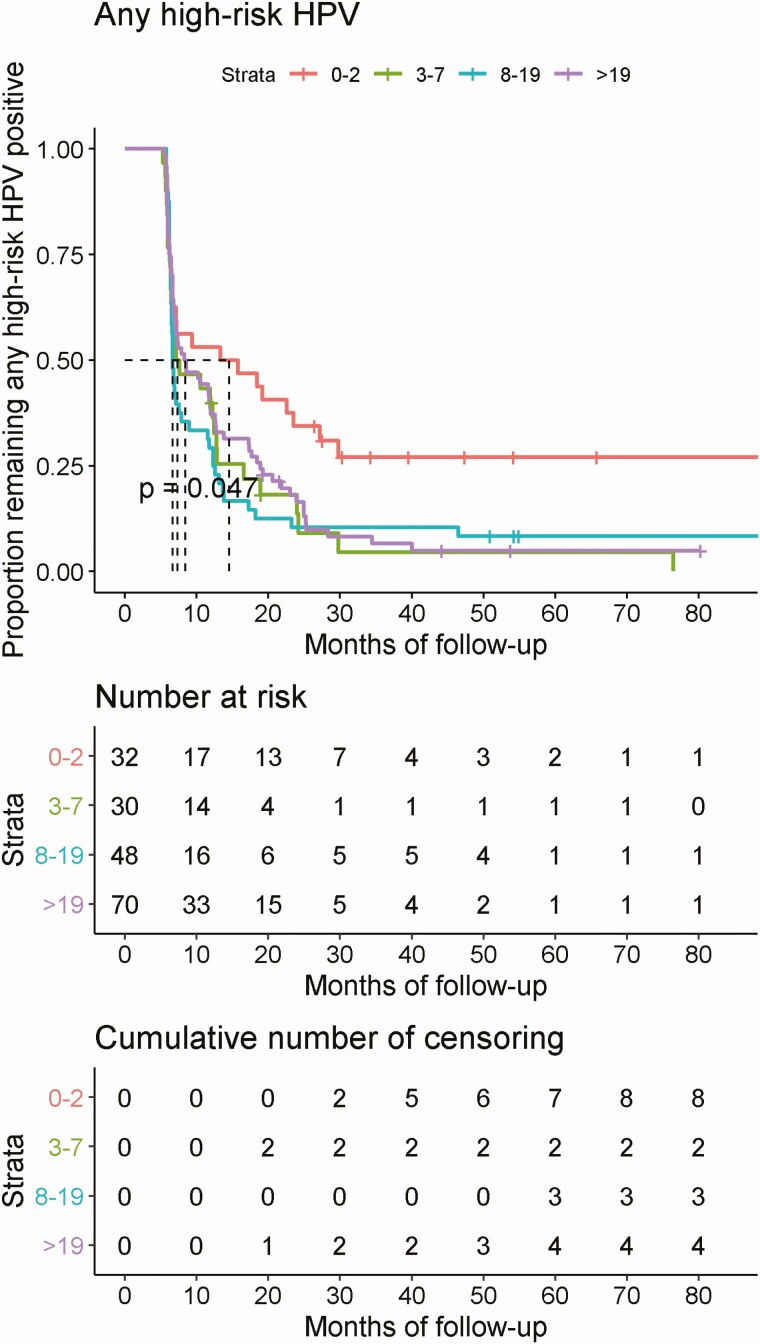
Methods: Oral gargle samples from 3095 HIM study participants were HPV genotyped using the SPF10 PCR-DEIA-LiPA25 assay (DDL Diagnostic Laboratory). Oral HPV persistence for individual and grouped high-risk HPV types among 184 men positive for any high-risk HPV at their oral baseline visit was assessed at 6-month intervals. Factors associated with grouped high-risk HPV/HPV16 persistence were examined using logistic regression. Kaplan-Meier curves were constructed to examine median time to HPV clearance overall, and by selected risk factors.
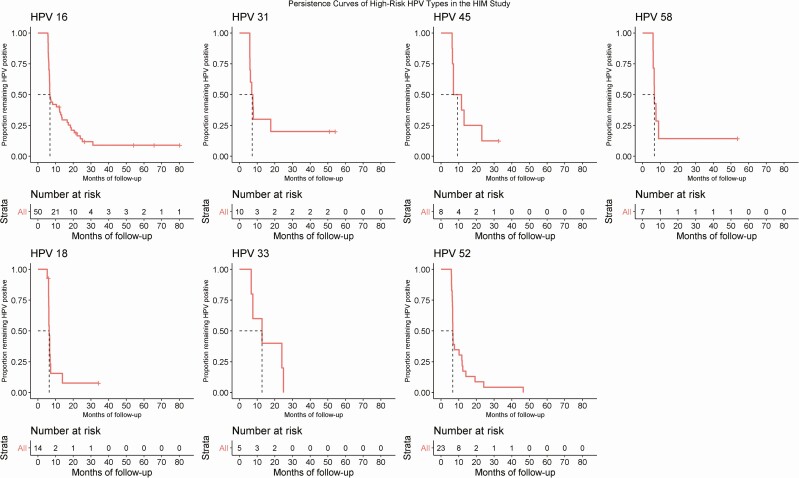
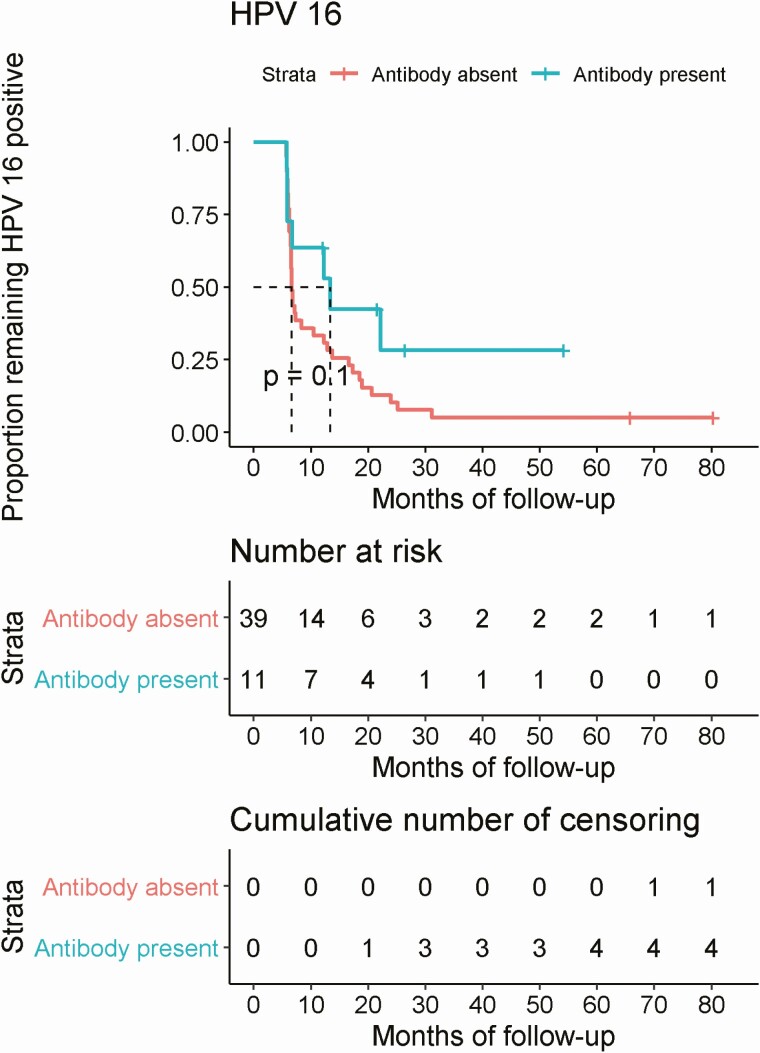
Results: Among the 7 HPV vaccine types, HPV33 had the longest median duration (7.6 months) followed by HPV16 and HPV45 (6.4 months). 10-30% of oral high-risk HPV infections persisted ≥24 months. Six months' persistence of oral high-risk HPV infections was positively associated with age and gingivitis and negatively with lifetime number of sexual partners, while 12 months' persistence was only inversely associated with lifetime number of sexual partners. Oral HPV16 persistence was positively associated with baseline HPV16 L1 antibody status.
Conclusions: Eighteen percent of HPV16 infections persisted beyond 24 months, potentially conferring higher risk of HPV-OPC among these men. Older age appears to be an important factor associated with oral high-risk HPV persistence. More studies among healthy men are required to understand the progression of oral HPV infection to HPV-OPC.
Keywords: HIM study; HPV persistence; oral HPV; oral HPV clearance; oropharyngeal cancer.
© The Author(s) 2020. Published by Oxford University Press for the Infectious Diseases Society of America.
Figures
References
-
- Näsman A, Attner P, Hammarstedt L, et al. Incidence of human papillomavirus (HPV) positive tonsillar carcinoma in Stockholm, Sweden: an epidemic of viral-induced carcinoma? Int J Cancer 2009; 125:362–6. - PubMed
-
- Lowy DR, Herrero R, Hildesheim A; Participants in the IARC/NCI Workshop on Primary Endpoints for Prophylactic HPV Vaccine Trials . Primary endpoints for future prophylactic human papillomavirus vaccine trials: towards infection and immunobridging. Lancet Oncol 2015; 16:e226–33. - PubMed
Publication types
MeSH terms
Grants and funding
LinkOut - more resources
Full Text Sources
Medical
