Review
. 2020 Dec;22(6):4992-5002.
doi: 10.3892/mmr.2020.11607. Epub 2020 Oct 16.

Research advances in molecular mechanisms underlying the pathogenesis of cystic fibrosis: From technical improvement to clinical applications (Review)

Affiliations
Review

Research advances in molecular mechanisms underlying the pathogenesis of cystic fibrosis: From technical improvement to clinical applications (Review)

Tao Wei et al. Mol Med Rep. 2020 Dec.

Abstract

Cystic fibrosis (CF) is a chronic disease causing severe impairment to the respiratory system and digestive tracts. Currently, CF is incurable. As an autosomal recessive disorder, the morbidity of CF is significantly higher among Caucasians of European descent, whereas it is less pervasive among African and Asian populations. The disease is caused by identical mutations (homozygosity) or different mutations (heterozygosity) of an autosomal recessive mutation at position 7q31.2‑q31.1 of chromosome 7. Diagnostic criteria and guidelines work concurrently with laboratory detection to facilitate precise CF detection. With technological advances, the understanding of CF pathogenesis has reached an unprecedented level, allowing for increasingly precise carrier screening, more effective early stage CF intervention and improved prognostic outcomes. These advances significantly increase the life quality and expectancy of patients with CF. Given the numerous improvements in the field of CF, the current review summarized the technical advances in the study of the molecular mechanisms underlying CF, as well as how these improvements facilitate the clinical outcomes of CF. Furthermore, challenges and obstacles to overcome are discussed.


Figures
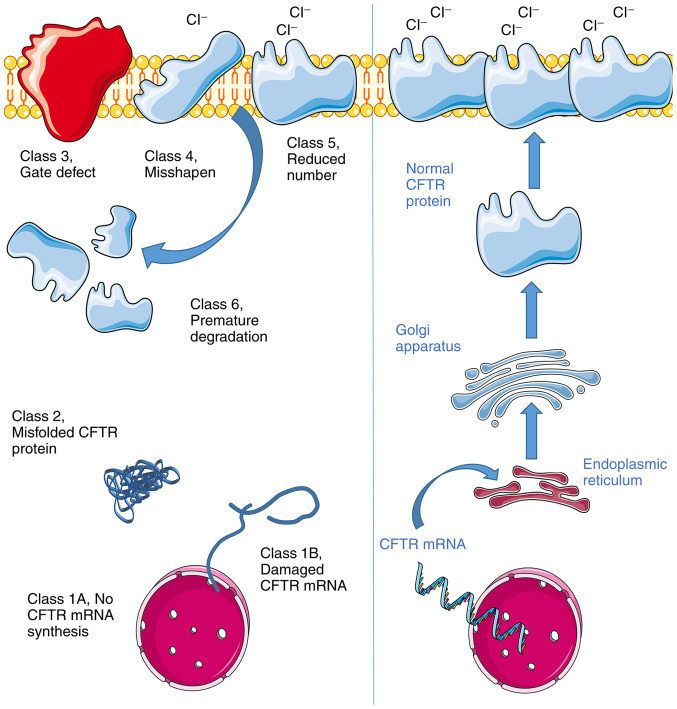
Figure 1.
Figure 1.
Different types of CFTR mutations. Generally, intact CFTR mRNA can be generated from the cell nucleus and following correct folding, sufficient amount of normal CFTR protein is transported to the cell membrane to serve as a Cl channel. In contrast, different malfunctions in this multi-step process lead to different CFTR defects. CFTR, cystic fibrosis transmembrane conductance regulator; Cl, chloride ion.
Figure 2.
Figure 2.
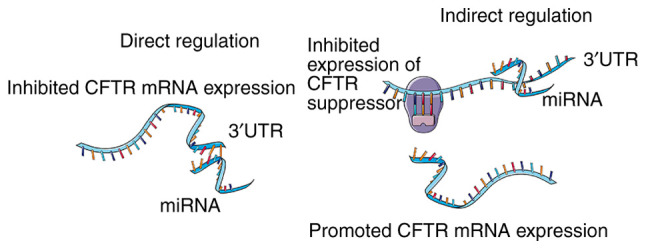
miRNA regulation of CFTR. The majority of studies have focused on the direction of miRNAs in the regulation of CFTR, whereby miRNAs lead to silence or degradation of CFTR mRNA by binding to its 3′UTR. Additionally, miRNAs inhibit the expression of certain CFTR suppressors, through which they promote the expression of CFTR mRNA. miRNA, microRNA; CFTR, cystic fibrosis transmembrane conductance regulator; UTR, untranslated region.
Figure 3.
Figure 3.
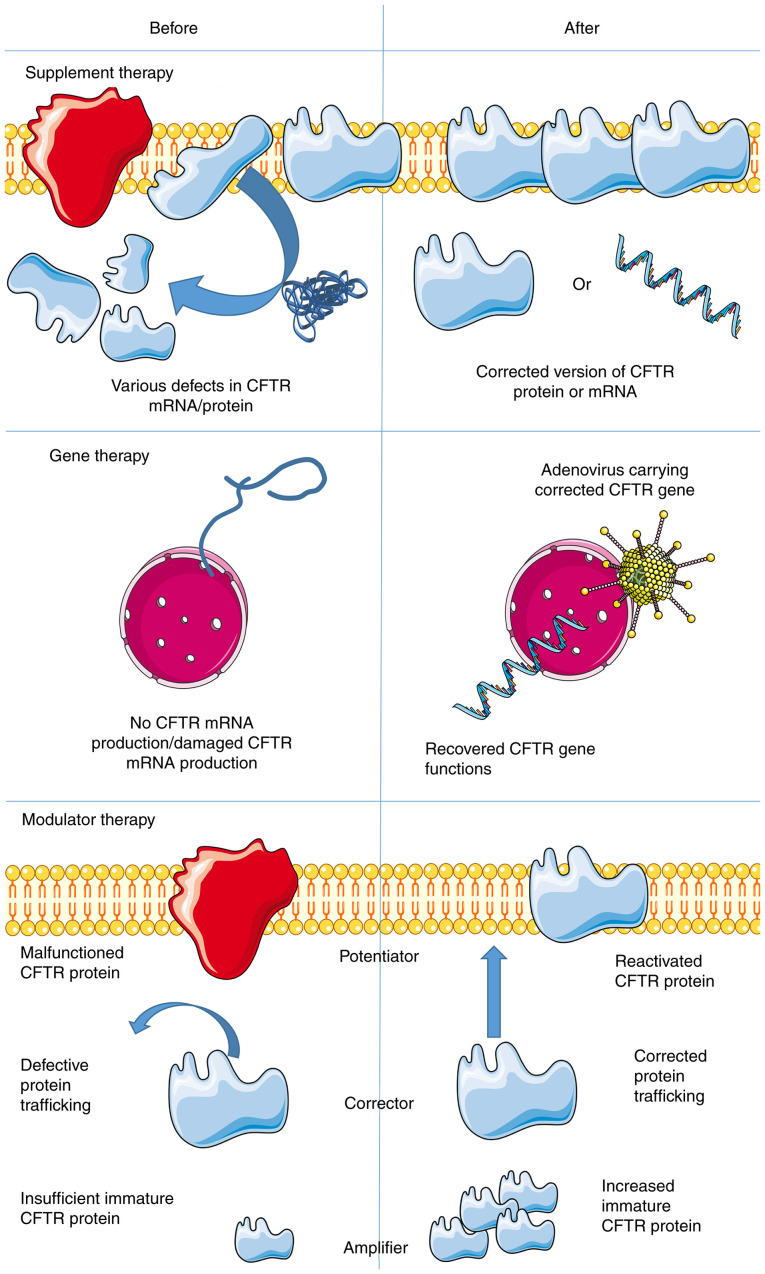
Schematic of several alternatives of molecular therapy. Comparisons were made between prior to and post-treatment. In supplement therapy, the corrected version of the CFTR protein (protein supplementation) or mRNA (RNA antisense therapy) were delivered to the cell. These exogenous molecules exerted their regulatory roles mainly in the cytoplasm. In gene therapy, packaged lentiviruses correcting the CFTR gene are directly inserted into the cell nucleus, thereby facilitating the normal transcription of CFTR mRNA. Furthermore, in modulator therapy, potentiators enhance the gating properties of malfunctioned CFTR, correctors induce correct CFTR protein folding/trafficking and amplifiers increase the production of immature CFTR protein, providing sufficient substrate for the corrector and potentiator. CFTR, cystic fibrosis transmembrane conductance regulator.

References

    1. Klimova B, Kuca K, Novotny M, Maresova P. Cystic fibrosis revisited-a review study. Med Chem. 2017;13:102–109. doi: 10.2174/1573406412666160608113235. - DOI - PubMed
    1. Brewington JJ, Filbrandt ET, LaRosa FJ, III, Ostmann AJ, Strecker LM, Szczesniak RD, Clancy JP. Detection of CFTR function and modulation in primary human nasal cell spheroids. J Cyst Fibros. 2018;17:26–33. doi: 10.1016/j.jcf.2017.06.010. - DOI - PMC - PubMed
    1. Keiser NW, Birket SE, Evans IA, Tyler SR, Crooke AK, Sun X, Zhou W, Nellis JR, Stroebele EK, Chu KK, et al. Defective innate immunity and hyperinflammation in newborn cystic fibrosis transmembrane conductance regulator-knockout ferret lungs. Am J Respir Cell Mol Biol. 2015;52:683–694. doi: 10.1165/rcmb.2014-0250OC. - DOI - PMC - PubMed
    1. Santoro D, Postorino A, Lucanto C, Costa S, Cristadoro S, Pellegrino S, Conti G, Buemi M, Magazzù G, Bellinghieri G. Cystic fibrosis: A risk condition for renal disease. J Ren Nutr. 2017;27:470–473. doi: 10.1053/j.jrn.2017.05.006. - DOI - PubMed
    1. Dekkers JF, Wiegerinck CL, de Jonge HR, Bronsveld I, Janssens HM, de Winter-de Groot KM, Brandsma AM, de Jong NW, Bijvelds MJ, Scholte BJ, et al. A functional CFTR assay using primary cystic fibrosis intestinal organoids. Nat Med. 2013;19:939–945. doi: 10.1038/nm.3201. - DOI - PubMed

MeSH terms

Substances