. 2020 Nov 25;142(47):19781-19798.
doi: 10.1021/jacs.0c09293. Epub 2020 Nov 11.

Solute-Solvent Interactions in Modern Physical Organic Chemistry: Supramolecular Polymers as a Muse

Affiliations

Solute-Solvent Interactions in Modern Physical Organic Chemistry: Supramolecular Polymers as a Muse

Mathijs F J Mabesoone et al. J Am Chem Soc. .

Abstract

Interactions between solvents and solutes are a cornerstone of physical organic chemistry and have been the subject of investigations over the last century. In recent years, a renewed interest in fundamental aspects of solute-solvent interactions has been sparked in the field of supramolecular chemistry in general and that of supramolecular polymers in particular. Although solvent effects in supramolecular chemistry have been recognized for a long time, the unique opportunities that supramolecular polymers offer to gain insight into solute-solvent interactions have become clear relatively recently. The multiple interactions that hold the supramolecular polymeric structure together are similar in strength to those between solute and solvent. The cooperativity found in ordered supramolecular polymers leads to the possibility of amplifying these solute-solvent effects and will shed light on extremely subtle solvation phenomena. As a result, many exciting effects of solute-solvent interactions in modern physical organic chemistry can be studied using supramolecular polymers. Our aim is to put the recent progress into a historical context and provide avenues toward a more comprehensive understanding of solvents in multicomponent supramolecular systems.


Conflict of interest statement

The authors declare no competing financial interest.

Figures
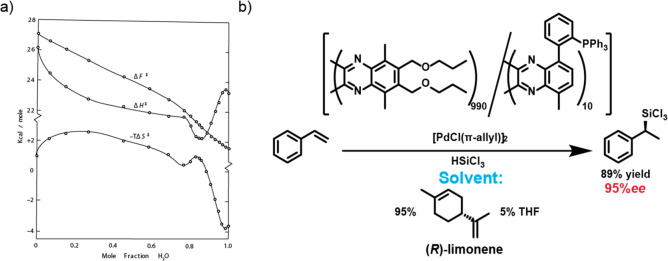
Figure 1
Figure 1
(a) Changes in transition state Gibbs free energy (ΔF), enthalpy (ΔH), and entropy (ΔS) of the solvolysis of t-butyl chloride in EtOH–H2O mixtures. Image adapted with permission from ref (25). Copyright 1957 American Chemical Society. (b) Poly(quinoxaline-2,3-diyl)s adopt a preferred helicity due to chiral solvent and transfer the chirality of the solvent through their catalytic activity to the silylated product of the reaction. Scheme adapted from ref (57) with permission from the American Chemical Society.
Figure 2
Figure 2
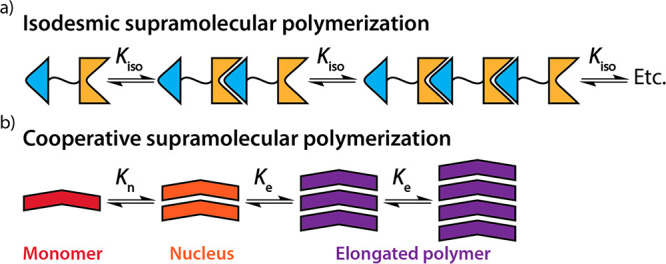
Cartoon representations of (a) an isodesmic supramolecular polymerization and (b) a cooperative, or nucleated, supramolecular polymerization.
Figure 3
Figure 3
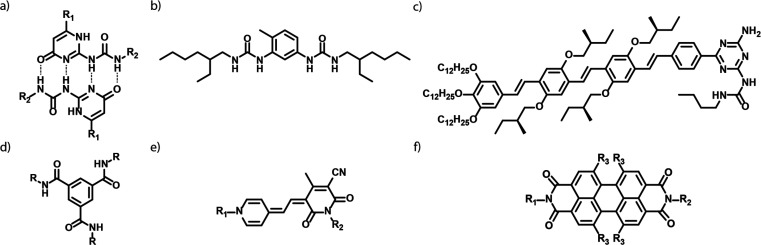
(a) Chemical structure of the dimerized UPy motif often used in isodesmic, telechelic supramolecular polymers. (b–d) Chemical structures of monomer platforms that form cooperative supramolecular polymers: (b) 2,4-di(N′-2-ethylhexylureido)toluene (EHUT), (c) an oligo(p-phenylene vinylene) derivative, as well as examples of the platforms of (d) the benzene-1,3,5-tricarboxamide, (e) merocyanine, and (f) perylenebisimide.
Figure 4
Figure 4
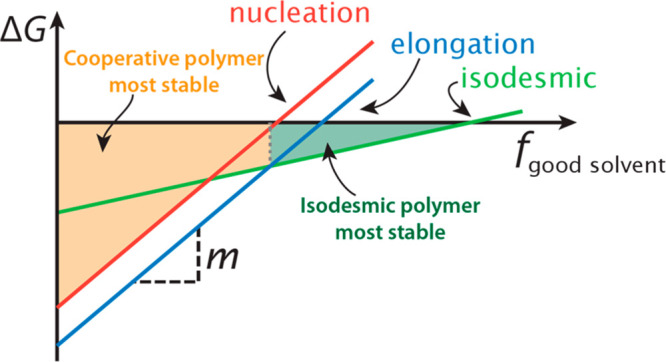
Schematic representation of the changes in Gibbs free energies (ΔG) upon the addition of a good solvent of the various aggregation pathways in a competitive supramolecular polymerization involving a cooperative and isodesmic pathway. As a fraction of good solvent, fgood-solvent, is added, the change in stability of the aggregates is given by their m-value. When the elongation or isodesmic pathway is lower in ΔG, the cooperative or isodesmic polymers, respectively, are the most stable polymers, as indicated by the shaded areas and dashed lines.
Figure 5
Figure 5
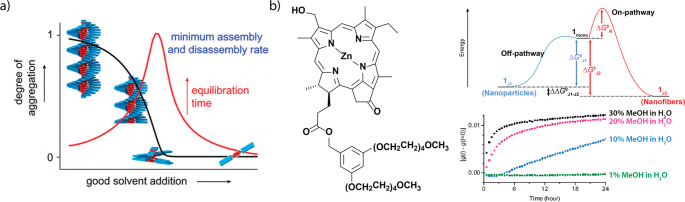
(a) Cartoon depiction of the solvent-dependent equilibration time of OPV derivatives (Figure 3c), as measured by Korevaar et al. Reprinted with permission from ref (102). Copyright 2012 American Chemical Society. (b) Solvent-dependent interconversion between kinetically trapped off-pathway aggregates (low signal, bottom figure) and thermodynamically stable on-pathway aggregates of a zinc-chlorin model system. Image adapted from ref (146). Published by The Royal Society of Chemistry.
Figure 6
Figure 6
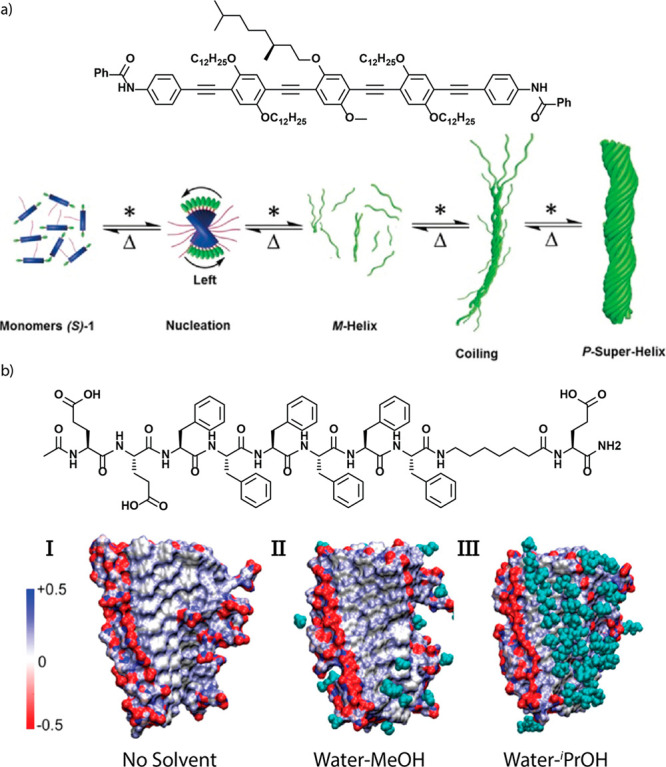
(a) Cartoon representation of the supramolecular polymerization and subsequent superhelix formation of oligo(phenylene ethynylene) derivatives. Reproduced with permission from ref (167). Copyright 2017 John Wiley and Sons. (b) Space filling model of the peptide amphiphile studied by Stevens and co-workers, showing how various alcohol cosolvents solvate the amphiphile surface. Image reproduced from ref (168). Copyright 2019 the American Chemical Society.
Figure 7
Figure 7
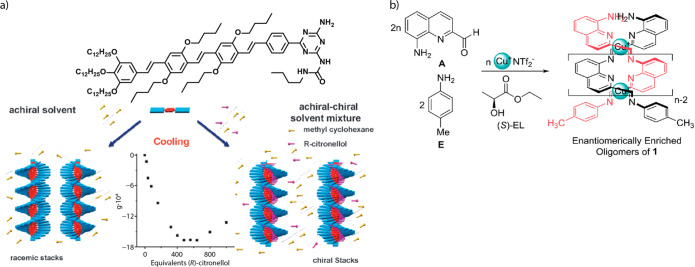
(a) (R)-Citronellol as cosolvent in MCH induces the formation of supramolecular polymers of OPV derivatives (Figure 2b) of a preferred handedness. Reproduced from ref (176) with permission from The Royal Society of Chemistry. (b) Chiral (S)-ethyl lactate ((S)-EL) solvent induces the formation of metallosupramolecular polymers of a single handedness. Figure adapted from ref (179). Copyright 2018 the American Chemical Society.
Figure 8
Figure 8
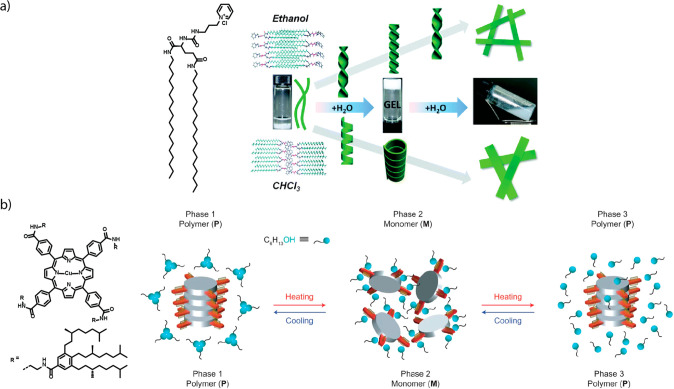
(a) Chemical structure of the glutamide-based amphiphile used by Liu et al., and cartoon representations of the different polymer morphologies formed in different solvents. Reproduced from ref (183) with permission from The Royal Society of Chemistry. (b) Schematic depiction of the thermally bisignate supramolecular polymerization developed by the group of Aida. Adapted with permission from Springer Nature from ref (191), copyright 2017.
Figure 9
Figure 9
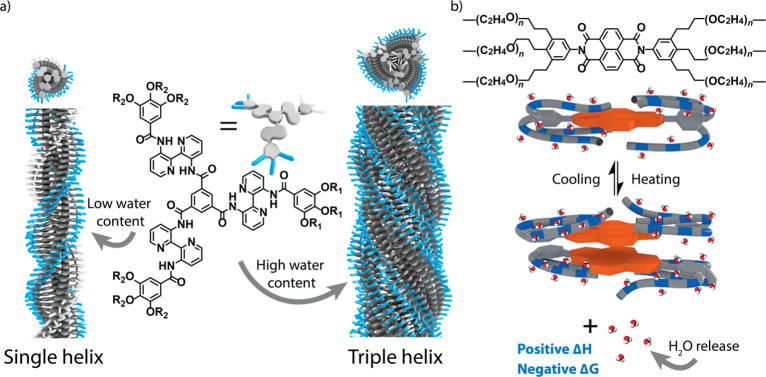
(a) Bipyridine–BTA platform from Gillissen et al. Image adapted with permission from ref (196). Copyright 2014, American Chemical Society. (b) Water-soluble naphthalene bisimides developed by the group of Würthner, which polymerize upon heating due to release of water. Image adapted from ref (204). Published by The Royal Society of Chemistry.

References

    1. Marcus Y. The Properties of Organic Liquids That Are Relevant to Their Use as Solvating Solvents. Chem. Soc. Rev. 1993, 22 (6), 409–416. 10.1039/cs9932200409. - DOI
    1. Ball P. Water as an Active Constituent in Cell Biology. Chem. Rev. 2008, 108 (1), 74–108. 10.1021/cr068037a. - DOI - PubMed
    1. Dill K. A.; Bromberg S.; Yue K.; Chan H. S.; Ftebig K. M.; Yee D. P.; Thomas P. D. Principles of Protein Folding - A Perspective from Simple Exact Models. Protein Sci. 1995, 4 (4), 561–602. 10.1002/pro.5560040401. - DOI - PMC - PubMed
    1. Tinoco I.; Bustamante C. How RNA Folds. J. Mol. Biol. 1999, 293 (2), 271–281. 10.1006/jmbi.1999.3001. - DOI - PubMed
    1. Banani S. F.; Lee H. O.; Hyman A. A.; Rosen M. K. Biomolecular Condensates: Organizers of Cellular Biochemistry. Nat. Rev. Mol. Cell Biol. 2017, 18 (5), 285–298. 10.1038/nrm.2017.7. - DOI - PMC - PubMed