


The State of Evidence in Patient Portals: Umbrella Review
- PMID: 33174851
- PMCID: PMC7688386
- DOI: 10.2196/23851
The State of Evidence in Patient Portals: Umbrella Review
Erratum in
-
Correction: The State of Evidence in Patient Portals: Umbrella Review.J Med Internet Res. 2021 Aug 16;23(8):e32421. doi: 10.2196/32421. J Med Internet Res. 2021. PMID: 34398799 Free PMC article.
Abstract
Background: Patient portals have emerged as a recognized digital health strategy. To date, research on patient portals has grown rapidly. However, there has been limited evaluation of the growing body of evidence on portal availability, use, clinical or health behavior and outcomes, and portal adoption over time.
Objective: This paper aims to comprehensively consolidate the current state of evidence on patient portals using the umbrella review methodology, introduce our approach for evaluating evidence for quantitative and qualitative findings presented in included systematic reviews, and present a knowledge translation tool that can be used to inform all stages of patient portal adoption.
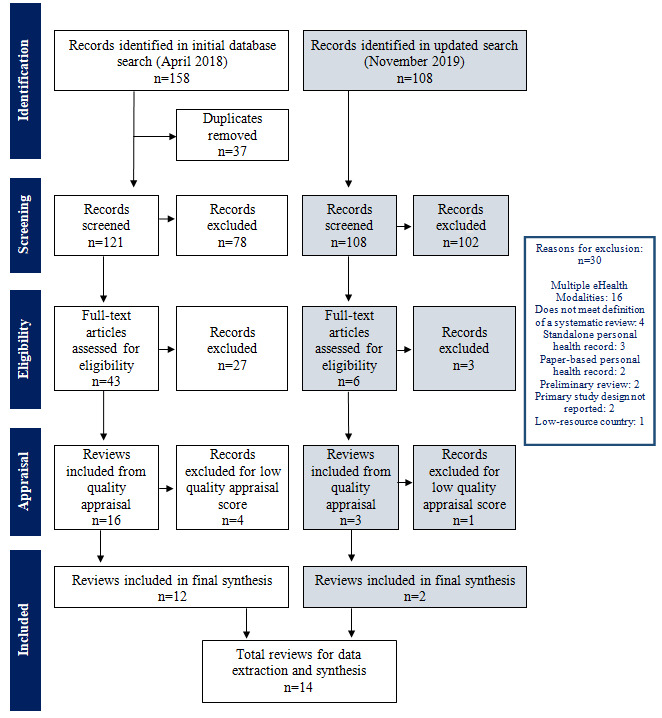
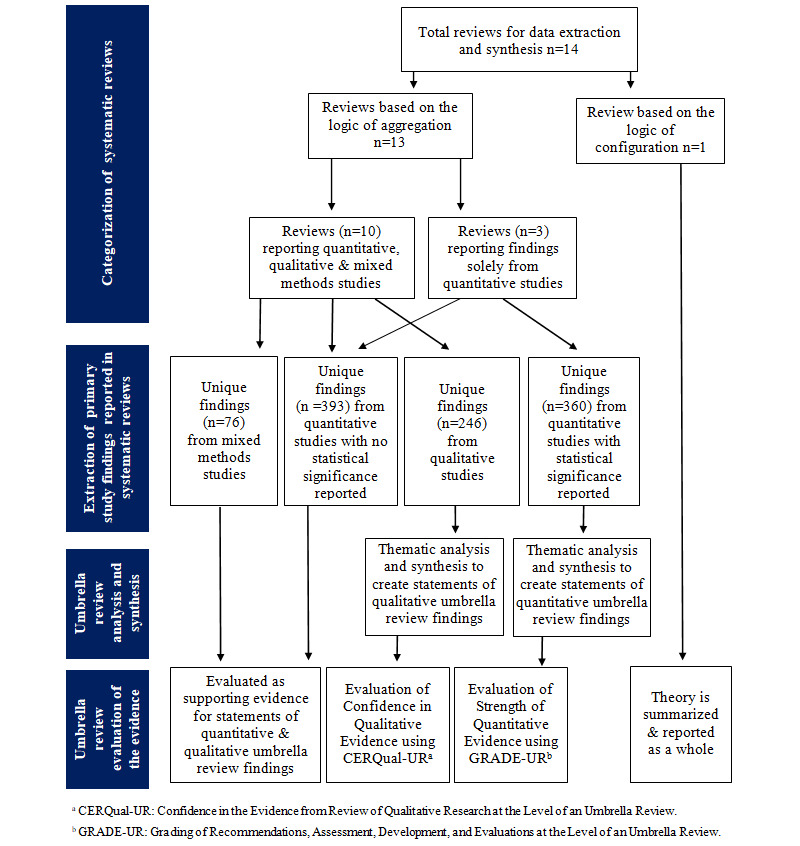
Methods: For this study, a modified version of the Joanna Briggs Institute umbrella review method was used. Multiple databases were searched for systematic reviews focused on patient portals, and the final sample included 14 reviews. We conducted a meta-level synthesis of findings from quantitative, qualitative, and mixed methods primary studies reported in systematic reviews. We organized the umbrella review findings according to the Clinical Adoption Meta-Model (CAMM). Vote-counting, GRADE (Grading of Recommendations, Assessment, Development, and Evaluations), and CERQual (Confidence in the Evidence from Review of Qualitative Research) were used to assess the umbrella review evidence.
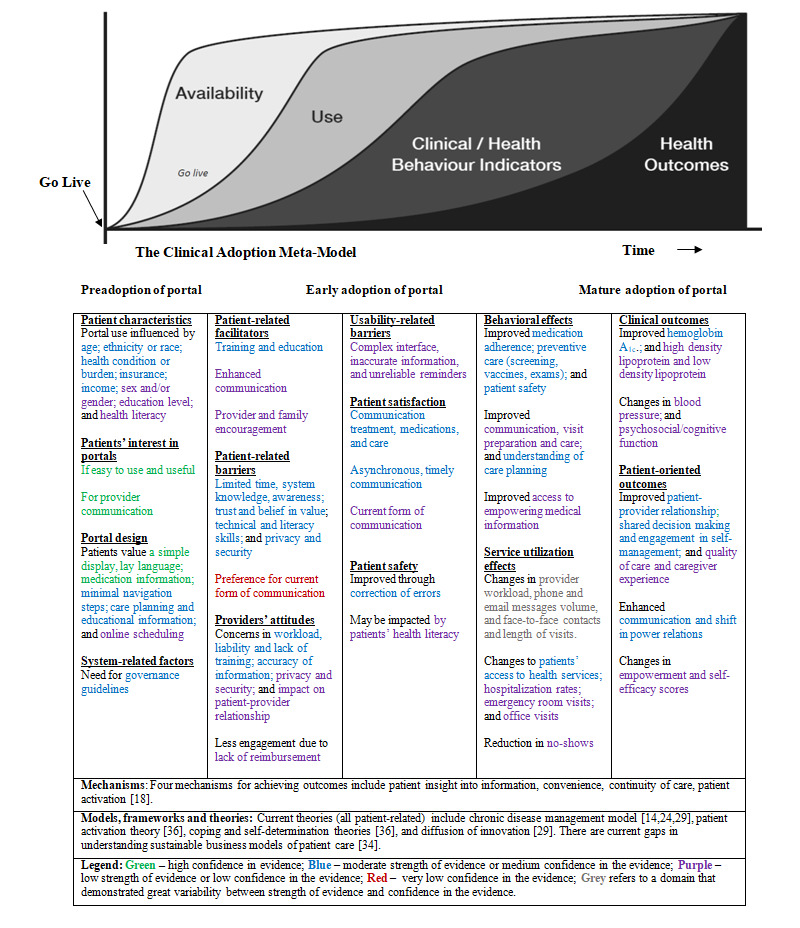
Results: Our knowledge translation tool summarizes the findings in the form of an evidence map. Organized by the CAMM categories, the map describes the following factors that influence portal adoption and effects over time: patient contexts, patient's interest and satisfaction, portal design, facilitators and barriers, providers' attitudes, service utilization, behavioral effects, clinical outcomes, and patient-reported outcomes. The map lists the theories and mechanisms recognized in the included portal research while identifying the need for business models and organizational theories that can inform all stages of portal adoption. Our GRADE and CERQual umbrella review evaluation resulted in the majority of evidence being rated as moderate to low, which reflects methodological issues in portal research, insufficient number of studies, or mixed results in specific focus areas. The 2 findings with a high rating of evidence were patients' interest in using portals for communication and the importance of a simple display of information in the portals. Over 40 portal features were identified in the umbrella review, with communication through secure messaging and appointment booking mentioned in all systematic reviews.
Conclusions: Our umbrella review provides a meta-level synthesis to make sense of the evidence on patient portals from published systematic reviews. Unsystematic and variable reporting of portal features undermines the ability to evaluate and compare portal effects and overlooks the specific context of portal use. Research designs sensitive to the social, organizational, policy, and temporal dimensions are needed to better understand the underlying mechanisms and context that leverage the identified factors to improve portal use and effects.
Keywords: CERQual; GRADE; evidence-based practice; patient portals; personal health records; systematic reviews; umbrella review.
©Marcy G Antonio, Olga Petrovskaya, Francis Lau. Originally published in the Journal of Medical Internet Research (http://www.jmir.org), 11.11.2020.
Conflict of interest statement
Conflicts of Interest: None declared.
Figures
References
-
- Vandekerckhove P, Vandekerckhove Y, Tavernier R, de Jaegher K, de Mul M. Leveraging user experience to improve video consultations in a cardiology practice during the COVID-19 pandemic: initial insights. J Med Internet Res. 2020 Jun 25;22(6):e19771. doi: 10.2196/19771. https://www.jmir.org/2020/6/e19771/ - DOI - PMC - PubMed
-
- Lindsay JA, Hogan JB, Ecker AH, Day SC, Chen P, Helm A. The importance of video visits in the time of COVID-19. J Rural Health. 2020 Jun 7;:-. doi: 10.1111/jrh.12480. epub ahead of print http://europepmc.org/abstract/MED/32506751. - DOI - PMC - PubMed
-
- Lau J, Knudsen J, Jackson H, Wallach AB, Bouton M, Natsui S, Philippou C, Karim E, Silvestri DM, Avalone L, Zaurova M, Schatz D, Sun V, Chokshi DA. Staying connected in the COVID-19 pandemic: telehealth at the largest safety-net system in the United States. Health Aff (Millwood) 2020 Aug;39(8):1437–42. doi: 10.1377/hlthaff.2020.00903. - DOI - PubMed
-
- Using MyHealth Records. Government of Alberta. -. [2020-05-01]. https://myhealth.alberta.ca/myhealthrecords#:~:text=You%20need%20to%20si....
Publication types
MeSH terms
LinkOut - more resources
Full Text Sources
