. 2020 Nov 24;59(46):4456-4462.
doi: 10.1021/acs.biochem.0c00800. Epub 2020 Nov 11.

Polyamines Mediate Folding of Primordial Hyperacidic Helical Proteins

Affiliations

Polyamines Mediate Folding of Primordial Hyperacidic Helical Proteins

Dragana Despotović et al. Biochemistry. .

Abstract

Polyamines are known to mediate diverse biological processes, and specifically to bind and stabilize compact conformations of nucleic acids, acting as chemical chaperones that promote folding by offsetting the repulsive negative charges of the phosphodiester backbone. However, whether and how polyamines modulate the structure and function of proteins remain unclear. In particular, early proteins are thought to have been highly acidic, like nucleic acids, due to a scarcity of basic amino acids in the prebiotic context. Perhaps polyamines, the abiotic synthesis of which is simple, could have served as chemical chaperones for such primordial proteins? We replaced all lysines of an ancestral 60-residue helix-bundle protein with glutamate, resulting in a disordered protein with 21 glutamates in total. Polyamines efficiently induce folding of this hyperacidic protein at submillimolar concentrations, and their potency scaled with the number of amine groups. Compared to cations, polyamines were several orders of magnitude more potent than Na+, while Mg2+ and Ca2+ had an effect similar to that of a diamine, inducing folding at approximately seawater concentrations. We propose that (i) polyamines and dications may have had a role in promoting folding of early proteins devoid of basic residues and (ii) coil-helix transitions could be the basis of polyamine regulation in contemporary proteins.


Conflict of interest statement

The authors declare no competing financial interest.

Figures
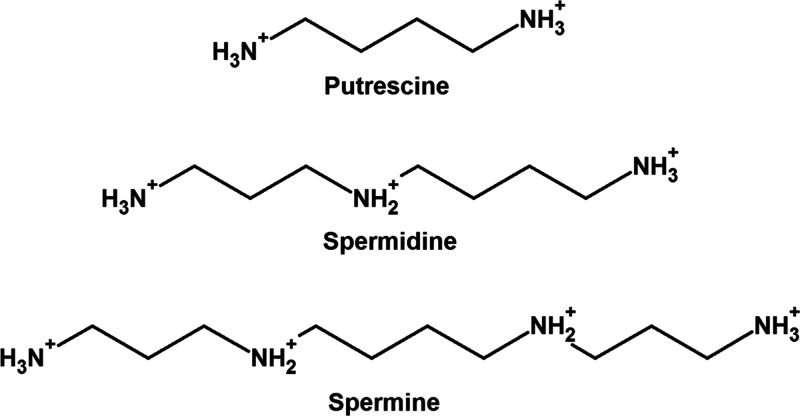
Figure 1
Figure 1
Natural polyamines used in this study. Polyamines are polycations at neutral pH, with pKas that range from 8 to 11.,
Figure 2
Figure 2
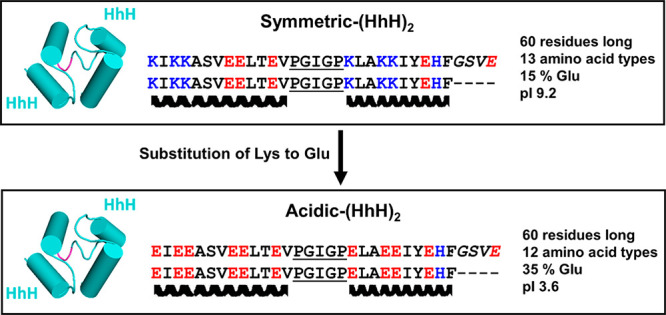
Design of acidic-(HhH)2. Symmetric-(HhH)2 is a fully symmetric protein constructed in a previous study to understand the properties of ancient protein forms. Derived from a family of dsDNA binding proteins, it is positively charged at neutral pH. To generate a hyperacidic model protein for this study, all lysine residues in symmetric-(HhH)2 were substituted with glutamate (see Results for more details). The conserved loop residues between the two helices of the HhH motif (PGIGP) are underlined, and the linker residues (GSVE) between the two HhH motifs are rendered in italics in the sequence and colored magenta in the structural model. The C-terminus of acidic-(HhH)2 bears a 6xHis tag connected by a two-residue Leu-Glu linker (not shown).
Figure 3
Figure 3
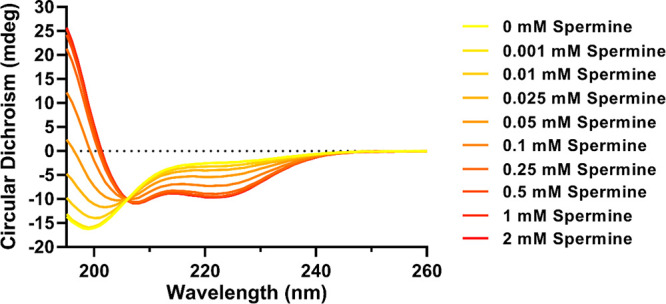
Folding of acidic-(HhH)2 upon spermine addition monitored by circular dichroism (CD). Shown are CD spectra of 5 μM acidic-(HhH)2 with spermine at varying concentrations. Each curve represents the average of two scans after buffer subtraction [5 mM Tris (pH 7.5) and 25 mM NaCl] and correction for dilution by added titrant. The development of a peak at <195 nm and negative bands at ∼208 and ∼222 nm suggests folding into a predominantly α-helical conformation. An isodichroic point at ∼206 nm suggests a two-state transition.
Figure 4
Figure 4
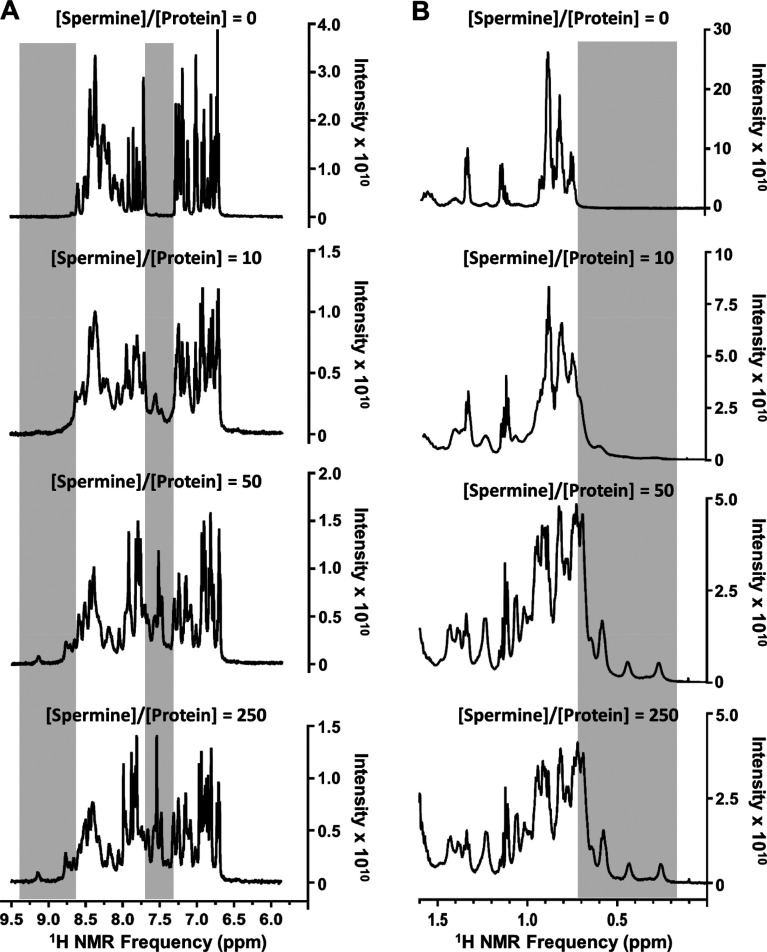
Titration of acidic-(HhH)2 with spermine monitored by NMR. 1D 1H NMR spectra of 100 μM acidic-(HhH)2 in varying concentrations of spermine (0, 1, 5, and 25 mM). The increasing peak dispersion and observation of new peaks upon addition of spermine (highlighted with a gray background) both indicate that spermine is promoting the acquisition of structure. (A) Close-up of the spectral region reporting amide and aromatic protons. (B) Spectral region corresponding to aliphatic protons, predominantly methyl groups.
Figure 5
Figure 5
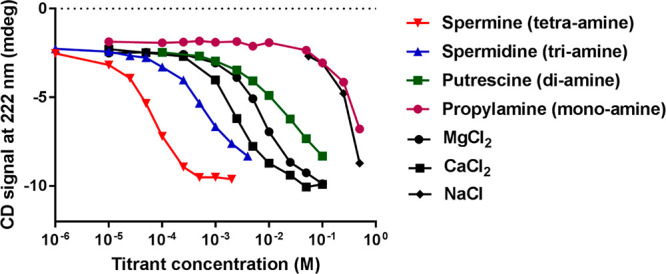
Titration of acidic-(HhH)2 with various polyamines and salts. Circular dichroism spectra of 5 μM acidic-(HhH)2 upon addition of various polyamines and salts were recorded (Figure S5). Plotted here is the CD signal at 222 nm, a reporter of α-helical structure. Empirical midpoint concentrations are 0.07 mM spermine, 0.7 mM spermidine, 21 mM putrescine, 420 mM propylamine, 2.6 mM CaCl2, 7.4 mM MgCl2, and 300 mM NaCl. The midpoint concentrations were estimated from a linear interpolation between points and assuming a folded signal of approximately −10 mdeg at 222 nm. Instead of a technical duplicate, we performed a second polyamine titration experiment with an independent protein preparation at twice the protein concentration, presented in Figure S4. The midpoint concentrations between the two titrations are within 20%, and the order of potency is the same.

References

    1. Michael A. J. (2016) Polyamines in Eukaryotes, Bacteria, and Archaea. J. Biol. Chem. 291, 14896–14903. 10.1074/jbc.R116.734780. - DOI - PMC - PubMed
    1. Kusano T.; Berberich T.; Tateda C.; Takahashi Y. (2008) Polyamines : Essential Factors for Growth and Survival. Planta 228, 367–381. 10.1007/s00425-008-0772-7. - DOI - PubMed
    1. Pasini A.; Caldarera C. M.; Giordano E. (2014) Chromatin Remodeling by Polyamines and Polyamine Analogs. Amino Acids 46, 595–603. 10.1007/s00726-013-1550-9. - DOI - PubMed
    1. Nilsson J.; Koskiniemi S.; Persson K.; Grahn B.; Holm I. (1997) Polyamines Regulate Both Transcription and Translation of the Gene Encoding Ornithine Decarboxylase Antizyme in Mouse. Eur. J. Biochem. 250, 223–231. 10.1111/j.1432-1033.1997.0223a.x. - DOI - PubMed
    1. Matsufuji S.; Matsufuji T.; Miyazaki Y.; Murakami Y.; Atkins J. F; Gesteland R. F; Hayashi S.-i. (1995) Autoregulatory Frameshifting in Decoding Mammalian Ornithine Decarboxylase Antizyme. Cell 80, 51–60. 10.1016/0092-8674(95)90450-6. - DOI - PMC - PubMed

Publication types