Review
. 2021 Aug 1;21(4):386-397.
doi: 10.17305/bjbms.2020.5219.

Epigenetically inactivated RASSF1A as a tumor biomarker

Affiliations
Review

Epigenetically inactivated RASSF1A as a tumor biomarker

Dora Raos et al. Bosn J Basic Med Sci. .

Abstract

RASSF1A, one of the eight isoforms of the RASSF1 gene, is a tumor suppressor gene that influences tumor initiation and development. In cancer, RASSF1A is frequently inactivated by mutations, loss of heterozygosity, and, most commonly, by promoter hypermethylation. Epigenetic inactivation of RASSF1A was detected in various cancer types and led to significant interest; current research on RASSF1A promoter methylation focuses on its roles as an epigenetic tumor biomarker. Typically, researchers analyzed genomic DNA (gDNA) to measure the amount of RASSF1A promoter methylation. Cell-free DNA (cfDNA) from liquid biopsies is a recent development showing promise as an early cancer diagnostic tool using biomarkers, such as RASSF1A. This review discusses the evidence on aberrantly methylated RASSF1A in gDNA and cfDNA from different cancer types and its utility for early cancer diagnosis, prognosis, and surveillance. We compared methylation frequencies of RASSF1A in gDNA and cfDNA in various cancer types. The weaknesses and strengths of these analyses are discussed. In conclusion, although the importance of RASSSF1A methylation to cancer has been established is included in several diagnostic panels, its diagnostic utility is still experimental.


Conflict of interest statement

Conflict of interest statement: The authors declare no conflict of interests.

Figures
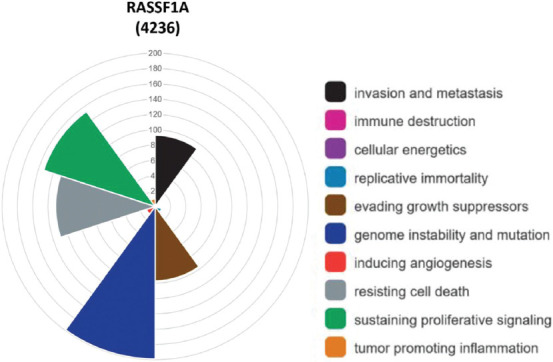
FIGURE 1
FIGURE 1
Distribution of hallmarks of cancer for RASSF1A. In 4236 scientific articles was detected that RASSF1A expression contributes the most to genome instability and mutation, and sustains proliferative signaling. Furthermore, it enables the cell to resist death, to evade growth suppressors and favors invasion of cancer and metastasis
FIGURE 2
FIGURE 2
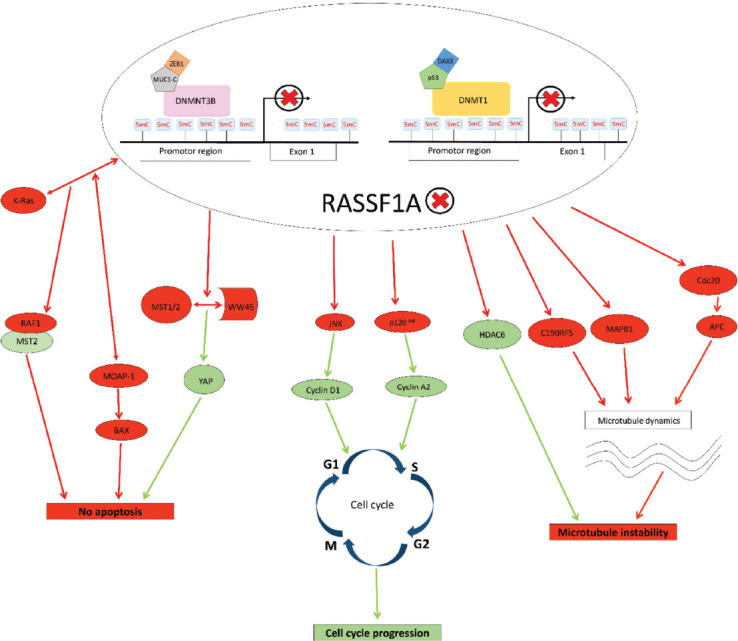
Impact of epigenetic inactivation of RASSF1A to cell signaling pathways. Red arrows represent disturbed or deactivated, while green ones represent activated signaling pathways. When expressed normally, RASSF1A causes repression of cyclin A2 and cyclin D1, which results in cell cycle arrest. RASSF1A also modulates apoptosis. Interactions of RASSF1A with K-Ras activates the MST2-LATS1 apoptotic pathway, i.e., RASSF1A modulates the RAF-1 activity due to competition with MST2 for RAF-1 binding. Also, the interaction of RASSF1A with K-Ras, enhances the interaction of RASSF1A and MOAP-1, promoting RASSF1A’s ability to induce BAX translocation to the mitochondria and cell death. RASSF1A binds to MST1/2 with adaptor protein WW45 that causes phosphorylation, respectively, leading to YAP phosphorylation and inhibition. Additionally, RASSF1A plays an important role in microtubule stability, by inhibiting HDAC6 (histone deacetylase 6), which results in an increase of acetylated microtubules, that are more stable. RASSF1A binds to microtubule-associated proteins (MAPs) which regulate microtubule stability. If RASSF1A is epigenetically inactivated, it causes microtubule instability, repression of apoptosis, and progression of the cell cycle, which favors tumorigenesis
FIGURE 3
FIGURE 3
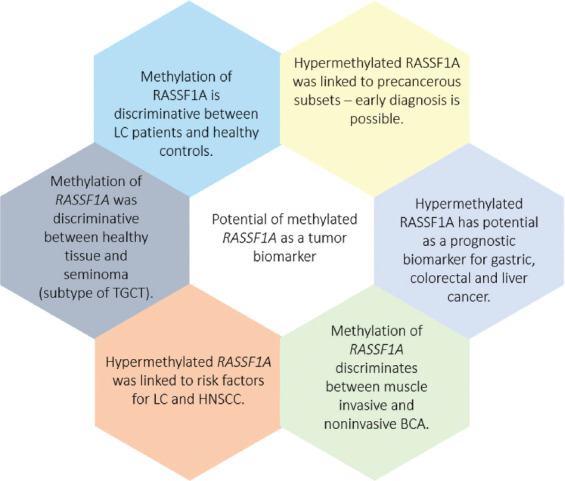
Potential of RASSF1A methylation as a tumor biomarker
FIGURE 4
FIGURE 4
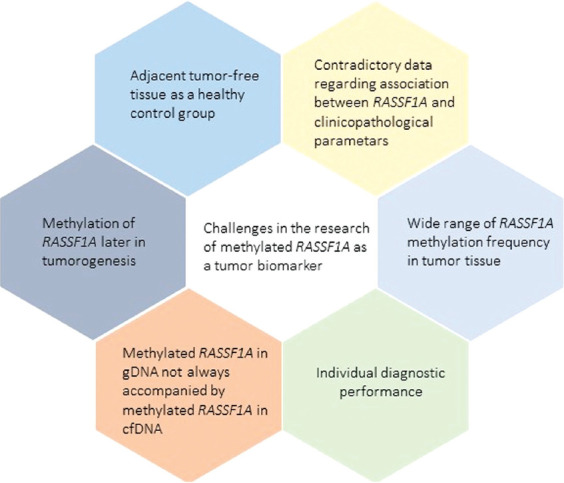
Drawbacks that presented itself in the research of methylated RASSF1A as a tumor biomarker. Highlighted drawbacks should be taken into account and possibly solved, before the translation of methylated RASSF1A as a tumor biomarker in the clinic

References

    1. Mun EJ, Babiker HM, Weinberg U, Kirson ED, Von Hoff DD. Tumor-treating fields:A fourth modality in cancer treatment. Clin Cancer Res. 2018;24(2):266–75. - PubMed
    1. Aghamir SMK, Heshmat R, Ebrahimi M, Khatami F. Liquid Biopsy:The Unique Test for Chasing the Genetics of Solid Tumors. Epigenetics Insights. 2020:13. - PMC - PubMed
    1. Krasic J, Sincic N, Samija I. Liquid biopsy for patients with cancer:different approaches and clinical applications. Molecular and Experimental Biology in Medicine. 2018;2:1–8.
    1. Poulet G, Massias J, Taly V. Liquid Biopsy:General Concepts. Acta Cytol. 2019;63(6):449–55. - PubMed

    1. Diaz LA, Bardelli A. Liquid biopsies:Genotyping circulating tumor DNA. J Clin Oncol. 2014;32(6):579–86. - PMC - PubMed