


Mid to late-life scores of depression in the cognitively healthy are associated with cognitive status and Alzheimer's disease pathology at death
- PMID: 33176024
- PMCID: PMC8048934
- DOI: 10.1002/gps.5470
Mid to late-life scores of depression in the cognitively healthy are associated with cognitive status and Alzheimer's disease pathology at death
Abstract
Objectives: Early diagnosis of Alzheimer's disease (AD) is essential for early interventions. Symptoms of depression could represent a prodromal stage of AD. Very early mood alterations may help to stratify those at highest risk of late-life AD. We aim to investigate associations between baseline/longitudinal scores for depression, presence of cognitive impairment and/or AD pathology at death.
Methods/design: Between 1991 and 2015, participants from The University of Manchester Longitudinal Study of Cognition in Normal Healthy Old Age underwent 10 waves of assessment using the Geriatric Depression Scale (GDS). AD pathology at death was evaluated in 106 eligible cases. Analyses aimed to examine associations between GDS scores, cognitive status and AD pathology (as measured by Braak stage, Thal phase and CERAD).
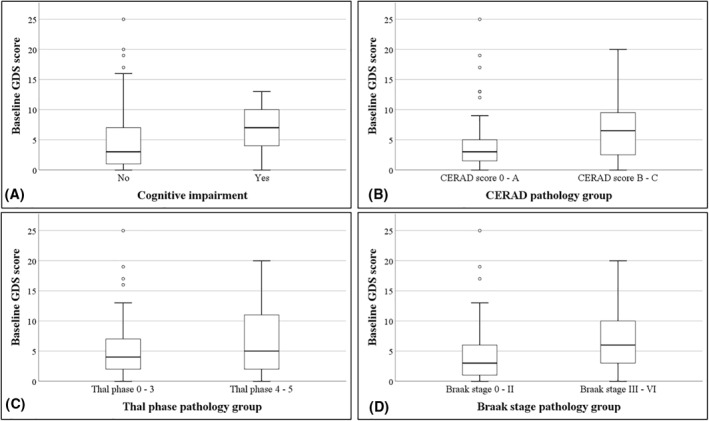
Results: Baseline GDS scores were significantly higher for those cognitively impaired at death than those cognitively normal. Significantly higher baseline GDS scores were found for those with greater Consortium to Establish a Registry for Alzheimer's Disease (CERAD) scores than those with lower CERAD scores. Similarly, significantly higher baseline GDS scores were found for those with a greater Braak stage than those with lower tau burden. These correlations remained after controlling for age at death, education and APOE ε4, but were less robust. Mean longitudinal GDS scores associated with cognition but not pathology.
Conclusions: GDS scores collected approximately 20 years before death were associated with cognitive status and AD pathology at death. We postulate that early AD-related pathological change produces raised GDS scores due to an overlapping neural basis with depression, and that this may be considered as an early diagnostic marker for AD.
Keywords: Alzheimer's disease; depression; early diagnosis; neuropathology; prodrome.
© 2020 The Authors. International Journal of Geriatric Psychiatry published by John Wiley & Sons Ltd.
Conflict of interest statement
The authors have declared that they have no conflict of interest to disclose.
All authors have read the manuscript and have agreed to be listed as authors. Andrew C Robinson devised and designed the study, performed data/statistical analysis and wrote the paper. Federico Roncaroli finalised neuropathological diagnosis and contributed to writing the manuscript. James Minshull assisted with writing the manuscript and performed immunohistochemistry. Calvin Heal performed data/statistical analysis and assisted with preparation of the manuscript. Daniela Montaldi assisted with preparation of the manuscript and advised on neuropsychology. Yvonne S Davidson performed immunohistochemistry and assisted with preparation of the manuscript. Antony Payton assisted with preparation of the manuscript. Michael A Horan helped to finalise clinical cognitive impairment diagnosis and provided clinical data. David MA Mann finalised neuropathological diagnosis and contributed to writing the manuscript. Neil Pendleton finalised clinical cognitive impairment diagnosis and assisted with preparation of the manuscript.
Figures
References
-
- Steffens DC. Late‐life depression and the prodromes of dementia. JAMA Psychiatry. 2017;74(7):673‐674. - PubMed
-
- Kokmen E, Beard CM, Chandra V, Offord KP, Schoenberg BS, Ballard DJ. Clinical risk factors for Alzheimer's disease: a population‐based case‐control study. Neurology. 1991;41(9):1393‐1397. - PubMed
-
- Steffens DC, Plassman BL, Helms MJ, Welsh‐Bohmer KA, Saunders AM, Breitner JC. A twin study of late‐onset depression and apolipoprotein E epsilon 4 as risk factors for Alzheimer's disease. Biol Psychiatry. 1997;41(8):851‐856. - PubMed
-
- Barnes DE, Alexopoulos GS, Lopez OL, Williamson JD, Yaffe K. Depressive symptoms, vascular disease, and mild cognitive impairment: findings from the Cardiovascular Health Study. Arch Gen Psychiatry. 2006;63(3):273‐279. - PubMed
Publication types
MeSH terms
Grants and funding
LinkOut - more resources
Full Text Sources
Medical
Miscellaneous
