


Dosage of oxytocin for augmentation of labor and women's childbirth experiences: A randomized controlled trial
- PMID: 33176392
- PMCID: PMC8248083
- DOI: 10.1111/aogs.14042
Dosage of oxytocin for augmentation of labor and women's childbirth experiences: A randomized controlled trial
Abstract
Introduction: The aim of this study was to compare childbirth experiences and experience of labor pain in primiparous women who had received high- vs low-dose oxytocin for augmentation of delayed labor.
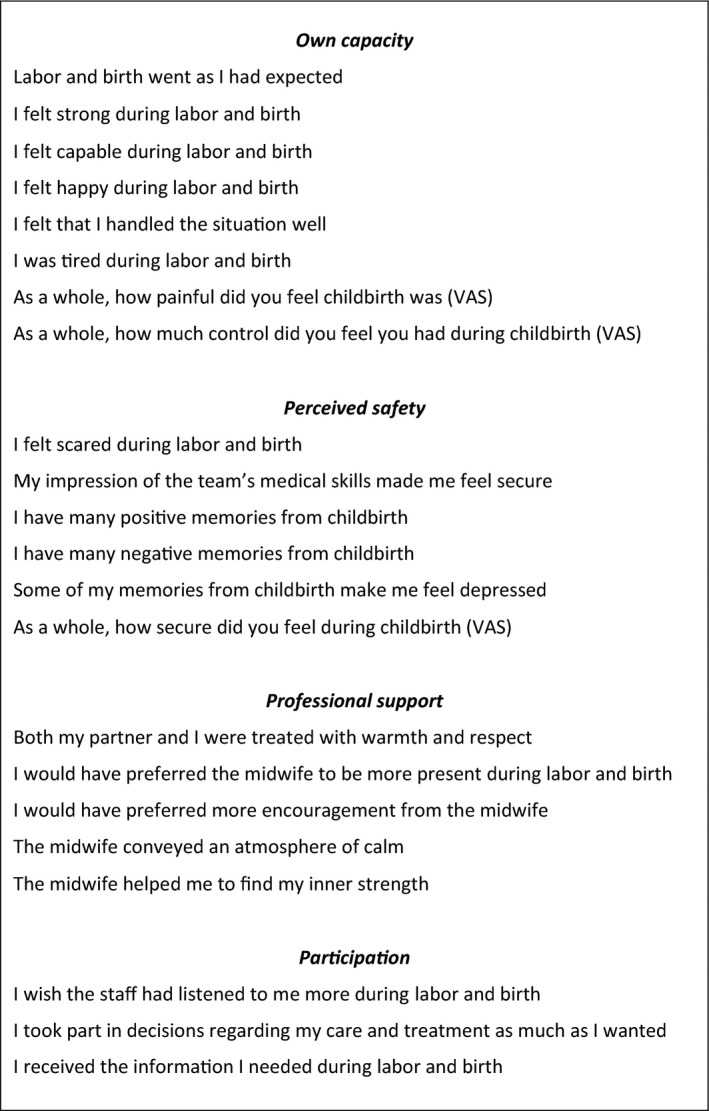
Material and methods: A multicenter, parallel, double-blind randomized controlled trial took place in six Swedish labor wards. Inclusion criteria were healthy primiparous women at term with uncomplicated singleton pregnancies, cephalic fetal presentation, spontaneous onset of labor, confirmed delayed labor progress and ruptured membranes. The randomized controlled trial compared high- vs low-dose oxytocin used for augmentation of a delayed labor progress. The Childbirth Experience Questionnaire version 2 (CEQ2) was sent to the women 1 month after birth. The CEQ2 consists of 22 items in four domains: Own capacity, Perceived safety, Professional support and Participation. In addition, labor pain was reported with a visual analog scale (VAS) 2 hours postpartum and 1 month after birth. The main outcome was the childbirth experience measured with the four domains of the CEQ2. The clinical trial number is NCT01587625.
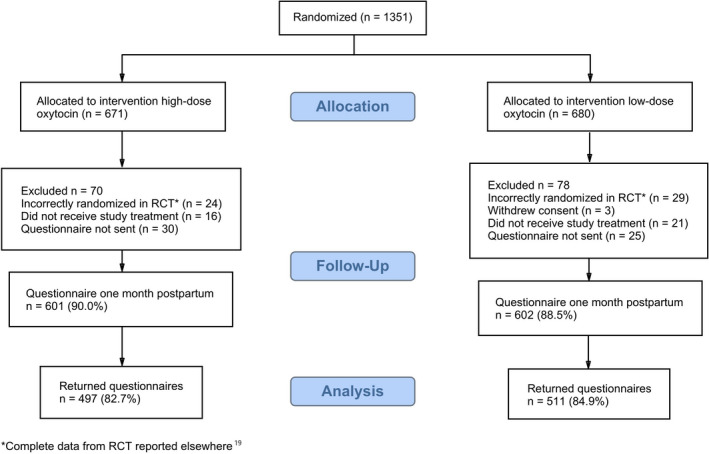
Results: The CEQ2 was sent to 1203 women, and a total of 1008 women (83.8%) answered the questionnaire. The four domains of childbirth experience were scored similarly in the high- and low-dose oxytocin groups of women: Own capacity (P = .36), Perceived safety (P = .44), Professional support (P = .84), Participation (P = .49). VAS scores of labor pain were reported as similar in both oxytocin dosage groups. Labor pain was scored higher 1 month after birth compared with 2 hours postpartum. There was an association between childbirth experiences and mode of birth in both the high- and low-dose oxytocin groups.
Conclusions: Different dosage of oxytocin for augmentation of delayed labor did not affect women's childbirth experiences assessed through CEQ2 1 month after birth, or pain assessment 2 hours or 1 month after birth.
Keywords: birth; childbirth experience; delayed labor; labor pain; oxytocin augmentation; randomized controlled trial.
© 2020 The Authors. Acta Obstetricia et Gynecologica Scandinavica published by John Wiley & Sons Ltd on behalf of Nordic Federation of Societies of Obstetrics and Gynecology (NFOG).
Conflict of interest statement
None.
Figures
References
-
- Lundgren I. Swedish women’s experience of childbirth 2 years after birth. Midwifery. 2005;21:346‐354. - PubMed
-
- Waldenstrom U, Hildingsson I, Rubertsson C, Radestad I. A negative birth experience: prevalence and risk factors in a national sample. Birth. 2004;31:17‐27. - PubMed
-
- Ayers S, Bond R, Bertullies S, Wijma K. The aetiology of post‐traumatic stress following childbirth: a meta‐analysis and theoretical framework. Psychol Med. 2016;46:1121‐1134. - PubMed
-
- Dencker A, Nilsson C, Begley C, et al. Causes and outcomes in studies of fear of childbirth: a systematic review. Women Birth. 2019;32:99‐111. - PubMed
-
- Shorey S, Yang YY, Ang E. The impact of negative childbirth experience on future reproductive decisions: a quantitative systematic review. J Adv Nurs. 2018;74:1236‐1244. - PubMed
Publication types
MeSH terms
Substances
Associated data
LinkOut - more resources
Full Text Sources
Other Literature Sources
Medical
