


Influence of day of surgery and prediction of LOS > 2 days after fast-track hip and knee replacement
- PMID: 33176546
- PMCID: PMC8158206
- DOI: 10.1080/17453674.2020.1844946
Influence of day of surgery and prediction of LOS > 2 days after fast-track hip and knee replacement
Abstract
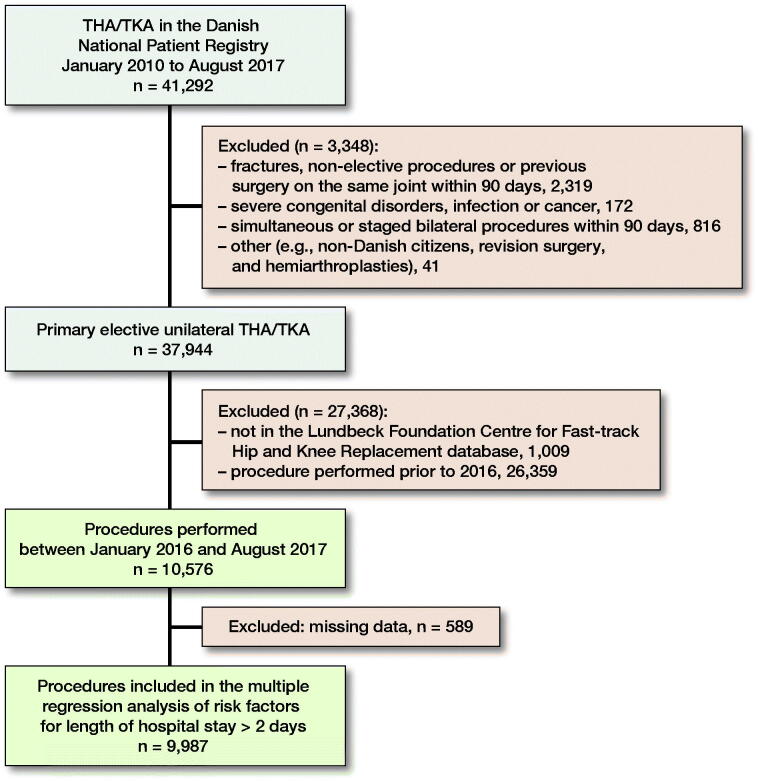
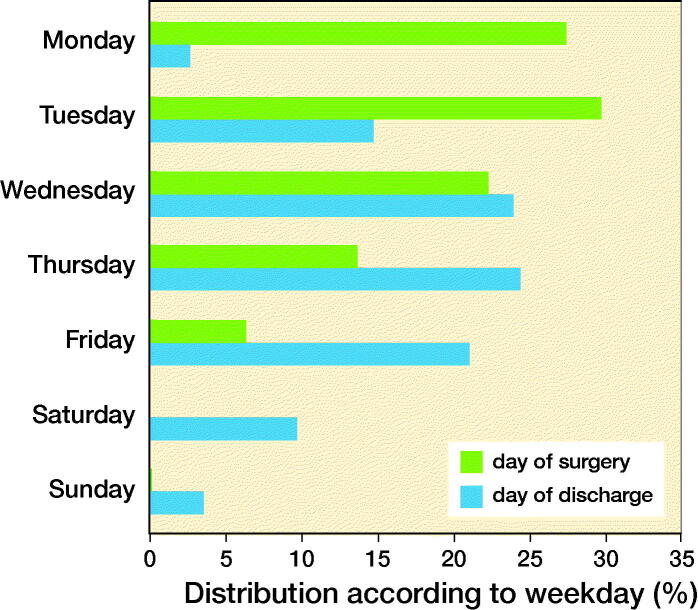
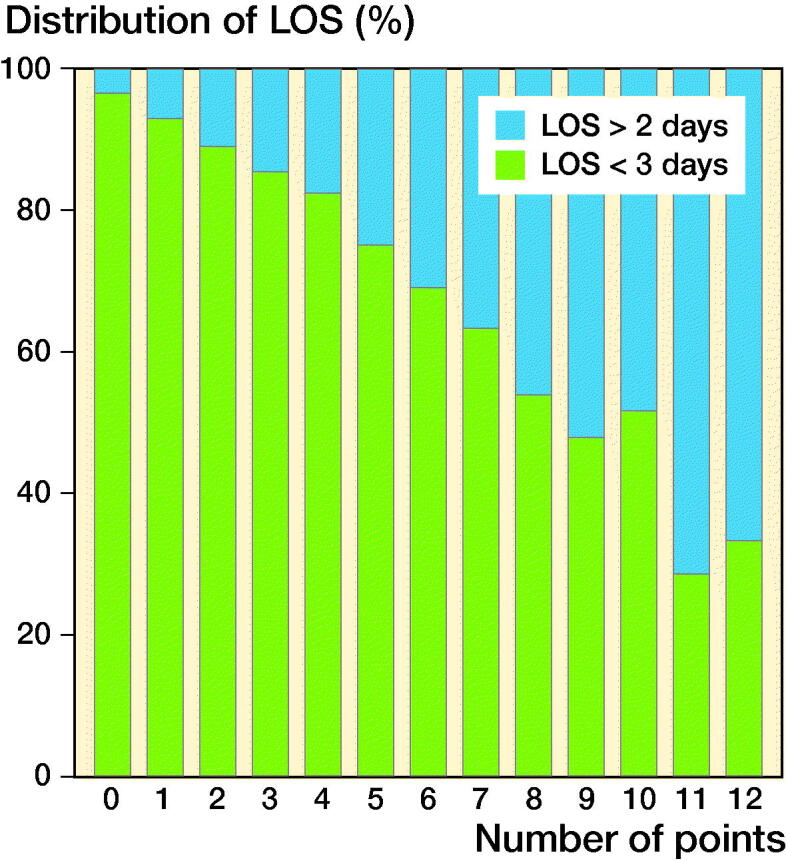
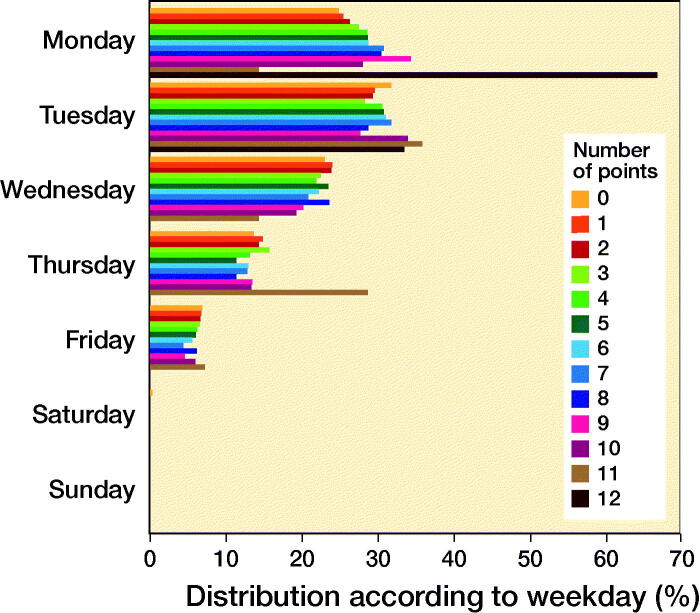
Background and purpose - Enhanced recovery programs have reduced length of stay (LOS) after hip and knee arthroplasty (THA/TKA). Although risk factors disposing to prolonged LOS are well documented, there is limited information on the role of weekday of surgery. This study analyzed the role of weekday of surgery and other potential risk factors for LOS > 2 days.Patients and methods - We included 10,576 unselected consecutive procedures between January 2016 and August 2017 within a multicenter fast-track THA/TKA collaboration with prospective collection of preoperative characteristics. We used multiple regression analysis of potential risk factors for LOS > 2 days followed by construction of a simple risk score from 0 to 15 points based on the calculated odds ratios.Results - Mean LOS was 1.9 (SD 1.8) days, with 80% of patients having surgery from Monday to Wednesday. Of these, 17% (95% CI 16-18) had a LOS > 2 days vs. 19% (CI 17-21) in those operated on Thursday and Friday. Patients were scheduled evenly throughout the week regardless of risk of LOS > 2 days and despite the fact that 38% (CI 35-40) of patients with ≥ 6 points (16% of the total population) had a LOS > 2 days compared with 14% (CI 13-14) in those with < 6 points. In these "high-risk" patients, the fraction with LOS > 2 days increased when having surgery on Thursdays or Fridays (43% CI 38-49) compared with Monday to Wednesday (37% CI 34-39).Interpretation - A detailed preoperative risk assessment may be helpful to plan the weekday of surgery in order to decrease LOS and weekend hospitalization.
Trial registration: ClinicalTrials.gov NCT01515670.
Figures
References
-
- Belmont P J Jr, Goodman G P, Waterman B R, Bader J O, Schoenfeld A J.. Thirty-day postoperative complications and mortality following total knee arthroplasty: incidence and risk factors among a national sample of 15,321 patients. J Bone Joint Surg Am 2014; 96(1): 20–6 doi: JBJS.M.00018. - PubMed
-
- Best M J, Buller L T, Gosthe R G, Klika A K, Barsoum W K.. Alcohol misuse is an independent risk factor for poorer postoperative outcomes following primary total hip and total knee arthroplasty. J Arthroplasty 2015; 30(8): 1293–8. - PubMed
-
- Cizmic Z, Feng J E, Anoushiravani A A, Borzio R W, Schwarzkopf R, Slover J D.. The risk assessment and prediction tool is less accurate in extended length of stay patients following total joint arthroplasty. J Arthroplasty 2019; 34(3): 418–21. - PubMed
-
- Cram P, Landon B E, Matelski J, Ling V, Stukel T A, Paterson J M, Gandhi R, Hawker G A, Ravi B.. Utilization and short-term outcomes of primary total hip and knee arthroplasty in the United States and Canada: an analysis of New York and Ontario administrative data. Arthritis Rheumatol (Hoboken, NJ) 2018; 70(4): 547–54. - PMC - PubMed
-
- den Hartog Y M, Mathijssen N M, Hannink G, Vehmeijer S B.. Which patient characteristics influence length of hospital stay after primary total hip arthroplasty in a “fast-track” setting? Bone Joint J 2015; 97-B(1): 19–23. - PubMed
Publication types
MeSH terms
Associated data
LinkOut - more resources
Full Text Sources
Medical