


Patterns of breast, prostate and cervical cancer incidence and mortality in Colombia: an administrative registry data analysis
- PMID: 33176754
- PMCID: PMC7661250
- DOI: 10.1186/s12885-020-07611-9
Patterns of breast, prostate and cervical cancer incidence and mortality in Colombia: an administrative registry data analysis
Abstract
Background: Cancer is widely recognized as a global public health problem. Breast, prostate, and cervical cancer are among the most frequent types in developing countries. Assessing their incidence and mortality by regions and municipalities is important to guide evidence-based health policy. Our aim was to describe the incidence and mortality trends for breast, cervical, and prostate cancer across regions and municipalities in Colombia during 2018.
Methods: We performed a cross-sectional analysis with data from people with breast, prostate, or cervical cancer, reported to the National Administrative Cancer Registry during 2018. A descriptive analysis was performed. Age-standardized incidence and mortality rates were estimated at national, regional, and municipal levels. Finally, we identify the regions and municipalities with significantly higher or lower incidence and mortality rates compared to national estimations.
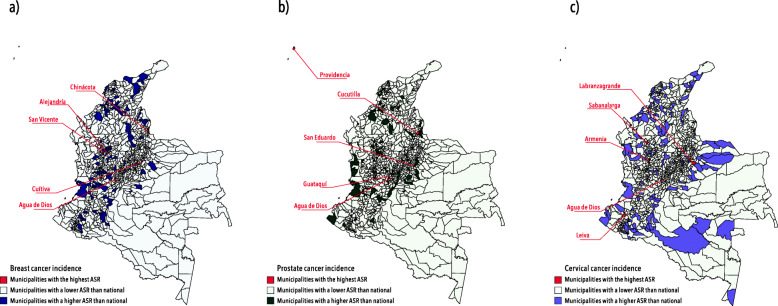
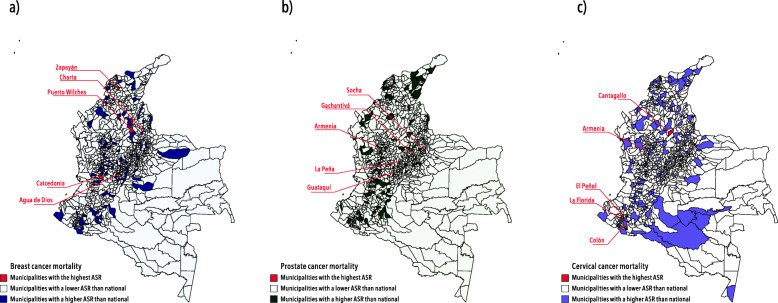
Results: Breast cancer was the most frequent type among all new cases and deaths in Colombia. Breast, prostate and cervical cancer incidence and mortality rates per 100,000 were: 18.69 (CI 95%: 18.15-19.25) and 10.48 (CI 95%: 10.07-10.91); 11.34 (CI 95%: 10.90-11.78) and 7.58 (CI 95%: 7.22-7.96); 5.93 (CI 95%: 5.62-6.25) and 4.31 (CI 95%: 4.05-4.58), respectively. Eastern region had both, incidence and mortality rates, significantly lower than national for all types of cancer. By municipalities, there was a heterogeneous pattern. Nonetheless, Agua de Dios (Cundinamarca), had one of the highest incidence rates for all types.
Conclusions: We observed clear differences in cancer incidence and mortality across regions and municipalities, depending on each type of cancer. Our findings are important to improve screening coverage, early detection, and treatment in the country.
Keywords: Cancer; Epidemiology; Incidence; Mortality; Registries.
Conflict of interest statement
The authors declare that they have no conflict of interest.
Figures
Comment in
-
Using administrative registries as a source for population-based cancer incidence and mortality.BMC Cancer. 2024 Feb 19;24(1):232. doi: 10.1186/s12885-023-11754-w. BMC Cancer. 2024. PMID: 38373947 Free PMC article. No abstract available.
References
-
- Fitzmaurice C, Abate D, Abbasi N, Abbastabar H, Abd-Allah F, Abdel-Rahman O, et al. Global, regional, and national cancer incidence, mortality, years of life lost, years lived with disability, and disability-adjusted life-years for 29 cancer groups, 1990 to 2017: a systematic analysis for the global burden of disease study. JAMA Oncol. 2019;5(12):1749–1768. doi: 10.1001/jamaoncol.2019.2996. - DOI - PMC - PubMed
-
- World Health Organization . World cancer report: cancer research for cancer prevention. Lyon: International Agency for Research on Cancer; 2020. p. 630.
