. 2020 Oct 15:11:551057.
doi: 10.3389/fimmu.2020.551057. eCollection 2020.

Acetylsalicylic Acid Promotes Corneal Epithelium Migration by Regulating Neutrophil Extracellular Traps in Alkali Burn

Affiliations

Acetylsalicylic Acid Promotes Corneal Epithelium Migration by Regulating Neutrophil Extracellular Traps in Alkali Burn

Ting Wan et al. Front Immunol. .

Abstract

Neutrophils are the first cells to migrate into the cornea in response to alkali burns, and excessive neutrophil infiltration is associated with inflammatory injury and a poorer prognosis. In an effort to understand the mechanisms underlying the inflammation mediated by neutrophils after alkali burns, we examined the role of alkali-activated neutrophils on human corneal epithelial cells (HCEs) proliferation and migration, as well as the effects of acetylsalicylic acid (ASA) and dexamethasone (DXM) on NETosis. We stimulated human neutrophils with sodium hydroxide (NaOH) and observed dose- and time-dependent neutrophil extracellular traps (NETs) formation. We also observed that ASA, but not DXM, significantly inhibited NaOH-induced NETosis. Furthermore, the activation of nuclear factor (NF)-κB, but not the production of reactive oxygen species, was involved in ASA-regulated NETosis. Moreover, NETs were found to be involved in alkali-activated neutrophils (ANs) induced neutrophil-HCE adhesion. ANs enhanced HCEs proliferation via phagocytosis. Meanwhile, ANs inhibited HCEs migration through the release of NETs, which was partially rescued by 5 mM ASA. In conclusion, ANs may interfere with HCEs proliferation and migration by phagocytosis and NETs formation, respectively. ASA may enhance HCEs migration by decreasing NETs formation through inhibition of NF-κB activation and could be a promising strategy for improving the prognosis of corneal alkali burns.

Keywords: acetylsalicylic acid (ASA); alkali burn; corneal epithelium; migration; neutrophil extracellular traps.


Figures

Figure 1
Figure 1
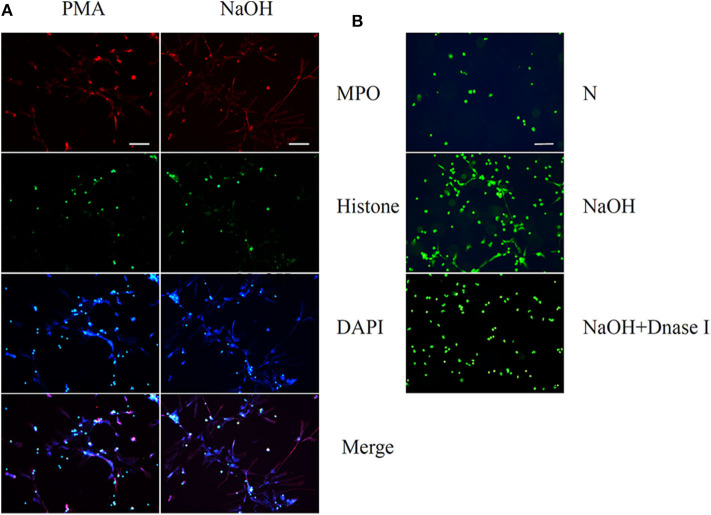
Phorbol 12-myristate 13-acetate (PMA) and Sodium hydroxide (NaOH) stimulate neutrophil extracellular traps (NETs) formation in human neutrophils. (A) Human neutrophil suspended in media were treated with PMA (50 nM) for 2 h or NaOH (5 mM) for 30 min. Neutrophils were labeled with 4′, 6′-diamidino-2-phenylindole (DAPI) to identify DNA (blue) and with antibodies to identify neutrophil histone (green) and MPO (red). (B) NaOH stimulated NETs formation could be degraded by DNase I as observed by SYTOX green staining. Bar: 75 μm.
Figure 2
Figure 2
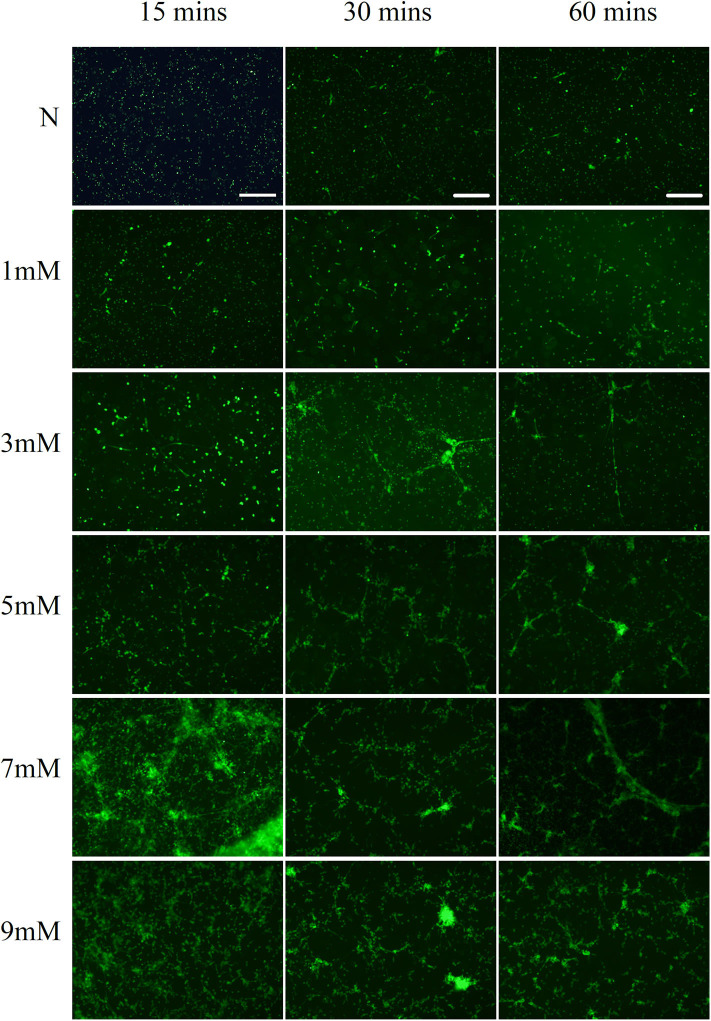
Alkali induces dose- and time-dependent NETs formation. Alkali triggered dose- and time-dependent NETs formation as demonstrated by SYTOX green staining. While only a few NETs structures were observed 60 min after 1 mM NaOH and 3 mM NaOH treatment, 5 mM NaOH stimulation for 30 min induced significant NETs generation. Moreover, many neutrophils died and detached as early as 15 min after both 7 mM NaOH and 9 mM NaOH treatment. Bar: 250 μm.
Figure 3
Figure 3
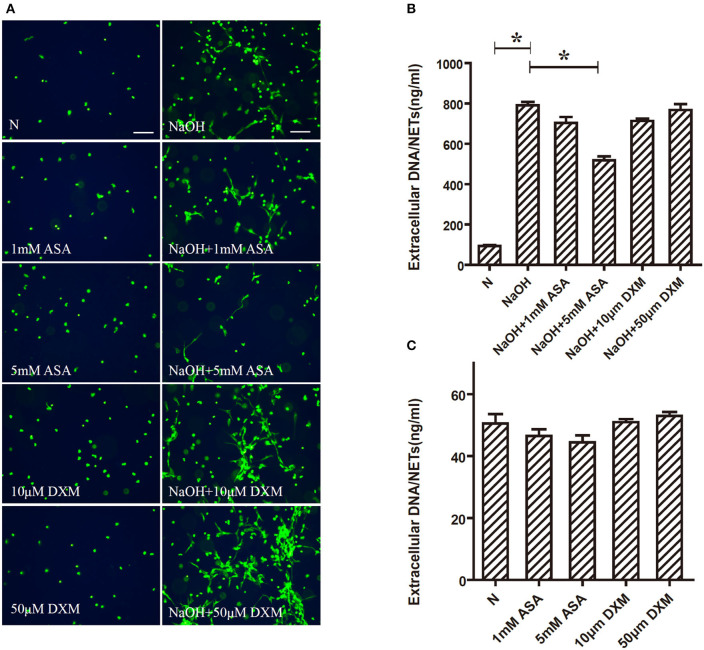
Alkali induced NETs formation is inhibited by ASA, but not by DXM. Human neutrophils suspended in media were pretreated for 30 min with ASA, DXM, or vehicle, and then NETs formation 30 min after stimulation with NaOH (5 mM) was examined using the membrane-impermeable DNA-binding dye SYTOX green and quantified by Quant-iTPicoGreen double-stranded deoxyribonucleic acid assay kit. (A) 5 mM ASA significantly inhibited alkali induced NETs formation. DXM and 1 mM ASA did not have any effect (B) Quantification of extracellular DNA confirmed that NaOH induced NETs formation was inhibited by ASA, but not by DXM. (C) Neither ASA nor DXM could induce NETs formation. The assay was repeated for three times with bloods from three different donors; error bars represent SD. *p < 0.05. Bar: 75 μm.
Figure 4
Figure 4
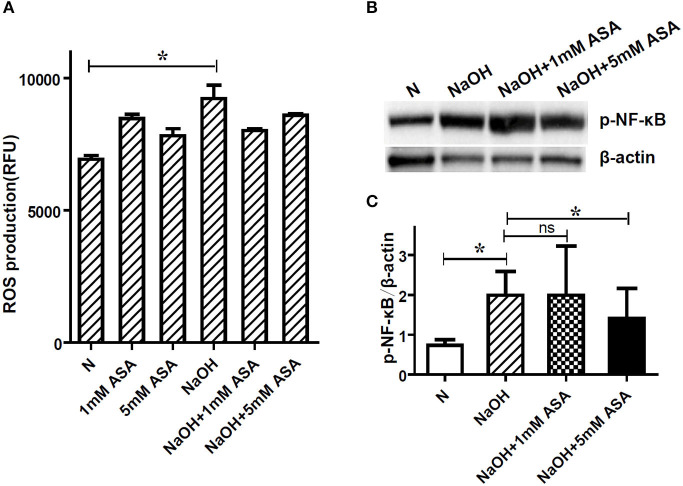
NF-κB activation, but not ROS production is involved in ASA regulated NETs formation. Neutrophils were pretreated for 30 min with ASA, DXM, or vehicle, and then stimulated with NaOH (5 mM) for 30 min. (A) ROS production was determined by dichlorofluorescein diacetate fluorescence. NaOH elicited significant neutrophil oxidative burst, but ASA treatment neither increased nor decreased this response. (B) NF-κB activation after alkali stimulation was determined by Western blot. (C) The gray degree of protein bands was detected by image J, and the value of p-NF-κB p65/β-actin was calculated. Quantification showed that p-NF-κB (p65) expression was significantly higher when the cells were stimulated with NaOH. This effect was inhibited by 5 mM ASA, but not modified by 1 mM ASA. Data represent mean ± SD of triplicate experiments, *p < 0.05.
Figure 5
Figure 5
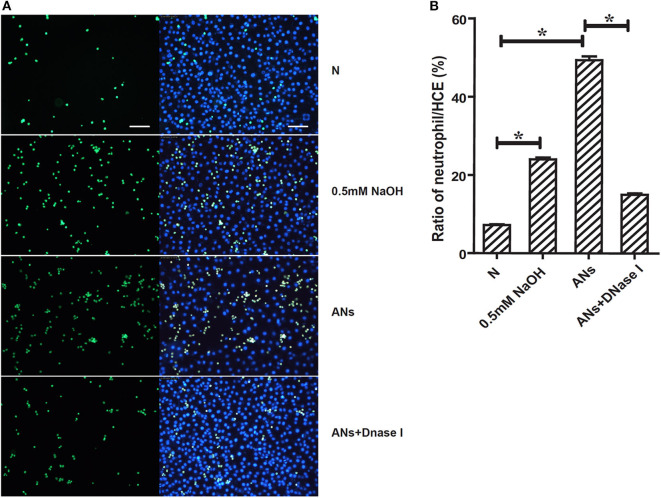
NETs are involved in AN-induced neutrophil-HCE adhesion. (A) Images presented showed the adhesion of Calcein AM (green) stained live neutrophils to corneal epithelial cells exposed to vehicle, 0.5 mM NaOH, AN, or AN with DNase I. (B) Quantification of the mean ratio of neutrophil/HCE showed that ANs significantly increased the neutrophil-HCE adhesion as compared with both control cells and cells treated with 0.5 mM NaOH. Moreover, this response could be significantly inhibited by DNase I. Data represent mean ± SD of triplicate experiments, *p < 0.05. Bar: 75 μm.
Figure 6
Figure 6
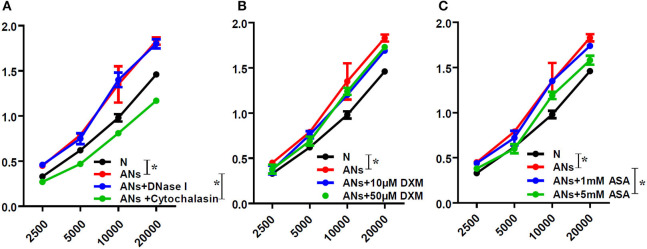
ANs promote HCE proliferation via phagocytosis, which could be inhibited by 5 mM ASA. The HCE proliferation exposed to vehicle, ANs, ANs with DNase I, ANs with Cytochalasin D, ANs with ASA or ANs with DXM were accessed by WST-1 test. (A) ANs promoted HCEs proliferation, which was inhibited by cytochalasin D, but not by DNase I. (B) DXM had no effect on the increase in AN-induced HCEs proliferation. (C) While 5 mM ASA slightly inhibited the increase in AN-induced HCE proliferation, 1 mM ASA had no effect on that response. Data represent mean ± SD of triplicate experiments, *p < 0.05.
Figure 7
Figure 7
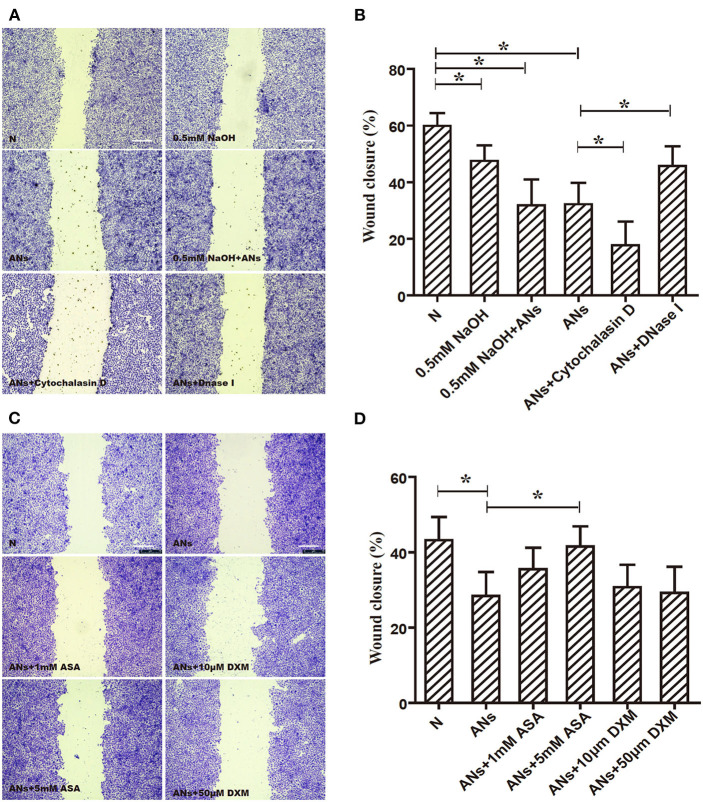
ANs inhibit HCE migration through NETs formation, which could be partially rescued by 5 mM ASA. (A) The HCE migration exposed to vehicle, 0.5 mM NaOH, 0.5 mM NaOH with ANs, ANs, ANs with DNase I, or ANs with Cytochalasin D were accessed by making a scratch on confluent monolayer of HCEs. (B) Quantification showed that 0.5 mM NaOH together with ANs significantly inhibited HCEs migration, this response was not eliminated by neutralizing the alkali in the medium with hydrochloric acid. Meanwhile, DNase I rescued AN-inhibited HCE migration (p < 0.05), but cytochalasin D exacerbated it. (C) The HCEs migration exposed to vehicle, ANs, ANs with ASA, or ANs with DXM were accessed by making a scratch on confluent monolayer of HCEs. (D) Quantification showed that while 5 mM ASA partially rescued AN-inhibited HCE migration, but neither DXM nor 1 mM ASA had any effect on that response. Data represent mean ± SD of triplicate experiments, *p < 0.05. Bar: 75 μm.

References

    1. Clare G, Suleman H, Bunce C, Dua H. Amniotic membrane transplantation for acute ocular burns. Cochrane Database Syst Rev. (2012) 9:CD009379. 10.1002/14651858.CD009379.pub2 - DOI - PMC - PubMed
    1. Lee P, Wang CC, Adamis AP. Ocular neovascularization: an epidemiologic review. Surv Ophthalmol. (1998) 43:245–69. 10.1016/S0039-6257(98)00035-6 - DOI - PubMed
    1. Wagoner MD. Chemical injuries of the eye: current concepts in pathophysiology and therapy. Surv Ophthalmol. (1997) 41:275–313. 10.1016/S0039-6257(96)00007-0 - DOI - PubMed
    1. Sakimoto T, Sugaya S, Ishimori A, Sawa M. Anti-inflammatory effect of IL-6 receptor blockade in corneal alkali burn. Exp Eye Res. (2012) 97:98–104. 10.1016/j.exer.2012.02.015 - DOI - PubMed
    1. Wang J. Neutrophils in tissue injury and repair. Cell Tissue Res. (2018) 371:531–9. 10.1007/s00441-017-2785-7 - DOI - PMC - PubMed

Publication types

MeSH terms

LinkOut - more resources