


Expression of MAPK and PI3K/AKT/mTOR Proteins according to the Chronic Liver Disease Etiology in Hepatocellular Carcinoma
- PMID: 33178273
- PMCID: PMC7644337
- DOI: 10.1155/2020/4609360
Expression of MAPK and PI3K/AKT/mTOR Proteins according to the Chronic Liver Disease Etiology in Hepatocellular Carcinoma
Abstract
Aims: Chronic liver disease (CLD) of different etiologies leads to hepatocellular carcinoma (HCC) by multiple mechanisms that may be translated into clinicopathological differences. We evaluated the tissue expression of the MAPK and PI3K/Akt/mTOR pathway proteins and their association with long-term outcome and other parameters, according to the etiology of the CLD, in HCC patients.
Methods: Clinicopathological data from 80 patients who underwent orthotopic liver transplantation for HCC treatment in a Brazilian referral center were compared according to CLD etiology. Event (tumor recurrence or death from any cause) occurrence and event-free survival (EFS) were analyzed. Pathway protein expression was assessed by immunohistochemistry (IHQ) in both tumor and underlying cirrhosis and by RT-PCR in tumor tissue.
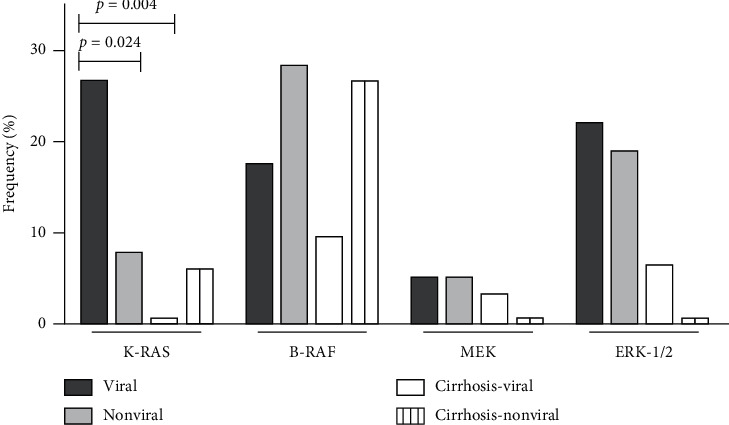
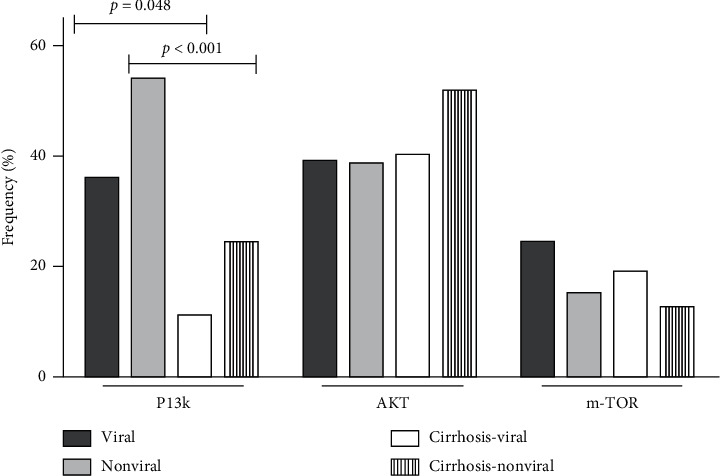
Results: Strong expression (SE) of KRAS was more frequent in tumors arising from viral (26.8%) than the nonviral group of liver disease (7.7%, p=0.024) and also than cirrhotic parenchyma (0%, p=0.004). SE of PI3K was more frequent in tumor than in cirrhosis (p=0.048, p < 0.01), without differences in its tumor expression among etiologic groups (p=0.111). mRNA of ERK, PI3K, and BRAF was expressed in the tumor, without differences between CLD etiologies, and there was no association with IHQ findings. Older age and microvascular invasion (MIV) were the only parameters independently associated with the event. MIV was also associated with shorter EFS.
Conclusions: Hepatitis B and C virus can lead to HCC by different mechanisms compared with nonviral hepatopathy. KRAS and PI3K may have a role in carcinogenesis. The prognostic and therapeutic implications need to be investigated.
Copyright © 2020 Paulo H. C. Diniz et al.
Conflict of interest statement
All authors declare that there are no conflicts of interest associated with this study.
Figures

References
-
- Global Burden of Disease Liver Cancer, Akinyemiju T., Abera S., et al. The burden of primary liver cancer and underlying etiologies from 1990 to 2015 at the global, regional, and national level: results from the global burden of disease study 2015. JAMA Oncology. 2017;3(12):1683–1691. doi: 10.1001/jamaoncol.2017.3055. - DOI - PMC - PubMed
-
- Alves R. C., Alves D., Guz B., et al. Advanced hepatocellular carcinoma. Review of targeted molecular drugs. Annals of Hepatology. 2011;10:21–27. - PubMed
LinkOut - more resources
Full Text Sources
Research Materials
Miscellaneous
