. 2020 Oct 29:2020:8352176.
doi: 10.1155/2020/8352176. eCollection 2020.

Wuqinxi Exercise Improves Hand Dexterity in Patients with Parkinson's Disease

Affiliations

Wuqinxi Exercise Improves Hand Dexterity in Patients with Parkinson's Disease

Tian Wang et al. Evid Based Complement Alternat Med. .

Abstract

Objective: This study was designed to evaluate the effect of Wuqinxi after one session and 12-week intervention on hand dexterity in patients with Parkinson's disease (PD).

Methods: Forty-six elderly participants with mild-to-moderate PD were randomly assigned to the groups trained with Wuqinxi (n = 23) or stretching (n = 23). All participants practiced 60 min session of either of these exercises, 2 sessions a week for 12 weeks in standing position. The score of Purdue Pegboard Test (PPT) and time for Soda Pop Test (SPT) were performed to assess hand dexterity and motor function along assessing the 39 items of Parkinson's Disease Questionnaire before and after 12-week interventions. In addition, the PPT scores were compared before vs. after one session of either of these two exercise modes.

Results: Single session with either Wuqinxi or stretching exercise tended to improve PPT scores in PD patients. Furthermore, the improved SPT time was significant (P < 0.01) following 12-week training interventions with Wuqinxi (-1.32 ± 0.38 sec) or stretching (-0.89 ± 0.16 sec), which showed no group difference (P=0.734). However, only the participants in Wuqinxi group significantly improved the PPT scores of the dominant hand (+0.61 ± 1.34), both hand (+1.83 ± 3.13) and assemble (+2.04 ± 3.44) performance after 12-week training intervention. In parallel with improved hand dexterity and motor function, 12-week Wuqinxi training also significantly improved the patient's emotional wellbeing.

Conclusion: The Wuqinxi intervention could be safely and effectively applied to improve hand dexterity following single-session exercise or 12-week training, which were accompanied by improved quality of life in patients with mild-to-moderate PD.


Conflict of interest statement

The authors declare that there are no conflicts of interest regarding the publication of this paper.

Figures
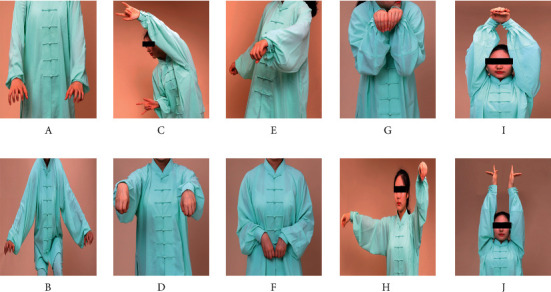
Figure 1
Figure 1
Illustrations of Wuqinxi exercise maneuvers. (a, b) Tiger exercise; (c, d) deer exercise; (e, f) bear exercise; (g, h) monkey exercise; (i, j) bird exercise.
Figure 2
Figure 2
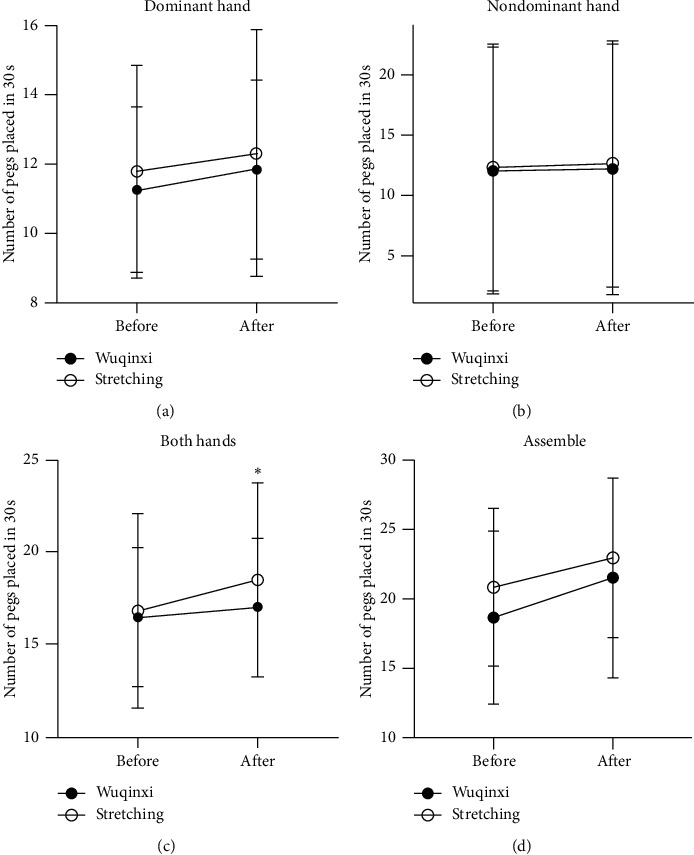
Placement of pegs after a single session of exercise. The number of pegs placed in 30 seconds after a single session of Wuqinxi (filled circles) and stretching (open circles). Asterisk denotes a significant difference between the groups. (a) Dominant hand. (b) Nondominant hand. (c) Both hands. (d) Assemble.
Figure 3
Figure 3
Placement of pegs after a 12-week training program. The number of pegs placed in 30 seconds in the Wuqinxi (filled circles) and stretching (open circles) groups after 12-week intervention. The PPT performance of the dominant hand (P=0.040), nondominant hand (P=0.056), both hands (P=0.010), and assemble (P=0.009) seem to be improved after 12-week training with Wuqinxi exercise. Asterisk denotes a significant difference between the groups. However, 12-week training with stretching exercise have no effect on hand dexterity tested in terms of the change in PPT performance. (a) Dominant hand. (b) Nondominant hand. (c) Both hands. (d) Assemble.
Figure 4
Figure 4
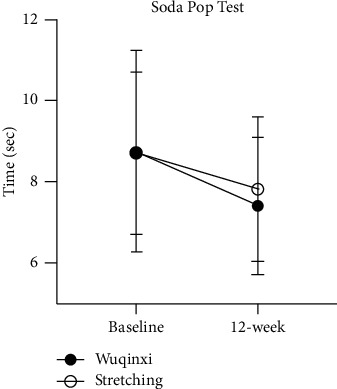
Soda Pop Test after a 12-week training program. The time spent on the Soda Pop Test is significantly improved in the Wuqinxi (filled circles) and stretching (open circles) groups after 12-week intervention. There is no difference between the groups.
Figure 5
Figure 5
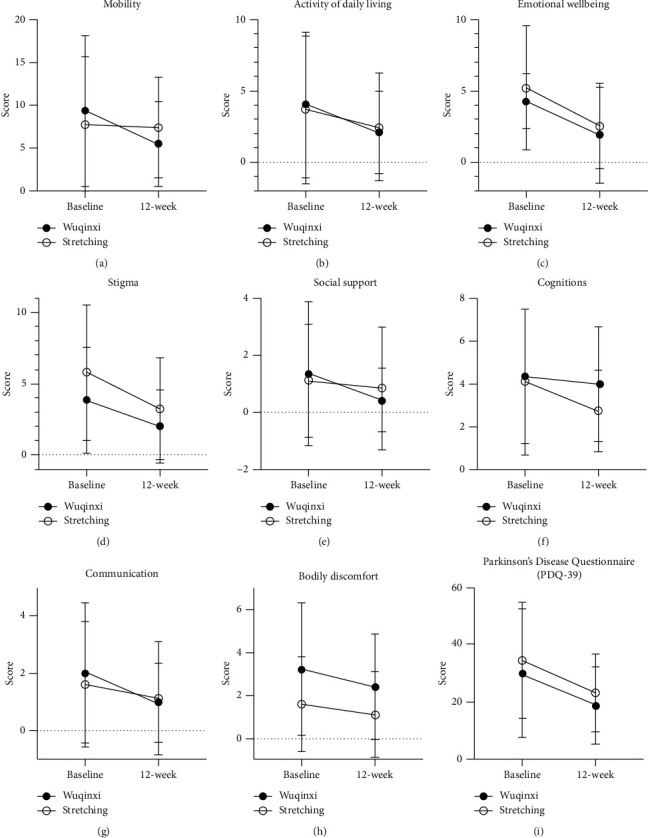
Scores of the 39 items of Parkinson's Disease Questionnaire before and after 12-week training. Scores of 8 dimensions and total points of the 39 items of Parkinson's Disease Questionnaire (PDQ-39) in the Wuqinxi (filled circles) and stretching (open circles) groups before vs. after 12-week exercise. Both interventions seem to improve the overall scores. The group difference is not significant. (a) Mobility. (b)Activity of daily living. (c) Emotional wellbeing. (d) Stigma. (e) Social support. (f) Cognitions. (g) Communication. (h) Bodily discomfort. (i) Parkinson's Disease Questionnaire (PDQ-39).

References

    1. Foki T., Vanbellingen T., Lungu C., et al. Limb-kinetic apraxia affects activities of daily living in Parkinson’s disease: a multi-center study. European Journal of Neurology. 2016;23(8):1301–1307. doi: 10.1111/ene.13021. - DOI - PMC - PubMed
    1. Foster E. R. Instrumental activities of daily living performance among people with Parkinson’s disease without dementia. American Journal of Occupational Therapy. 2014;68(3):353–362. doi: 10.5014/ajot.2014.010330. - DOI - PMC - PubMed
    1. Kandaswamy D., MuthuKumar M., Alexander M., et al. Quantitative assessment of hand dysfunction in patients with early Parkinson’s disease and focal hand dystonia. Journal of Movement Disorders. 2018;11(1) doi: 10.14802/jmd.17046. - DOI - PMC - PubMed
    1. Pohar S. L., Allyson Jones C. The burden of Parkinson disease (PD) and concomitant comorbidities. Archives of Gerontology and Geriatrics. 2009;49(2):317–321. doi: 10.1016/j.archger.2008.11.006. - DOI - PubMed
    1. Haaxma C. A., Bloem B. R., Overeem S., Borm G. F., Horstink M. W. I. M. Timed motor tests can detect subtle motor dysfunction in early Parkinson’s disease. Movement Disorders. 2010;25(9):1150–1156. doi: 10.1002/mds.23100. - DOI - PubMed

LinkOut - more resources