


Urine-derived stem/progenitor cells: A focus on their characterization and potential
- PMID: 33178393
- PMCID: PMC7596444
- DOI: 10.4252/wjsc.v12.i10.1080
Urine-derived stem/progenitor cells: A focus on their characterization and potential
Abstract
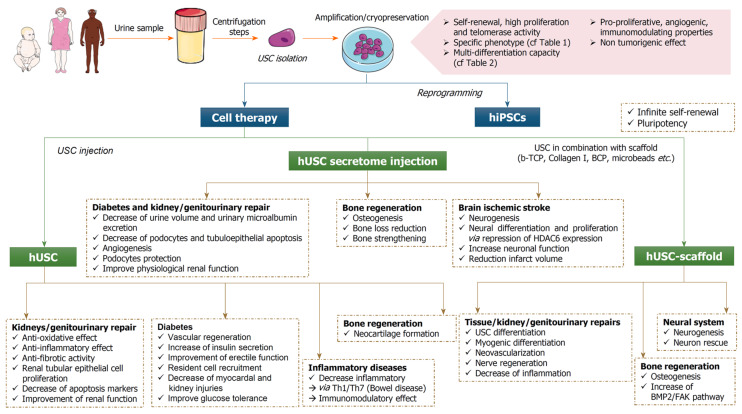
Cell therapy, i.e., the use of cells to repair an affected tissue or organ, is at the forefront of regenerative and personalized medicine. Among the multiple cell types that have been used for this purpose [including adult stem cells such as mesenchymal stem cells or pluripotent stem cells], urine-derived stem cells (USCs) have aroused interest in the past years. USCs display classical features of mesenchymal stem cells such as differentiation capacity and immunomodulation. Importantly, they have the main advantage of being isolable from one sample of voided urine with a cheap and unpainful procedure, which is broadly applicable, whereas most adult stem cell types require invasive procedure. Moreover, USCs can be differentiated into renal cell types. This is of high interest for renal cell therapy-based regenerative approaches. This review will firstly describe the isolation and characterization of USCs. We will specifically present USC phenotype, which is not an object of consensus in the literature, as well as detail their differentiation capacity. In the second part of this review, we will present and discuss the main applications of USCs. These include use as a substrate to generate human induced pluripotent stem cells, but we will deeply focus on the use of USCs for cell therapy approaches with a detailed analysis depending on the targeted organ or system. Importantly, we will also focus on the applications that rely on the use of USC-derived products such as microvesicles including exosomes, which is a strategy being increasingly employed. In the last section, we will discuss the remaining barriers and challenges in the field of USC-based regenerative medicine.
Keywords: Cell therapy; Exosomes; Kidney injury and repair; Regenerative medicine; Urine progenitor cells; Urine-derived stem cells.
©The Author(s) 2020. Published by Baishideng Publishing Group Inc. All rights reserved.
Conflict of interest statement
Conflict-of-interest statement: The authors declare that they have no conflict of interest.
Figures
References
-
- Wang J, Chen Z, Sun M, Xu H, Gao Y, Liu J, Li M. Characterization and therapeutic applications of mesenchymal stem cells for regenerative medicine. Tissue Cell. 2020;64:101330. - PubMed
-
- Zhao T, Luo D, Sun Y, Niu X, Wang Y, Wang C, Jia W. Human urine-derived stem cells play a novel role in the treatment of STZ-induced diabetic mice. J Mol Histol. 2018;49:419–428. - PubMed
-
- Liu Y, Ma W, Liu B, Wang Y, Chu J, Xiong G, Shen L, Long C, Lin T, He D, Butnaru D, Alexey L, Zhang Y, Zhang D, Wei G. Urethral reconstruction with autologous urine-derived stem cells seeded in three-dimensional porous small intestinal submucosa in a rabbit model. Stem Cell Res Ther. 2017;8:63. - PMC - PubMed
Publication types
LinkOut - more resources
Full Text Sources
Other Literature Sources
Miscellaneous
