


From Standard to Escalated Anticoagulant Prophylaxis in Fractured Older Adults With SARS-CoV-2 Undergoing Accelerated Orthopedic Surgery
- PMID: 33178713
- PMCID: PMC7593394
- DOI: 10.3389/fmed.2020.566770
From Standard to Escalated Anticoagulant Prophylaxis in Fractured Older Adults With SARS-CoV-2 Undergoing Accelerated Orthopedic Surgery
Abstract
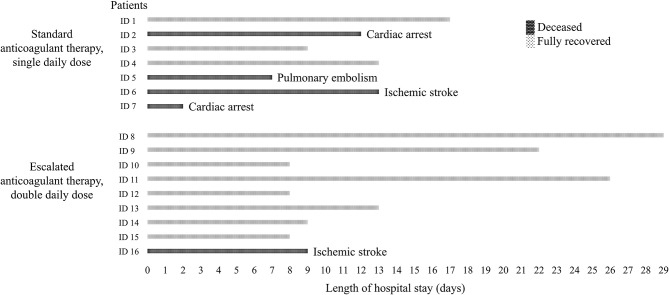
Proximal femoral fractures in older adults are not uncommon and represent a great challenge for orthopedic surgeons because of the high risks of complications. In the COVID-19 panorama, fractures occurring in infected older adults become an even more intricate task because of concomitant metabolic derangements due to SARS-CoV-2. Multidisciplinary protocols are mandatory and pharmacological treatment in infected patients should be tailored. Regrettably, the spread of the virus in northern Italy, has been faster than scientific progress in characterizing the disease and many hospitals have had to manage the symptoms on a daily clinical bases. Our Italian hospital in the region of Lombardy, which has been the epicenter of the Italian pandemic, has admitted sixteen patients with fractured femurs in March and April 2020. The first seven patients were treated with the antithrombotic prophylaxis of a single daily dose of low-molecular-weight heparin, but we observed the highest prevalence of deaths from cardiovascular complications (four deaths). By doubling the daily dose of anticoagulants in the subsequent patients, we observed a reduction in the incidence of death (one death out of nine). Controversies exist about the surgical treatment of fractures in older adults during this pandemic. However, we have observed an increased survival after fall trauma in infected older adults if treated with high doses of anticoagulant. Although not being statistically significant, our results are in line with the current knowledge of the pathophysiology of SARS-CoV-2 infection, but more studies should be shared about the efficacy and dosage of anticoagulants in traumatic injuries of the elderly.
Keywords: COVID-19 drug treatment; SARS-CoV-2; anticoagulants; femoral fractures; low-molecular-weight heparin.
Copyright © 2020 Perazzo, Giorgino, Briguglio, Zuffada, Accetta, Mangiavini and Peretti.
Figures
References
-
- Zagra L, Faraldi M, Pregliasco F, Vinci A, Lombardi G, Ottaiano I, et al. Changes of clinical activities in an orthopaedic institute in North Italy during the spread of COVID-19 pandemic: a seven-week observational analysis. Int Orthop. (2020) 44:1591–8. 10.1007/s00264-020-04590-1 - DOI - PMC - PubMed
-
- Munoz Vives JM, Jornet-Gibert M, Camara-Cabrera J, Esteban PL, Brunet L, Delgado-Flores L, et al. Mortality rates of patients with proximal femoral fracture in a worldwide pandemic: preliminary results of the Spanish HIP-COVID observational study. J Bone Joint Surg Am. (2020) 102:e69. 10.2106/JBJS.20.00686 - DOI - PMC - PubMed
LinkOut - more resources
Full Text Sources
Miscellaneous
