. 2021 Oct;15(5):751-760.
doi: 10.1007/s11701-020-01170-8. Epub 2020 Nov 11.

Multi-wavelength fluorescence imaging with a da Vinci Firefly-a technical look behind the scenes

Affiliations

Multi-wavelength fluorescence imaging with a da Vinci Firefly-a technical look behind the scenes

Philippa Meershoek et al. J Robot Surg. 2021 Oct.

Abstract

The field of fluorescence-guided surgery builds on colored fluorescent tracers that have become available for different clinical applications. Combined use of complementary fluorescent emissions can allow visualization of different anatomical structures (e.g. tumor, lymphatics and nerves) in the same patient. With the aim to assess the requirements for multi-color fluorescence guidance under in vivo conditions, we thoroughly characterized two FDA-approved laparoscopic Firefly camera systems available on the da Vinci Si or da Vinci Xi surgical robot. In this process, we studied the cameras' performance with respect to the photophysical properties of the FDA-approved dyes Fluorescein and ICG. Our findings indicate that multi-wavelength fluorescence imaging of Fluorescein and ICG is possible using clinical-grade fluorescence laparoscopes, but critical factors for success include the photophysical dye properties, imaging system performance and the amount of accumulated dye. When comparing the camera performance, the Xi system provided more effective excitation (adaptions in the light source) and higher detection sensitivity (chip-on-a-tip and/or enhanced image processing) for both Fluorescein and ICG. Both systems can readily be used for multi-wavelength fluorescence imaging of Fluorescein and ICG under clinically relevant conditions. With that, another step has been made towards the routine implementation of multi-wavelength image-guided surgery concepts.

Keywords: Fluorescence-guided surgery; Laparoscopic surgery; Multi-wavelength fluorescence; Multiplexing; Multispectral fluorescence; Robotic surgery.


Conflict of interest statement

KPB, AMM and FWBvL are (partly) employed by ORSI Academy, a surgical training center.

Figures
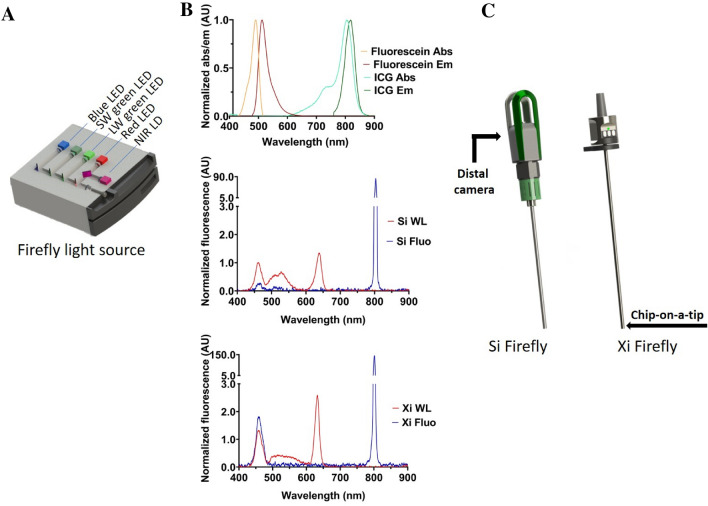
Fig. 1
Fig. 1
Hardware components of the da Vinci Si and Xi vision cart systems. a schematic representation of the light source, b top: excitation and emission spectra of Fluorescein and ICG, middle: Spectral properties of the Si light source in white light mode (red) and fluorescence mode (blue), bottom: Spectral properties of the Si and Xi light sources in white light mode (red) and fluorescence mode (blue), c schematic representation of the Si and XI Firefly laparoscopes and their detector location. LED light-emitting diode, SW short-wave, LW long-wave, NIR near-infrared, LD laser diode, Abs absorbance, Em emission, WL white light mode, Fluo fluorescence mode
Fig. 2
Fig. 2
Illustration of the relevant excitation intensity calculations (formula 5), displaying the spectral overlap of the excitation light source and the fluorescent dye absorbance. Example with Fluorescein: the normalized dye absorption spectrum (blue) multiplied by the illumination spectrum (black) results in a weighted illumination spectrum (red). The integral of this weighted illumination spectrum (red with dashed area under the curve) provides the relevant excitation intensity
Fig. 3
Fig. 3
Detection sensitivity. Dilution series of Fluorescein and ICG imaged using the Si Firefly system (top) and the Xi Firefly system (bottom) showing white light and fluorescence imaging
Fig. 4
Fig. 4
Concentration dependent fluorescence intensities for Fluorescein and ICG. For ICG self-quenching starts to occur around 5 × 10⁻⁵ M. For Fluorescein, self-quenching only starts around much higher values: 4 × 10⁻⁴ M
Fig. 5
Fig. 5
Multispectral imaging of Fluorescein and ICG in vivo with the Firefly Si and Xi. a White light (WL) image obtained with the Si Firefly showing a lymphatic vessel (yellow arrow) containing Fluorescein (in yellow) and b the same in vivo features visualized with fluorescence settings (Siunprocessed) revealing a lymph node (pink arrow) containing ICG (in pink) as well. c WL image obtained with the Xi Firefly showing two lymphatic vessels containing Fluorescein and d the same in vivo features visualized with fluorescence settings (Xiprocessed) showing both fluorescence signatures in green

References

    1. Gibbs SL. Near infrared fluorescence for image-guided surgery. Quant Imaging Med Surg. 2012;2(3):177–187. - PMC - PubMed
    1. Alander JT, et al. A review of indocyanine green fluorescent imaging in surgery. Int J Biomed Imaging. 2012;2012:940585. doi: 10.1155/2012/940585. - DOI - PMC - PubMed
    1. Rosenthal EL, et al. Safety and Tumor Specificity of Cetuximab-IRDye800 for Surgical Navigation in Head and Neck Cancer. Clin Cancer Res. 2015;21(16):3658–3666. doi: 10.1158/1078-0432.CCR-14-3284. - DOI - PMC - PubMed
    1. de Valk KS, et al. A zwitterionic near-infrared fluorophore for real-time ureter identification during laparoscopic abdominopelvic surgery. Nat Commun. 2019;10(1):3118. doi: 10.1038/s41467-019-11014-1. - DOI - PMC - PubMed
    1. Folli S, et al. Immunophotodiagnosis of colon carcinomas in patients injected with fluoresceinated chimeric antibodies against carcinoembryonic antigen. Proc Natl Acad Sci U S A. 1992;89(17):7973–7977. doi: 10.1073/pnas.89.17.7973. - DOI - PMC - PubMed

LinkOut - more resources
