


Association of Preexisting Interstitial Lung Abnormalities With Immune Checkpoint Inhibitor-Induced Interstitial Lung Disease Among Patients With Nonlung Cancers
- PMID: 33180128
- PMCID: PMC7662135
- DOI: 10.1001/jamanetworkopen.2020.22906
Association of Preexisting Interstitial Lung Abnormalities With Immune Checkpoint Inhibitor-Induced Interstitial Lung Disease Among Patients With Nonlung Cancers
Abstract
Importance: Immune checkpoint inhibitor-induced interstitial lung disease (ICI-ILD) is clinically serious and life-threatening. Preexisting interstitial lung abnormalities have been shown to be risk factors for ICI-ILD in patients with lung cancer.
Objective: To evaluate whether interstitial lung abnormalities are associated with ICI-ILD in patients with nonlung cancers.
Design, setting, and participants: This cohort study was conducted between December 2015 and May 2019 at Hiroshima University Hospital. A total of 199 consecutive patients with head and neck cancer, malignant melanoma, oral cavity cancer, urological cancer, and gastrointestinal cancer who received anti-programmed cell death 1 (PD-1) antibody monotherapy were included. Data analysis was conducted from December 2015 to May 2019.
Main outcomes and measures: The associations between potential risk factors and the development of ICI-ILD were examined. Information on patient characteristics before antibody administration, including chest computed tomography findings, was obtained. The diagnosis of ICI-ILD was defined as abnormal computed tomography shadows occurring during treatment with anti-PD-1 antibodies.
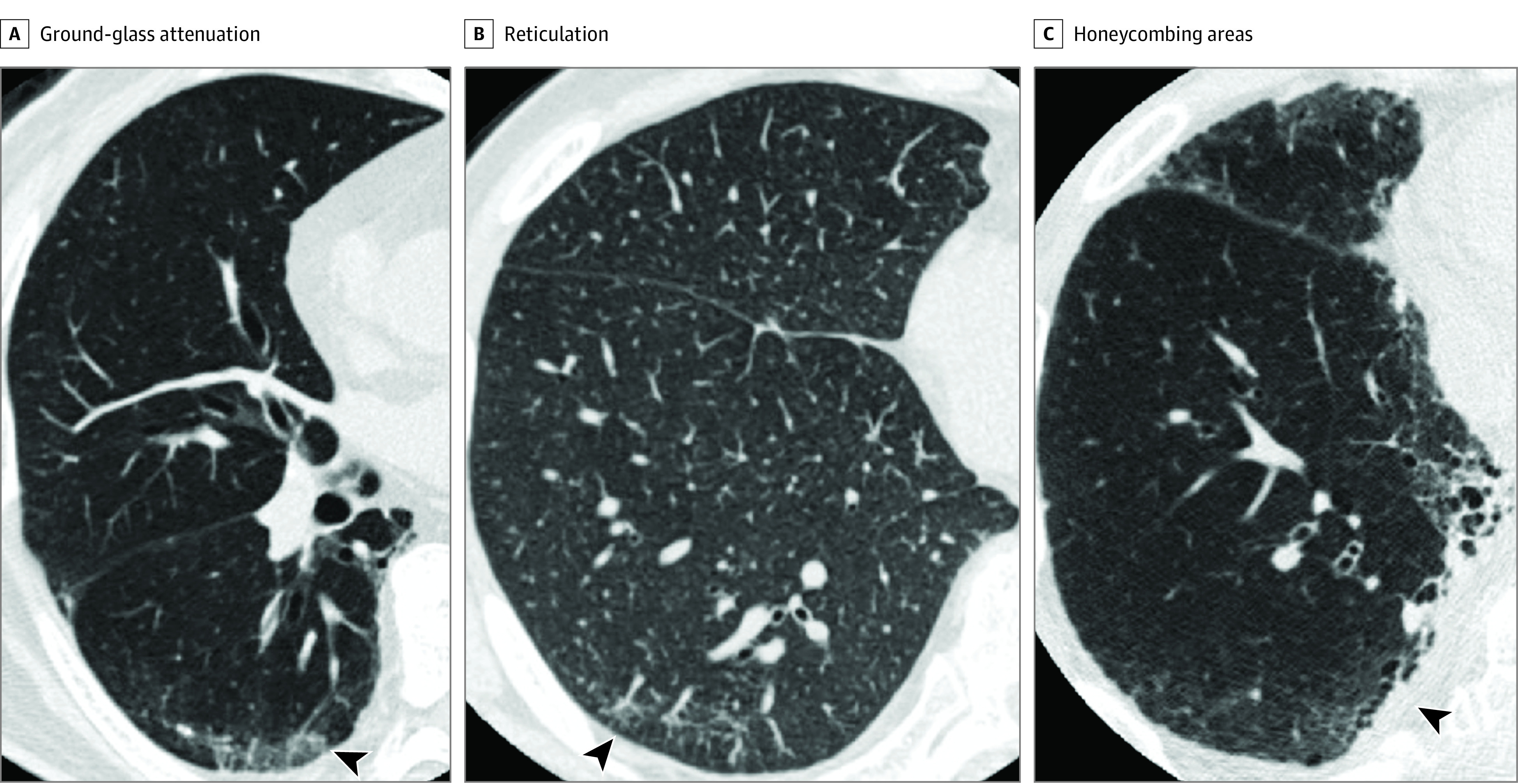
Results: A total of 199 patients were enrolled in the study. The median (range) age was 66 (20-93) years, and most patients (133 [66.8%]) were men. Nineteen patients (9.5%) developed ICI-ILD. There was no significant difference in the baseline characteristics between patients with and without ICI-ILD. The logistic regression analyses revealed that interstitial lung abnormalities were associated with increased risk of ICI-ILD (odds ratio, 6.29; 95% CI, 2.34-16.92; P < .001), and ground glass attenuation in interstitial lung abnormalities was an independently associated risk factor (odds ratio, 4.05; 95% CI, 1.29-12.71; P = .01).
Conclusions and relevance: In this cohort study, preexisting interstitial lung abnormalities, including ground glass attenuation, were risk factors associated with ICI-ILD in patients with nonlung cancers. This observation is consistent with previously reported findings in patients with lung cancer. Therefore, we should pay more attention to the development of ICI-ILD in patients with interstitial lung abnormalities, regardless of cancer type.
Conflict of interest statement
Figures
References
-
- Kang YK, Boku N, Satoh T, et al. Nivolumab in patients with advanced gastric or gastro-oesophageal junction cancer refractory to, or intolerant of, at least two previous chemotherapy regimens (ONO-4538-12, ATTRACTION-2): a randomised, double-blind, placebo-controlled, phase 3 trial. Lancet. 2017;390(10111):2461-2471. doi: 10.1016/S0140-6736(17)31827-5 - DOI - PubMed
Publication types
MeSH terms
Substances
LinkOut - more resources
Full Text Sources
Medical
