Review
. 2021 Apr;64(4):407-415.
doi: 10.1165/rcmb.2020-0359PS.

Pulmonary Endothelial Dysfunction and Thrombotic Complications in Patients with COVID-19

Affiliations
Review

Pulmonary Endothelial Dysfunction and Thrombotic Complications in Patients with COVID-19

Cristina Rodríguez et al. Am J Respir Cell Mol Biol. 2021 Apr.

Abstract

Severe acute respiratory syndrome coronavirus 2 (SARS-CoV-2), a new strain of a Coronaviridae virus that presents 79% genetic similarity to the severe acute respiratory syndrome coronavirus, has been recently recognized as the cause of a global pandemic by the World Health Organization, implying a major threat to world public health. SARS-CoV-2 infects host human cells by binding through the viral spike proteins to the ACE-2 (angiotensin-converting enzyme 2) receptor, fuses with the cell membrane, enters, and starts its replication process to multiply its viral load. Coronavirus disease (COVID-19) was initially considered a respiratory infection that could cause pneumonia. However, in severe cases, it extends beyond the respiratory system and becomes a multiorgan disease. This transition from localized respiratory infection to multiorgan disease is due to two main complications of COVID-19. On the one hand, it is due to the so-called cytokine storm: an uncontrolled inflammatory reaction of the immune system in which defensive molecules become aggressive for the body itself. On the other hand, it is due to the formation of a large number of thrombi that can cause myocardial infarction, stroke, and pulmonary embolism. The pulmonary endothelium actively participates in these two processes, becoming the last barrier before the virus spreads throughout the body. In this review, we examine the role of the pulmonary endothelium in response to COVID-19, the existence of potential biomarkers, and the development of novel therapies to restore vascular homeostasis and to protect and/or treat coagulation, thrombosis patients. In addition, we review the thrombotic complications recently observed in patients with COVID-19 and its potential threatening sequelae.

Keywords: COVID-19; coagulation/thrombosis; endothelial cell; pulmonary embolism.


Figures
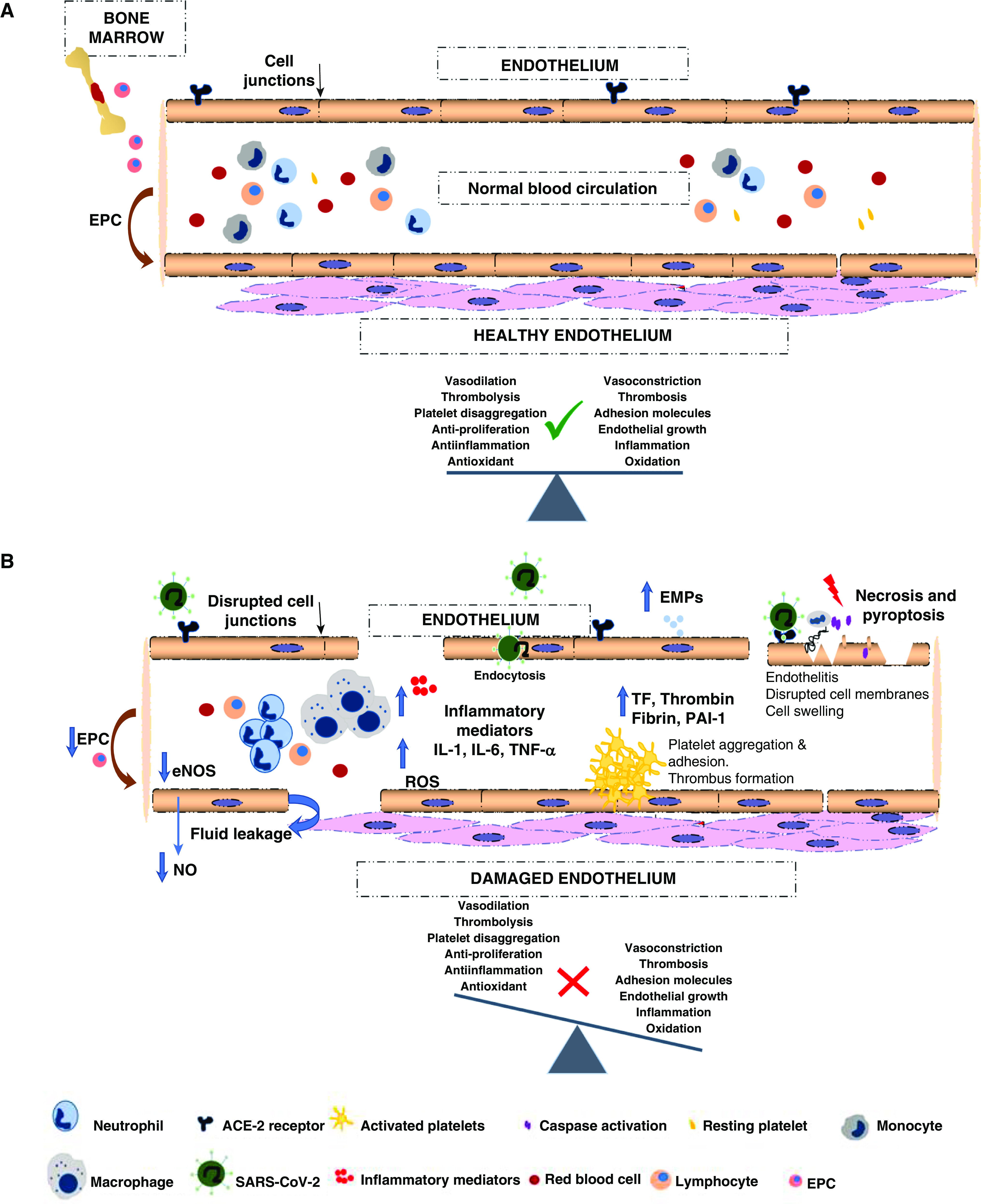
Figure 1.
Figure 1.
Potential mechanisms through which the novel severe acute respiratory syndrome coronavirus 2 (SARS-CoV-2) has effects on the endothelium. (A) Healthy endothelium: maintenance of a perfect dynamic balance among different factors that modulate systemic blood flow, coagulation, inflammatory responses, proliferation, and the oxidative state. (B) Damaged endothelium: the entrance of SARS-CoV-2 into endothelial cells triggers endothelial dysfunction associated with apoptosis and pyroptosis. Damage is produced by dysregulation of the balance between injury and repair capacity, leading to the release of inflammatory mediators that cause a state of abnormal systemic thromboinflammation, with an increase of oxidative and proliferative factors. Red arrows indicate EPC mobilization from the bone marrow to peripheral circulation. The black arrow points to the disrupted cell junctions. Blue arrows indicate increase in the decrease levels of inflammatory mediators and thrombotic factors. The red lightning bolt indicates injury, cell death (necrosis and pyroptosis). The green check mark indicates vascular homeostasis, and the red cross indicates damaged endothelium. EMP = endothelial microparticle; eNOS = endothelial NO synthase; EPC = endothelial progenitor cells; NO = nitric oxide; ROS = reactive oxygen species; TF = tissue factor.
Figure 2.
Figure 2.
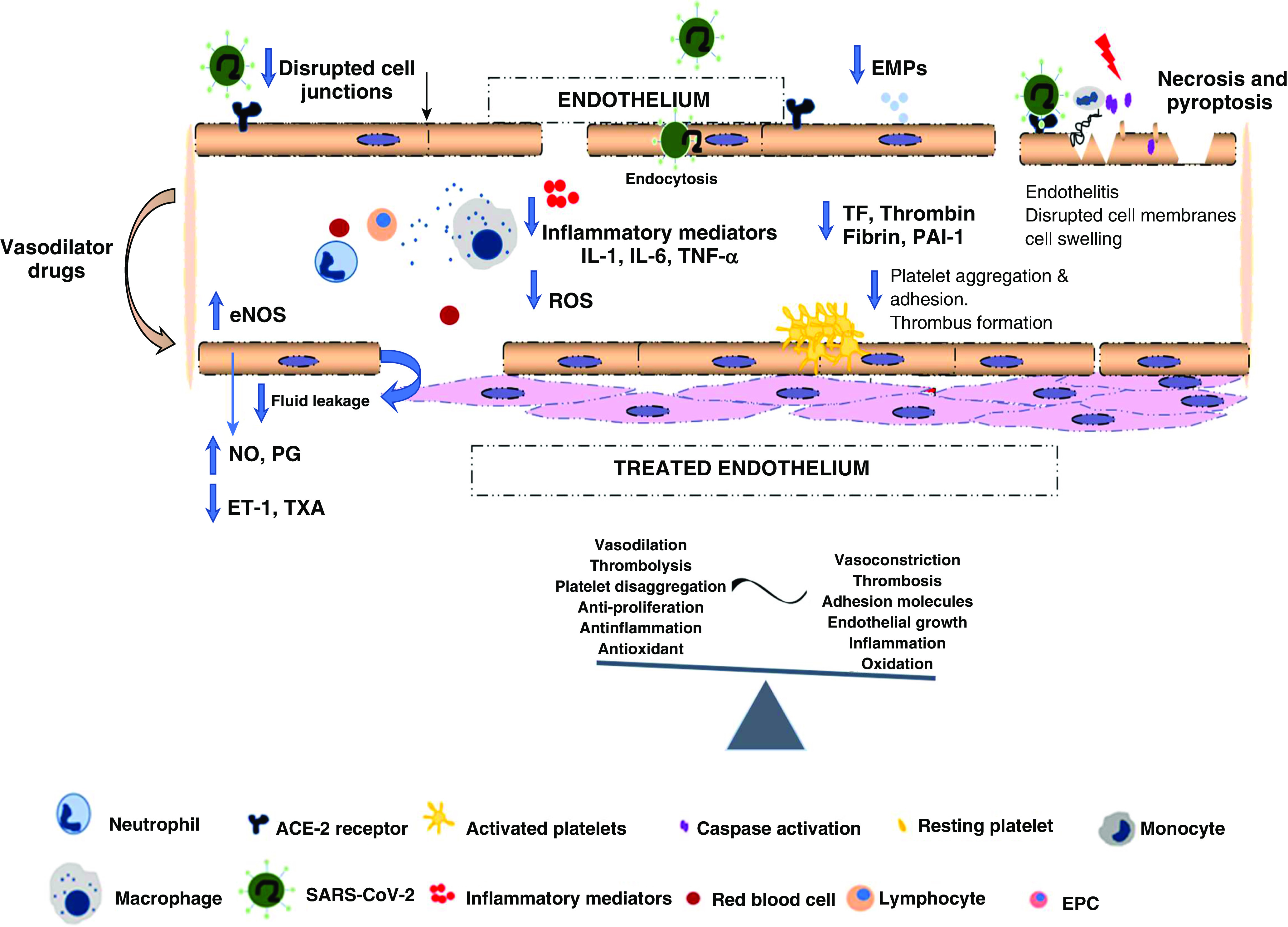
Treated endothelium: vasodilator drugs used nowadays may produce a protective effect on the endothelium that can mitigate the development to severe stages of coronavirus disease (COVID-19). Red arrows indicate EPC mobilization from the bone marrow to peripheral circulation. The black arrow points to the disrupted cell junctions. Blue arrows indicate increase in the decrease levels of inflammatory mediators and thrombotic factors. The red lightning bolt indicates injury, cell death (necrosis and pyroptosis). The green check mark indicates vascular homeostasis, and the red cross indicates damaged endothelium. ET-1 = endothelin-1; PG = prostacyclins; TXA = thromboxane.

Comment in

  • COVID-19 and Coagulopathy.
    Inoue KI, Sagawa T, Takano H. Inoue KI, et al. Am J Respir Cell Mol Biol. 2021 Jun;64(6):764. doi: 10.1165/rcmb.2020-0588LE. Am J Respir Cell Mol Biol. 2021. PMID: 33770450 Free PMC article. No abstract available.

References

    1. Smolders VF, Zodda E, Quax PHA, Carini M, Barberà JA, Thomson TM, et al. Metabolic alterations in cardiopulmonary vascular dysfunction. Front Mol Biosci. 2019;5:120. - PMC - PubMed
    1. Eelen G, de Zeeuw P, Treps L, Harjes U, Wong BW, Carmeliet P. Endothelial cell metabolism. Physiol Rev. 2018;98:3–58. - PMC - PubMed
    1. Sandoo A, van Zanten JJ, Metsios GS, Carroll D, Kitas GD. The endothelium and its role in regulating vascular tone. Open Cardiovasc Med J. 2010;4:302–312. - PMC - PubMed
    1. Winn RK, Harlan JM. The role of endothelial cell apoptosis in inflammatory and immune diseases. J Thromb Haemost. 2005;3:1815–1824. - PubMed
    1. Varga Z, Flammer AJ, Steiger P, Haberecker M, Andermatt R, Zinkernagel AS, et al. Endothelial cell infection and endotheliitis in COVID-19. Lancet. 2020;395:1417–1418. - PMC - PubMed

MeSH terms