Review
. 2020 Nov 9;9(11):1098.
doi: 10.3390/antiox9111098.

Are Flavonoids Effective Antioxidants in Plants? Twenty Years of Our Investigation

Affiliations
Review

Are Flavonoids Effective Antioxidants in Plants? Twenty Years of Our Investigation

Giovanni Agati et al. Antioxidants (Basel). .

Abstract

Whether flavonoids play significant antioxidant roles in plants challenged by photooxidative stress of different origin has been largely debated over the last few decades. A critical review of the pertinent literature and our experimentation as well, based on a free-of-scale approach, support an important antioxidant function served by flavonoids in plants exposed to a wide range of environmental stressors, the significance of which increases with the severity of stress. On the other side, some questions need conclusive answers when the putative antioxidant functions of plant flavonoids are examined at the level of both the whole-cell and cellular organelles. This partly depends upon a conclusive, robust, and unbiased definition of "a plant antioxidant", which is still missing, and the need of considering the subcellular re-organization that occurs in plant cells in response to severe stress conditions. This likely makes our deterministic-based approach unsuitable to unveil the relevance of flavonoids as antioxidants in extremely complex biological systems, such as a plant cell exposed to an ever-changing stressful environment. This still poses open questions about how to measure the occurred antioxidant action of flavonoids. Our reasoning also evidences the need of contemporarily evaluating the changes in key primary and secondary components of the antioxidant defense network imposed by stress events of increasing severity to properly estimate the relevance of the antioxidant functions of flavonoids in an in planta situation. In turn, this calls for an in-depth analysis of the sub-cellular distribution of primary and secondary antioxidants to solve this still intricate matter.

Keywords: UV-B radiation; antioxidant enzymes; cytoplasm-located flavonoids; early land plants; flavonols; hydrogen peroxide; photoprotection; reactive oxygen species; vacuolar flavonoids.


Conflict of interest statement

The authors declare no conflict of interest.

Figures
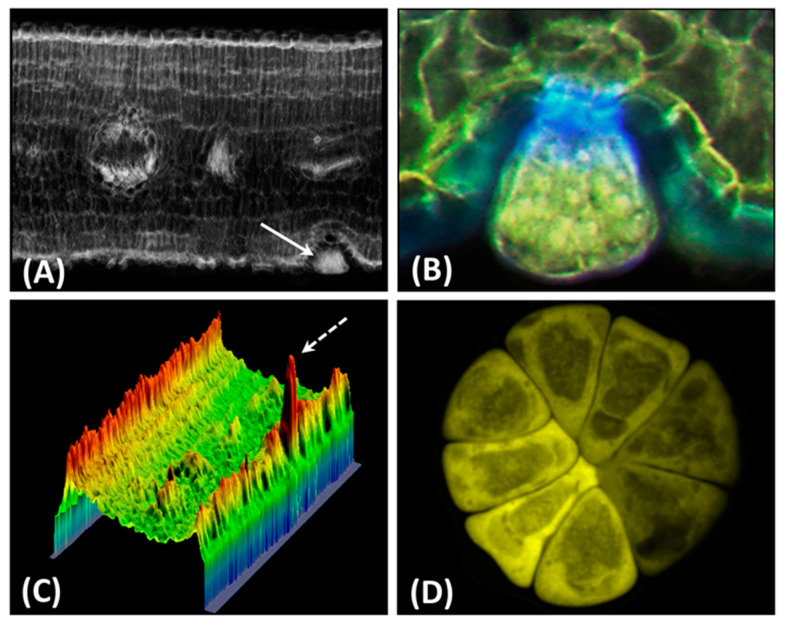
Figure 1
Figure 1
Flavonoids wxcluively accumulate in P. latifolia leaves. (A) Imaging of the ratio of fluorescence intensity at 580 nm (F580, flavonoid fluorescence) to fluorescence at 470 nm (F470, hydroxycinnamate fluorescence) of a Naturstoff-stained cross-section excited at 365 nm. (B) and (D) False-colour F580 images of the glandular trichome (denoted by the arrow in A), assigning the yellow channel to F580. (C) Three-dimensional false colour image of the cross section in (A). Highest values of F580/F470 in the glandular trichome (white arrows in A and C) indicates hydroxycinnamates do not appreciably accumulate in this organ. Methodological details given in Agati et al. [14].
Figure 2
Figure 2
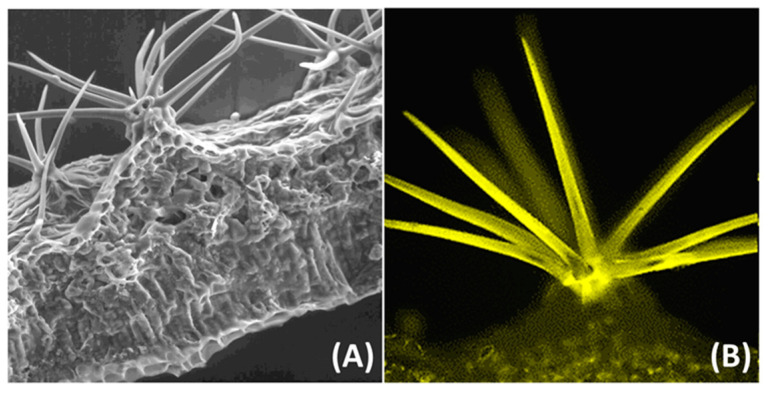
Mere UV-screening effects of flavonoids in non-glandular trichomes of Cistus salvifolius leaves. (A) View of a leaf cross-section in Cryo Scan Electron Microscopy (Cryo-SEM). (B) Fluorescence image recorded at 565-570 nm of cross-section stained with Naturstoff reagent, and excited at 488 nm. Flavonoids are coumaroyl derivatives of kaempferol 3-O-glucoside and are associated with the cell wall of the trichome arms, as detailed in Tattini et al. [42]. The occurrence of p-coumaric (max. absorbance at 315 nm) and kaempferol moieties (max absorbance at 351 nm) offers the best screening against UV-B and UV-A radiation.
Figure 3
Figure 3
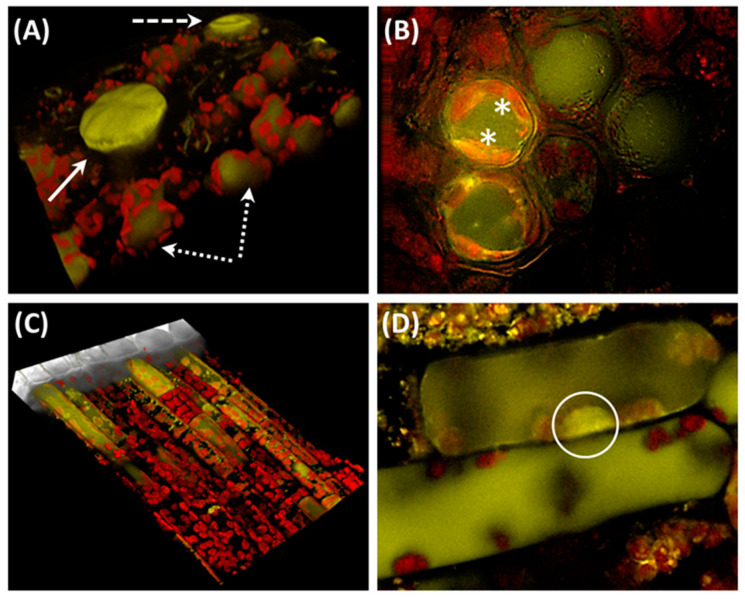
Flavonoids occur in different organs, cells and sub-cellular organelles. (A) Confocal laser scanning microscopy of Ligustrum vulgare leaves showing the accumulation of flavonoids in glandular trichomes (solid arrow), the vacuoles of mesophyll cells (dotted arrows) and the guard cells of stomata (*). (B) Flavonoids in mesophyll cells have not unique vacuolar accumulation, but are additionally associated to chloroplasts. (C) A 3D view of mesophyll cells: flavonoids accumulate in different layers of palisade tissue. (D) An enlarged view of flavonoid distribution in mesophyll cells, showing the location of flavonoids in the cell nucleus (enclosed in the circle). Tissue specimen were stained with Naturstoff reagent, excited at 488 nm and fluorescence recorded over both the 562–646 nm and the 687–757 nm waveband to detect flavonoids and chlorophyll, respectively. Pictures are merged images of F562-646 and F687-757.
Figure 4
Figure 4
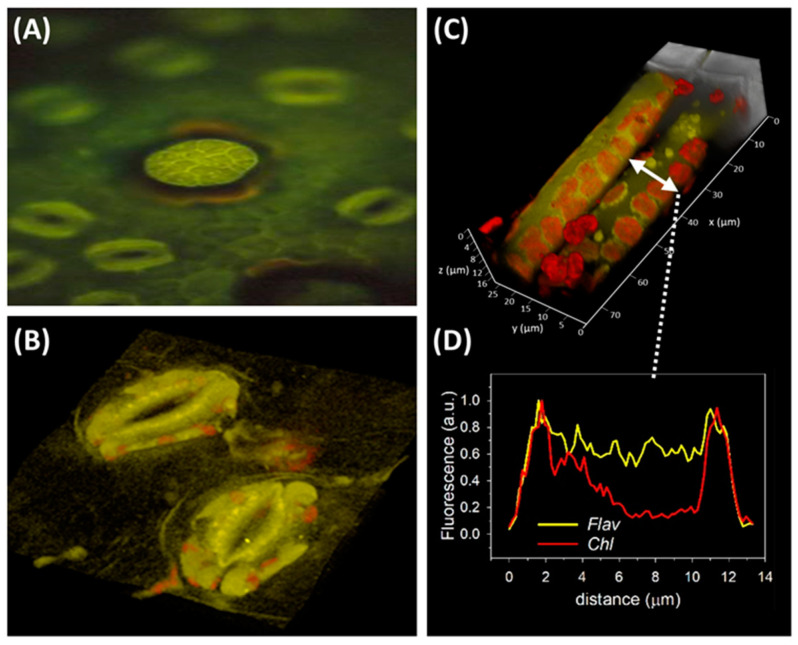
Flavonoids occur in stomata guard cells and chloroplasts. (A) Fluorescence image of Naturstoff-stained abaxial leaf surface excited at 365 nm and fluorescence image acquired at 580 nm. (B). Confocal laser scanning (CLS) 3D image showing flavonoids (yellow fluorescence recorded over 562–646 nm waveband) and chlorophyll (red fluorescence recorded over the 687–757 nm waveband), respectively, in stomata guard cells under 488 nm excitation. Distribution of yellow fluorescence is consistent with a cytoplasmic location of flavonoids (C) A CLS 3D view of palisade mesophyll cells showing the distribution of flavonoids in the vacuole and in the chloroplasts. (D) Profiles of fluorescence intensity of chlorophyll and flavonoids throughout the entire cell as shown by the arrow in (C), showing the co-localization of chlorophyll and flavonoid fluorescence.

References

    1. Tohge T., Fernie A.R. Leveraging natural variance towards enhanced understanding of phytochemical sunscreens. Trends Plant Sci. 2017;22:308–315. doi: 10.1016/j.tplants.2017.01.003. - DOI - PubMed
    1. Brunetti C., Fini A., Sebastiani F., Gori A., Tattini M. Modulation of phytohormone signaling: A primary function of flavonoids in plant–environment interactions. Front. Plant Sci. 2018;9:1042. doi: 10.3389/fpls.2018.01042. - DOI - PMC - PubMed
    1. Davies K.M., Jibran R., Zhou Y., Albert N.W., Brummell D.A., Jordan B.R., Bowman J.L., Schwinn K.E. The evolution of flavonoid biosynthesis: A bryophyte perspective. Front. Plant Sci. 2020;11:7. doi: 10.3389/fpls.2020.00007. - DOI - PMC - PubMed
    1. Brunetti C., Sebastiani F., Tattini M. ABA, flavonols and the evolvability of land plants. Plant Sci. 2019;280:448–454. doi: 10.1016/j.plantsci.2018.12.010. - DOI - PubMed
    1. Rozema J., van de Staaij J., Björn L.A., Caldwell M. UV-B as an environmental factor in plant life: Stress and regulation. Trends Ecol. Evol. 1997;12:22–28. doi: 10.1016/S0169-5347(96)10062-8. - DOI - PubMed

LinkOut - more resources