Review
. 2020 Nov 9;9(11):2444.
doi: 10.3390/cells9112444.

Visfatin: A Possible Role in Cardiovasculo-Metabolic Disorders

Affiliations
Review

Visfatin: A Possible Role in Cardiovasculo-Metabolic Disorders

Ali Dakroub et al. Cells. .

Abstract

Visfatin/NAMPT (nicotinamide phosphoribosyltransferase) is an adipocytokine with several intriguing properties. It was first identified as pre-B-cell colony-enhancing factor but turned out to possess enzymatic functions in nicotinamide adenine dinucleotide biosynthesis, with ubiquitous expression in skeletal muscles, liver, cardiomyocytes, and brain cells. Visfatin exists in an intracellular (iNAMPT) and extracellular (eNAMPT) form. Intracellularly, visfatin/iNAMPT plays a regulatory role in NAD+ biosynthesis and thereby affects many NAD-dependent proteins such as sirtuins, PARPs, MARTs and CD38/157. Extracellularly, visfatin is associated with many hormone-like signaling pathways and activates some intracellular signaling cascades. Importantly, eNAMPT has been associated with several metabolic disorders including obesity and type 1 and 2 diabetes. In this review, a brief overview about visfatin is presented with special emphasis on its relevance to metabolic diseases. Visfatin/NAMPT appears to be a unique molecule with clinical significance with a prospective promising diagnostic, prognostic, and therapeutic applications in many cardiovasculo-metabolic disorders.

Keywords: NAD+; PARPs/MARTs; metabolic disorders; sirtuins; visfatin/NAMPT.


Conflict of interest statement

The authors declare no conflict of interest.

Figures
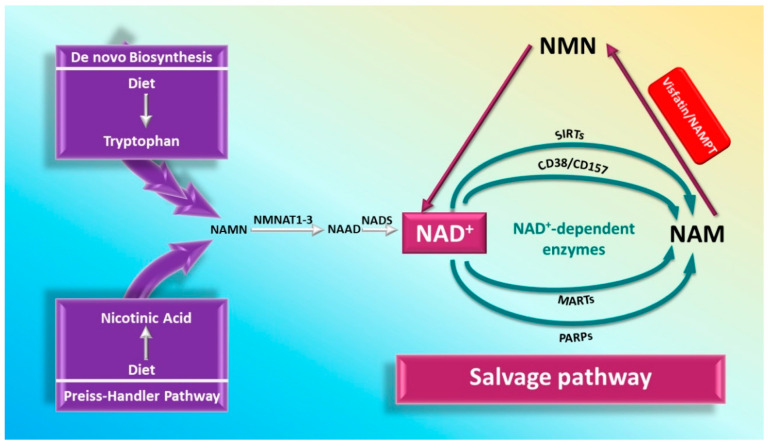
Figure 1
Figure 1
The three-mammalian nicotinamide adenine dinucleotide (NAD+) biosynthesis pathways. De novo synthesis and the Preiss–Handler pathway start from nutritionally-derived tryptophan (essential amino acid) and nicotinic acid (NA), respectively. Both will eventually yield nicotinic acid mononucleotide (NAMN), which will be converted to nicotinic acid adenine dinucleotide (NAAD) via nicotinamide mononucleotide adenylyltransferases (NMNATs). NAAD conversion to NAD+ is catalyzed by nicotinamide adenine dinucleotide synthetase (NADS). Nicotinamide (NAM) constitute an important precursor for NAD+ inside the cell via the salvage (rescue) pathway. NAM is the product of several NAD+ dependent enzymes: sirtuins (SIRTs), poly (ADP-ribose) polymerases (PARPs), mono (ADP-ribose) transferases (MARTs), cluster of differentiation 38 (CD38) and CD157. NAM will be converted to nicotinamide mononucleotide (NMN) in the rate determining step of the salvage pathway via nicotinamide phosphoribosyltransferase (NAMPT) or visfatin. NAD+ may be regenerated from NMN via nicotinamide mononucleotide adenylyltransferase (NMNAT).
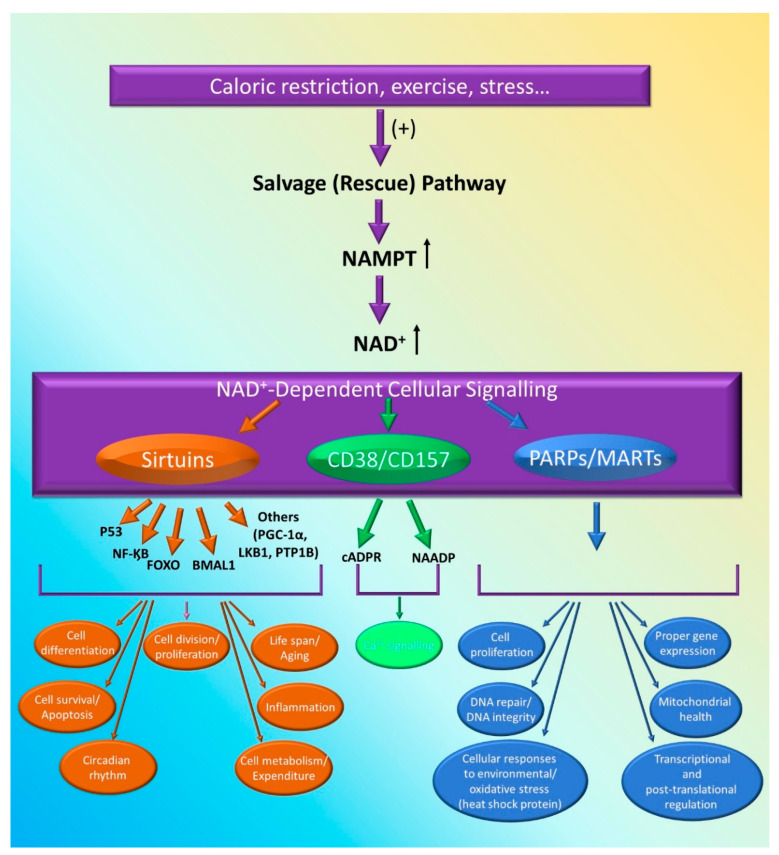
Figure 2
Figure 2
The salvage (rescue) pathway remains a predominant pathway to meet NAD+ cellular requirements. Several NAD+ dependent cellular signaling pathways exist and involve sirtuins, CD38/CD157, and PARPs/MARTs. They are essential for various cellular biological functions such as cellular division, proliferation, inflammation, maintaining genome integrity, DNA and protein synthesis, cellular anti-oxidative power, cellular metabolism, energy expenditure, mitochondrial health, and aging. FOXO: fork-head box class O; BMAL1: brain and muscle aryl hydrocarbon receptor nuclear translocator-like.
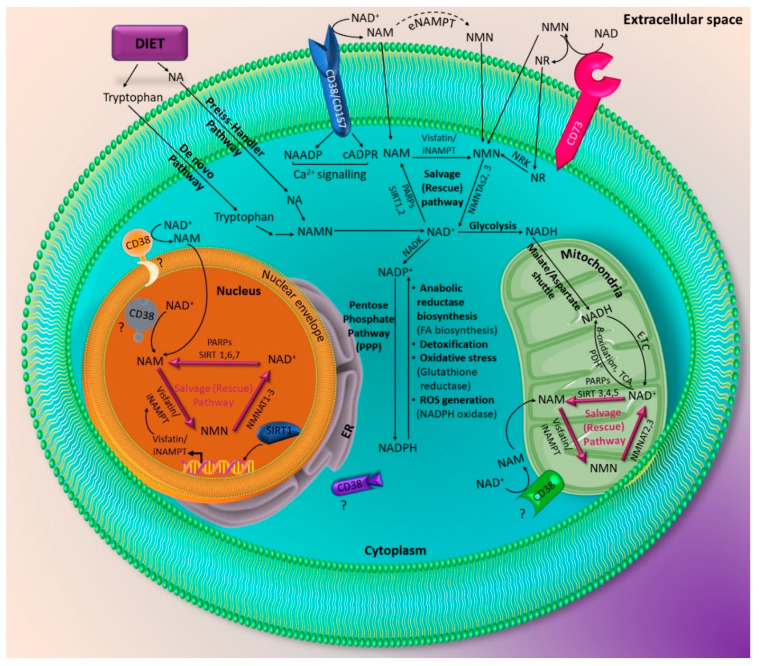
Figure 3
Figure 3
Various physiological roles of intracellular visfatin (iNAMPT). iNAMPT can be located in the cytoplasm, nucleus, and mitochondria. iNAMPT triggers its effects by regulating the levels of the core molecule NAD+. NAD+ levels are maintained through the de novo, Preiss–Handler, and salvage pathways. NAD+ is heavily converted to NAM by several cellular NAD+ dependent enzymes which include SIRT 1, 2 in the cytoplasm, SIRT 1, 6, 7 in the nucleus, and SIRT 3, 4, 5, in the mitochondria and PARPs. NAM will be converted to NMN via iNAMPT which is the rate limiting step in the salvage pathway. NAD+ can be regenerated from NMN via nicotinamide mononucleotide adenylyltransferases (NMNATs). The ectoenzyme CD38 converts NAD+ to NAM to produce NAADP and cADPR involved in intracellular Ca2+ signaling. CD38 can be also present on inner/outer mitochondrial membrane or inner/outer nuclear envelope. NAD+ can be metabolized extracellularly to NMN via the ectoenzyme CD73. NAD+ is a core molecule that plays a role in basic cellular metabolism. NAD+ is a key substrate for glycolysis, the tricarboxylic acid cycle (TCA), pyruvate dehydrogenase (PDH), beta-oxidation yielding NADH. The reduced form NADH can be regenerated via electron transport chain (ETC). NAD+ exist also in a phosphorylated form NADP+. The reduced form NADPH determines the anti-oxidative power of the cell. It is involved in anabolic biosynthesis (fatty acid (FA) biosynthesis), detoxification, cellular responses during oxidative stress via glutathione reductase, and protection against reactive oxygen species (ROS) via NADPH oxidase. NR: nicotinamide riboside.

References

    1. Murphy K., Bloom S.R. Are all fats created equal? Nat. Med. 2006;12:32–33. doi: 10.1038/nm0106-32. - DOI - PubMed
    1. Hassan M., Latif N., Yacoub M. Adipose tissue: Friend or foe? Nat. Rev. Cardiol. 2012;9:689–702. doi: 10.1038/nrcardio.2012.148. - DOI - PubMed
    1. Fain J.N., Madan A.K., Hiler M.L., Cheema P., Bahouth S.W. Comparison of the Release of Adipokines by Adipose Tissue, Adipose Tissue Matrix, and Adipocytes from Visceral and Subcutaneous Abdominal Adipose Tissues of Obese Humans. Endocrinology. 2004;145:2273–2282. doi: 10.1210/en.2003-1336. - DOI - PubMed
    1. Lee W.J., Wu C., Lin H., Lee I., Tseng J., Chou M.M., Sheu W.H.H. Visfatin-induced expression of inflammatory mediators in human endothelial cells through the NF-κB pathway. Int. J. Obes. 2009;33:465–472. doi: 10.1038/ijo.2009.24. - DOI - PubMed
    1. Jia S.H., Li Y., Parodo J., Kapus A., Fan L., Rotstein O.D., Marshall J.C. Pre–B cell colony–enhancing factor inhibits neutrophil apoptosis in experimental inflammation and clinical sepsis. J. Clin. Investig. 2004;113:318–1327. doi: 10.1172/JCI19930. - DOI - PMC - PubMed

Publication types