


The Routines-Based Model Internationally Implemented
- PMID: 33182740
- PMCID: PMC7697325
- DOI: 10.3390/ijerph17228308
The Routines-Based Model Internationally Implemented
Abstract
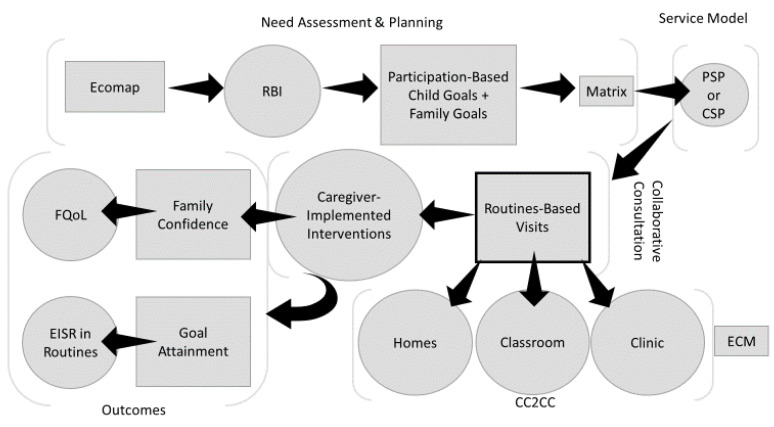
Professionals from 10 countries are implementing practices from the Routines-Based Model, which has three main components: needs assessment and intervention planning, a consultative approach, and a method for running classrooms. Its hallmark practices are the Routines-Based Interview, support-based visits with families, and a focus on child engagement. Implementers were interested in actual practices for putting philosophy and theory into action in their systems and cultures. We describe implementation challenges and successes and conclude that (a) models have to be adaptable, (b) some principles and practices are indeed universal, (c) we can shape excellent practices for international use, and (d) leadership is vital.
Keywords: collaborative consultation; implementation; international; intervention planning; routines.
Conflict of interest statement
Authors declare no conflict of interest.
Figures
References
-
- McWilliam R.A., Trivette C.M., Dunst C.J. Behavior engagement as a measure of the efficacy of early intervention. Anal. Int. Dev. Disabil. 1985;5:59–71. doi: 10.1016/S0270-4684(85)80006-9. - DOI
-
- McWilliam R.A. Metanoia in early intervention: Transformation to a family-centered approach. Rev. Latinoam. Educ. Inclusiva. 2016;10:155–173.
-
- Idol L., Nevin A., Paolucci-Whitcomb P. Collaborative Consultation. 2nd ed. PRO-ED; Austin, TX, USA: 1994.
-
- Jung L.A. Identifying families’ supports and other resources. In: McWilliam R.A., editor. Working with Families of Young Children with Special Needs. Brookes Publishing; Baltimore, MD, USA: 2010. pp. 9–26.
-
- McWilliam R.A. The Routines-Based Model for supporting speech and langauge. Logop. Foniatr. Audiol. 2016;36:178–184. doi: 10.1016/j.rlfa.2016.07.005. - DOI
MeSH terms
LinkOut - more resources
Full Text Sources
