. 2020 Nov 10;10(11):1532.
doi: 10.3390/biom10111532.

Magnoflorine-Isolation and the Anticancer Potential against NCI-H1299 Lung, MDA-MB-468 Breast, T98G Glioma, and TE671 Rhabdomyosarcoma Cancer Cells

Affiliations

Magnoflorine-Isolation and the Anticancer Potential against NCI-H1299 Lung, MDA-MB-468 Breast, T98G Glioma, and TE671 Rhabdomyosarcoma Cancer Cells

Estera Okon et al. Biomolecules. .

Abstract

Magnoflorine (MGN) is a quaternary aporphine alkaloid that exhibits numerous therapeutic properties, including neuropsychopharmacological, anti-anxiety, immunomodulatory, anti-inflammatory, antioxidant, or antifungal activities. The aim of the present study was an investigation of the influence of MGN on viability, proliferation, induction of apoptosis, and cell cycle arrest in NCI-H1299 lung, MDA-MB-468 breast, T98G glioma, and TE671 rhabdomyosarcoma cancer cells. MGN was isolated from the roots of Berberis cretica L. by counter-current partition chromatography (CPC). Cell viability and proliferation assessments were performed by means of MTT (3-(4,5-dimethylthiazol-2-yl)-2,5-diphenyltetrazolium bromide) and 5-bromo-2'-deoxyuridine (BrDU) assays, respectively. The induction of apoptosis and cell cycle progression was measured using fluorescence-activated cell sorting analysis. MGN in high doses inhibits proliferation, induces apoptosis, and inhibits cell cycle in S/G2 phases in a dose-dependent manner. MGN seems to be a promising anti-cancer compound in therapy of some types of lung, breast, glioma, and rhabdomyosarcoma cancers, for which current standard therapies are limited or have severe strong side effects.

Keywords: Berberidaceae; Berberis cretica; CPC; HPLC-MS; anti-cancer activity; counter-current chromatography; isoquinoline alkaloids; magnoflorine; natural products.


Conflict of interest statement

The authors declare no conflict of interest.

Figures
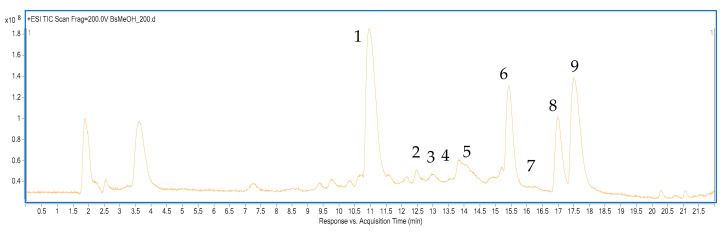
Figure 1
Figure 1
The total ion chromatogram of the methanolic extract from Berberis cretica roots.
Figure 2
Figure 2
The part of counter-current partition chromatography (CPC)-UV chromatogram (at 290 nm) of the Berberis cretica root extract that show the elution of magnoflorine (MGN) (A) and the total ion chromatogram (TIC) of the isolated MGN (B).
Figure 3
Figure 3
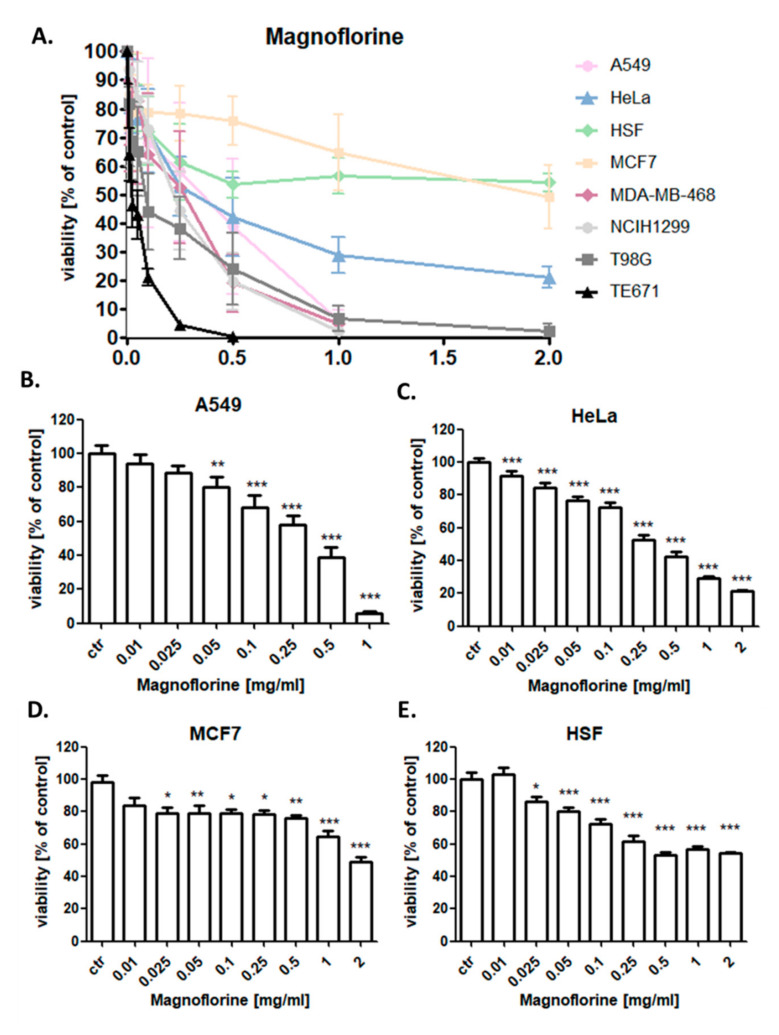
Effect of magnoflorine (MGN) on viability of human lung cancer (A549 (A,B) and H1299 (A) [1]), breast cancer (MCF7 (A,D) and MDA-MB-468 (A) [1]), cervix cancer (HeLa) (A,C), glioma (T98G (A) [1]), rhabdomyosarcoma (TE671 (A) [1]), and human skin fibroblast (HSF (A,E)) cells. The cancer cells were exposed to either culture medium alone (control) or magnoflorine (0.01–2 mg/mL) for 96 h. Normalized cell viability measured by the methylthiazolyldiphenyl-tetrazolium bromide (MTT) assay is presented as mean ± SD at each concentration. The differences between groups were evaluated using the one-way ANOVA; Tukey’s post-hoc test. *** p < 0.001, ** p < 0.01, * p < 0.05; n = 18 per concentration from three independent experiments.
Figure 4
Figure 4
Effect of magnoflorine (MGN) on the proliferation of T98G glioma (A,E), MDA-MB-468 breast (B,E), NCIH1299 lung (C,E), and TE671 rhabdomyosarcoma (D,E) cancer cells in 5-bromo-2ʹ-deoxyuridine (BrdU) assay. Cancer cells were incubated for 48 h alone (control) or in the presence of magnoflorine (0.01–1 mg/mL). The differences between groups were evaluated using the one-way ANOVA; Tukey’s post-hoc test. *** p < 0.001. Results from three independent experiments were presented as mean ± SD of the mean.
Figure 5
Figure 5
Effects of magnoflorine (MGN) on caspase-3 activation in T98G glioma (A), MDA-MB-468 breast (B), NCIH1299 lung (C), and TE671 rhabdomyosarcoma (D) cancer cells. Cancer cell lines were cultivated for 48 h with different doses of MGN (5–10 mg/mL) and analyzed by flow cytometry. The values present the percentage of the cells with active caspase-3. The results are depicted as means ± SD, n = 9 from three separate experiments. Statistical analysis was performed using one-way ANOVA test. *** p < 0.001.
Figure 6
Figure 6
Representative dot plots of the flow cytometry analysis of T98G glioma cells after 48 h treatment with medium (ctr) (A) or magnoflorine (5 mg/mL) (B), 7.5 mg/mL (C), and 10 mg/mL (D); n = 9 per concentration from three independent experiments. R2-cells with active caspase-3 (apoptotic cells).
Figure 7
Figure 7
Effects of magnoflorine (MGN) on the cell cycle progression in NCIH1299 lung (A), MDA-MB-468 breast (B), T98G glioma (C), and TE671 rhabdomyosarcoma (D) cancer cells. Cancer cell lines were cultivated for 48 h with different doses of magnoflorine (5–10 mg/mL) and analyzed by flow cytometry. The results are depicted as means ± SD, n = 9 from three separate experiments.

References

    1. Okon E., Luszczki J.J., Kukula-Koch W., Halasa M., Jarzab A., Khurelbat D., Stepulak A., Wawruszak A. Synergistic or additive pharmacological interactions between magnoflorine and cisplatin in human cancer cells of different histological origin. Int. J. Mol. Sci. 2020;21:2848. doi: 10.3390/ijms21082848. - DOI - PMC - PubMed
    1. Li B., Han L., Cao B., Yang X., Zhu X., Yang B., Zhao H., Qiao W. Use of magnoflorine-phospholipid complex to permeate blood-brain barrier and treat depression in the CUMS animal model. Drug Deliv. 2019;26:566–574. doi: 10.1080/10717544.2019.1616236. - DOI - PMC - PubMed
    1. Xu T., Kuang T., Du H., Li Q., Feng T., Zhang Y., Fan G. Magnoflorine: A review of its pharmacology, pharmacokinetics and toxicity. Pharmacol. Res. 2020;152:104632. doi: 10.1016/j.phrs.2020.104632. - DOI - PubMed
    1. De La Peña J.B.I., Lee H.L., Yoon S.Y., Kim G.H., Lee Y.S., Cheong J.H. The involvement of magnoflorine in the sedative and anxiolytic effects of Sinomeni Caulis et Rhizoma in mice. J. Nat. Med. 2013;67:814–821. doi: 10.1007/s11418-013-0754-3. - DOI - PubMed
    1. Ahmad W., Jantan I., Kumolosasi E., Haque M.A., Bukhari S.N.A. Immunomodulatory effects of Tinospora crispa extract and its major compounds on the immune functions of RAW 264.7 macrophages. Int. Immunopharmacol. 2018;60:141–151. doi: 10.1016/j.intimp.2018.04.046. - DOI - PubMed

Publication types

MeSH terms